AI Risks Are Real but Manageable: A Pragmatic Guide to Addressing Artificial Intelligence Challenges

A pragmatic guide to understanding and managing real AI risks without falling into panic or blind optimism.
AI risks—from deepfakes and algorithmic bias to job displacement and malicious use—are real and present. However, history shows that humanity can manage disruptive technologies through institutional design, regulation, and technical safeguards. This article advocates for a pragmatic middle ground between doomsday panic and blind optimism, outlining multi-level governance approaches spanning technical, regulatory, industry, and societal dimensions.
Finding Balance Between Panic and Optimism
The explosive development of artificial intelligence has plunged the entire tech world into two extreme emotions: one side views it as the greatest technological revolution in human history, while the other fears it could bring uncontrollable disasters that threaten human existence. However, the truly rational stance lies somewhere in between—AI risks are real, but they are not unmanageable.
This perspective sparked lively discussion on the Hacker News community (the original post received 32 upvotes and 29 comments). The core of the discussion centered on: how can we face the opportunities and challenges brought by AI technology with a pragmatic attitude, rather than being driven by fear or blind optimism?
The Real Face of AI Risks
Short-Term Risks: Challenges Already Happening
When we discuss AI risks, it's easy to be drawn to sci-fi narratives of "superintelligence destroying humanity," thereby overlooking the more pressing practical problems of today. In fact, short-term risks are what we must address first.
These risks include:
-
Proliferation of Misinformation: AI-generated deepfake content is eroding the social trust system. Deepfake technology, based on deep learning architectures such as Generative Adversarial Networks (GANs) and diffusion models, can generate highly realistic fake images, videos, and audio content. Since 2024, the barrier to entry for such technology has dropped dramatically—ordinary users can generate convincing face-swap videos or voice clones within minutes using open-source tools. In scenarios involving political elections, financial fraud, and reputation damage, deepfakes have already caused billions of dollars in losses. This means the "authenticity infrastructure" of our information environment is under unprecedented pressure.
-
Algorithmic Bias: Discriminatory biases hidden in AI decision-making systems affect fairness. These biases typically originate from historical inequality patterns in training data—when AI models learn from data that reflects existing societal biases, they systematically encode these biases into their decision-making logic. In high-stakes scenarios like credit approval, criminal justice risk assessment, and hiring screening, algorithmic bias can cause sustained unfair treatment of specific groups, and due to its concealed and scalable nature, it's harder to detect and correct than individual-level discrimination.
-
Employment Impact: The displacement effect of automation technology on traditional jobs continues to intensify. Unlike previous waves of automation that primarily affected blue-collar work, generative AI is for the first time impacting knowledge workers at scale—from content creation, translation, and programming to legal documents and financial analysis, numerous white-collar positions once thought to require "creativity" are facing transformation. The McKinsey Global Institute estimates that by 2030, up to 300 million full-time jobs globally could see their work content substantially altered by generative AI.
-
Malicious Use: AI being used for cyberattacks, precision fraud, and other criminal activities. Large language models have lowered the technical barriers for phishing, social engineering attacks, and malicious code writing, enabling attackers to launch large-scale attacks at lower cost and higher efficiency. AI-driven adaptive attacks can also dynamically adjust strategies based on target feedback, posing greater challenges to traditional defense methods.
These problems are not hypothetical futures—they are happening right now.
Long-Term Risks: Warranting Vigilance but Not Panic
Regarding the existential risks AI might pose, there is a clear divide within the field. Some researchers believe that as AI capabilities continue to improve, ensuring its goals remain aligned with human values (the so-called "alignment problem") will become increasingly difficult.
The Alignment Problem is a core topic in AI safety research, referring to how to ensure that an AI system's behavioral objectives remain consistent with humanity's true intentions and values. The difficulty lies in the fact that human values themselves are fuzzy, contradictory, and context-dependent, making them hard to express in precise mathematical formalization. Current mainstream alignment techniques include Reinforcement Learning from Human Feedback (RLHF), Constitutional AI, and other methods, but whether these techniques remain effective when facing systems that surpass human capabilities remains an open question. In 2023, several AI pioneers including Geoffrey Hinton and Yoshua Bengio publicly expressed concerns about long-term risks, while others of equal stature such as Yann LeCun believe current concerns are premature.
However, other experts argue that such concerns have been overblown and divert attention from real-world problems. Their arguments include: current AI systems are still fundamentally statistical pattern matchers, far from true general intelligence; and excessive focus on distant hypothetical risks may lead to resource misallocation, neglecting the urgent problems of bias, misuse, and transparency that need solving today.
Regardless of one's stance, a consensus is forming: rather than falling into pointless doomsday anxiety, it's better to invest energy in building practical governance frameworks and technical safeguard mechanisms.
Why AI Risks Are Manageable
Lessons from History
Looking across the history of human technological development—from steam engines and electricity to nuclear energy and the internet—virtually every disruptive technology was accompanied by enormous concerns and risks at its inception. And history has shown that humanity has always managed to gradually tame these risks through institutional design, regulatory frameworks, and technical improvements.
Take nuclear energy as an example: the appearance of the atomic bomb in 1945 gave humanity the ability to destroy itself for the first time, and nuclear fear loomed over the globe during the Cold War. But through the Treaty on the Non-Proliferation of Nuclear Weapons, the International Atomic Energy Agency's oversight mechanisms, and continuously improving nuclear power plant safety standards, humanity built a governance system over several decades that, while imperfect, is fundamentally effective. The development of the internet similarly went through a process from early regulatory vacuum to gradually establishing data protection laws, cybersecurity standards, and platform governance frameworks. These historical precedents show that managing technological risk is not achieved overnight—it's a process of continuous iteration that evolves alongside the technology itself.
AI is no exception. The key is whether we are willing to invest sufficient resources early on to research and build appropriate safety mechanisms, rather than responding reactively only after problems spiral out of control.
A Multi-Pronged Governance Approach
Effectively managing AI risks requires coordinated efforts across multiple levels:
Technical Level: Increase investment in AI safety and interpretability research, develop tools that can detect and prevent AI misuse, and establish standards for model evaluation and red team testing.
AI Explainability/Interpretability research aims to reveal the decision-making logic within deep neural networks. Current major approaches include Mechanistic Interpretability—understanding a model's internal representations by analyzing neuron activation patterns; attention visualization—tracing information flow paths in Transformer models; and probing techniques—training small classifiers to detect whether intermediate layers encode specific concepts. Companies like Anthropic have made significant progress in this area, such as successfully identifying feature directions related to honesty and harmfulness in the Claude model, but for large models with hundreds of billions of parameters, fully understanding their behavioral mechanisms remains an enormous challenge.
Red Teaming originates from adversarial exercise concepts in the military domain. In AI safety, it refers to specialized teams systematically attempting to breach an AI system's safety boundaries to discover potential vulnerabilities and harmful output patterns. Organizations like OpenAI and Google DeepMind conduct large-scale red team testing before releasing major models, covering dimensions including jailbreak attacks, harmful content generation, privacy leaks, and biased outputs. In 2023, the U.S. White House organized a public red team challenge at the DEF CON hacker conference, signaling that this practice is moving toward standardization and institutionalization.
Regulatory Level: Governments need to develop moderate and flexible regulatory policies that neither stifle innovation nor allow risks to proliferate unchecked. Ideal regulation should focus on high-risk application scenarios rather than imposing blanket restrictions on all AI development.
Regarding the global regulatory landscape, the EU's AI Act, officially passed in 2024, adopted a risk-tier-based layered regulatory framework that classifies AI applications into four levels—unacceptable risk, high risk, limited risk, and minimal risk—applying different degrees of regulatory requirements to each tier. The United States tends toward a combination of executive orders and industry self-regulation, with the Biden administration's 2023 AI Executive Order requiring frontier model developers to report safety test results to the government before release. China's regulation focuses on specific areas such as algorithmic recommendation, generative AI, and deep synthesis, having issued multiple specialized regulations. The differentiation in global regulatory approaches reflects varying judgments about the balance between innovation and safety across nations, while also creating cross-border compliance complexity challenges.
Industry Level: AI development companies should proactively assume responsibility, establish internal safety review processes, and promote the sharing of best practices within the industry. Currently, multiple leading AI companies including Anthropic, OpenAI, and Google have established dedicated safety teams and responsible AI practice frameworks. Industry alliances like the Frontier Model Forum work to promote coordination of safety standards, while organizations like Partnership on AI serve as bridges for multi-stakeholder collaboration. However, the tension between safety investment and commercial competitive pressure persists, and how to avoid "safety theater"—where formal safety commitments mask a substantive race to the bottom—remains a core challenge facing the industry.
Societal Level: Enhance public AI literacy, helping people understand the boundaries of AI capabilities so they can make wiser decisions at both individual and collective levels. This includes integrating AI literacy training into education systems, helping the public understand the statistical nature of AI systems—they excel at pattern recognition but lack genuine understanding, and can produce convincing but potentially incorrect outputs. A public equipped with AI literacy can not only use AI tools more effectively but also participate more meaningfully in democratic discussions about AI governance.
Pragmatism: The Right Attitude Toward AI Risks
Avoiding Two Extremes
When facing AI, we should neither become blind technological optimists nor descend into pessimistic doomsday prophets.
Excessive optimism leads us to overlook real risks and rush forward with technology deployment without adequate safeguards; excessive pessimism might cause us to miss out on technology's enormous benefits due to fear, or even fall into a paralysis of inaction. This polarization phenomenon is nothing new in technology discussions—scholars call it two sides of "technological determinism": utopianism (believing technology inevitably brings progress) and dystopianism (believing technology inevitably leads to catastrophe). The common error of both is viewing technology as an autonomous force unaffected by human choice, while ignoring the decisive role that social institutions, policy choices, and collective action play in shaping technological outcomes.
True wisdom lies in acknowledging the reality of risks while believing in humanity's capacity to manage these risks through collective effort.
Action Over Anxiety
Rather than spending enormous amounts of time debating whether AI will destroy humanity, it's better to focus attention on concrete actions:
-
What can we do to reduce bias in AI systems? Multiple technical pathways are currently available, including auditing and rebalancing training data, applying fairness constraints to model outputs, and implementing continuous post-deployment monitoring and correction mechanisms.
-
How can we establish reliable content provenance mechanisms to combat misinformation? Standards like C2PA (Coalition for Content Provenance and Authenticity) are driving cryptographic signing and provenance tracking for digital content, while watermark-based identification of AI-generated content is also rapidly advancing.
-
How do we help those whose jobs are being displaced complete career transitions? This requires coordinated collaboration among governments, enterprises, and educational institutions, including establishing lifelong learning systems, providing social safety nets during transition periods, and redesigning job roles to achieve human-AI collaboration rather than human-AI replacement.
These questions may not be as attention-grabbing as sci-fi narratives, but they are precisely the key to determining whether AI technology can truly benefit humanity.
Conclusion: Facing Risks Head-On, Responding Proactively
AI technology is profoundly changing our world. The risks it brings cannot be ignored, but they are by no means insurmountable. History tells us that humanity has always found ways to manage the risks of new technologies while embracing them.
Facing AI, what we need is neither panic nor blind optimism, but a fact-based pragmatic attitude: acknowledge the risks, respond proactively, and continuously improve. Only in this way can we truly harness this powerful technology, making it a force that drives human progress rather than an uncontrolled threat.
As computer scientist Alan Kay said: "The best way to predict the future is to invent it." Facing the future of AI, we are not passive bystanders but active shapers. Every discussion about safety standards, every governance policy formulated, every responsible technology deployment—each one casts a vote for AI's future.
Related articles

Roc 0.1.0 Preview: A Fast, Friendly, and Functional New Programming Language
Roc language nears its first numbered release 0.1.0, transitioning from experimental to usable. Explore its platform architecture, core features, and toolchain.
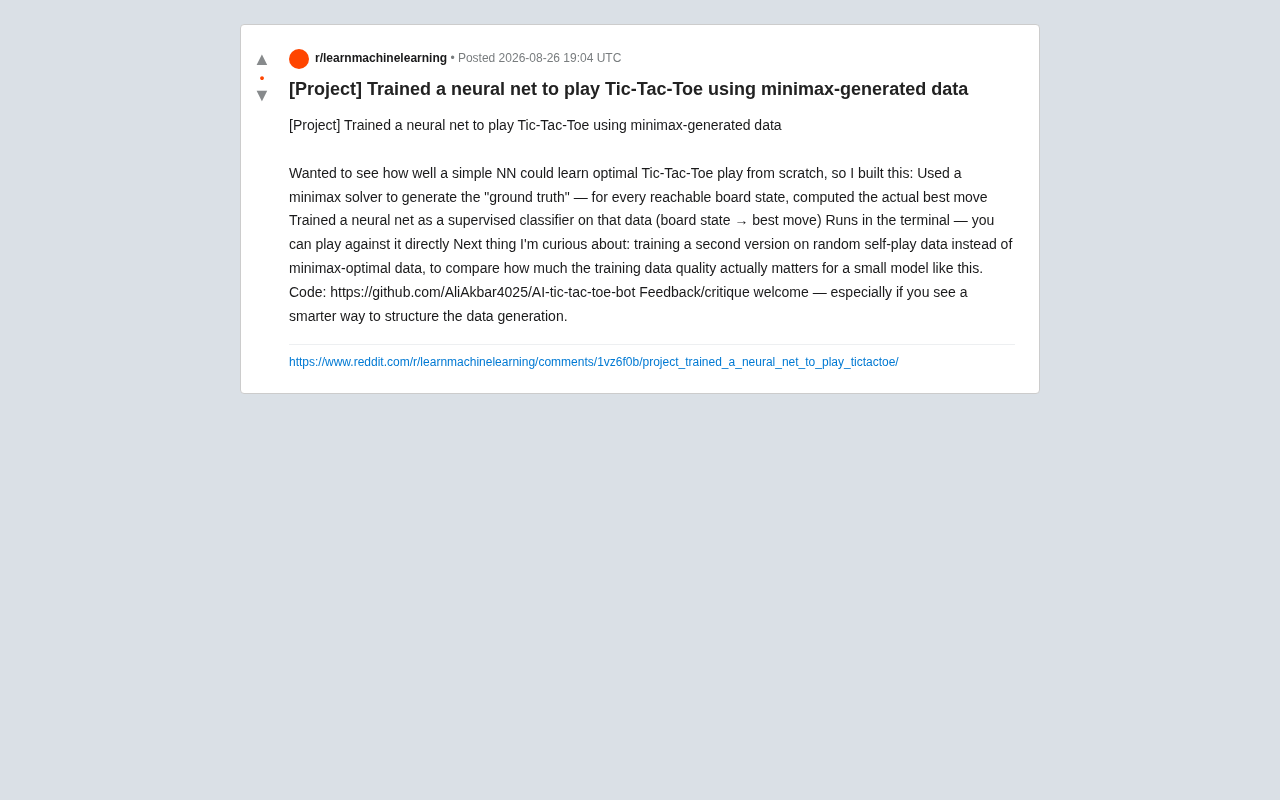
Training a Neural Network to Play Tic-Tac-Toe with Minimax Data: A Data Quality Experiment
Explore how Minimax-generated optimal data trains a neural network to play Tic-Tac-Toe. This article covers knowledge distillation, supervised learning modeling, and how data quality critically impacts small model performance.

Gemini Conversation History vs. Google Activity Logs: A Hidden AI Data Transparency Concern
A user discovered persistent inconsistencies between Google Gemini's conversation history and account activity logs, raising AI data transparency and privacy compliance concerns.