Gemini Conversation History vs. Google Activity Logs: A Hidden AI Data Transparency Concern
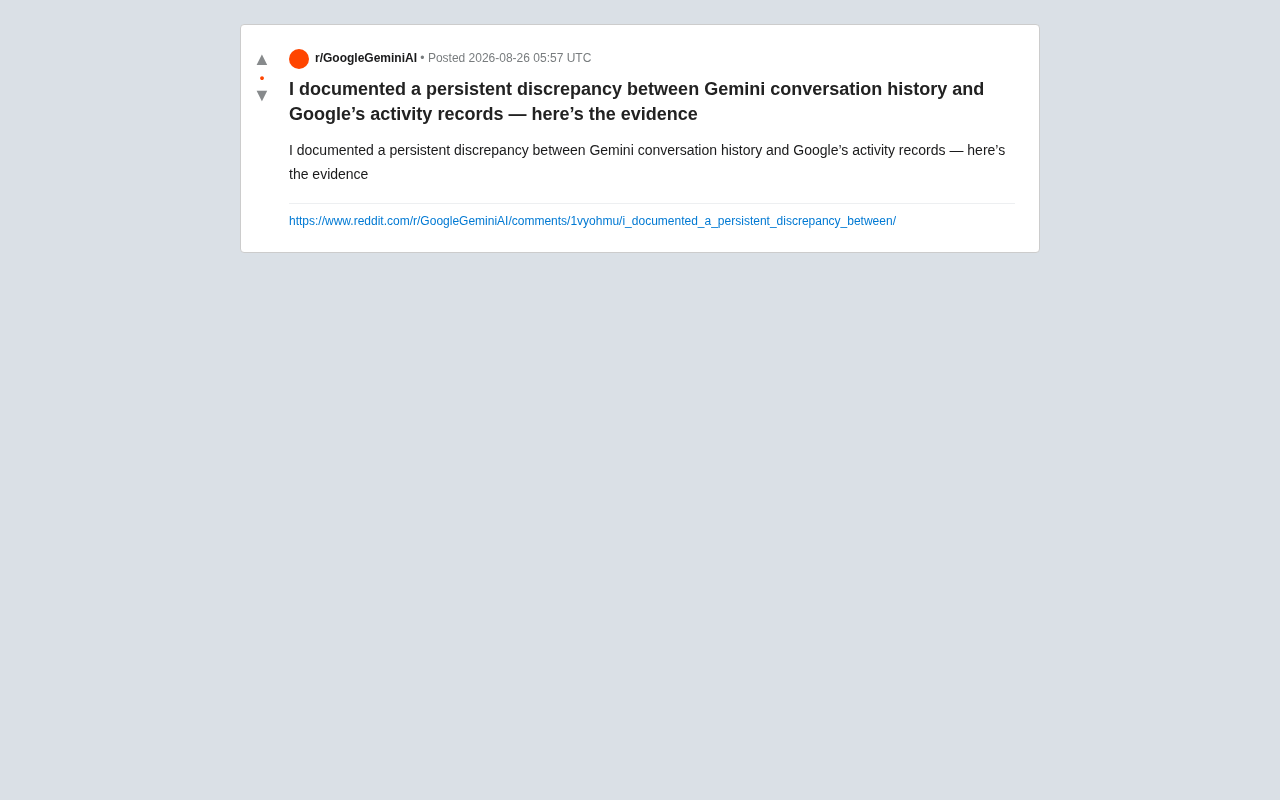
Gemini conversation logs and Google Activity records show persistent discrepancies, raising data transparency concerns.
A Reddit user documented persistent inconsistencies between Google Gemini's conversation history and Google Account Activity Records. This raises important questions about AI data transparency, user control, and regulatory compliance under GDPR and CCPA. While technical factors like sync delays and product migrations may explain the gaps, the issue highlights a broader industry challenge: maintaining auditable, consistent data records as AI products become deeply embedded in daily life.
An Overlooked AI Data Transparency Issue
Recently, a Reddit user published a detailed report pointing out persistent inconsistencies between Google's AI assistant Gemini's conversation history and the Google Account Activity Records. While this finding comes from a single user's observation, it touches on a core issue facing AI products today: the transparency and auditability of data records.
For ordinary users, the conversation history displayed in the Gemini interface should correspond with the behavioral logs recorded in Google Account's "My Activity" page. Google's "My Activity" is a centralized user behavior logging system that records user interactions across Google's product ecosystem—including search history, YouTube watch history, Maps navigation, voice assistant commands, and more. Launched in 2016, the system was designed to replace previously scattered history pages, giving users a unified portal to view, manage, and delete their data. For Gemini, conversation records should theoretically be synced as a category of activity within this system. However, since Gemini was integrated into the Google ecosystem later as an AI product, its data pipeline may have architectural differences from native Google services.
Yet according to the user's documentation, reproducible discrepancies exist between these two data sources—certain conversations are visible in one place but missing or displayed in a different state in the other. This kind of "persistent discrepancy" is precisely what warrants attention.
Why Gemini Data Consistency Matters So Much
The Foundation of Users' Right to Know
AI assistants record vast amounts of user input, which may include sensitive information, personal privacy, and even work secrets. One premise of users trusting these products is: "I can see and manage all the data I generate." When Gemini's conversation history and Google's official activity logs are inconsistent, users effectively lose complete control over their own data—you can't determine which record represents the "truth."
Compliance and Audit Perspective
From the standpoint of privacy regulations like GDPR and CCPA, data portability and access rights require platforms to present users with complete and accurate records of their collected data. Specifically, GDPR (General Data Protection Regulation) Article 15 grants data subjects the "right of access," requiring data controllers to confirm whether they are processing relevant personal data and provide a complete copy of that data; Article 20 stipulates the "right to data portability," entitling users to receive their data in a structured, commonly used format. CCPA (California Consumer Privacy Act) and its amendment CPRA similarly grant consumers the right to know and access their collected personal information. If a platform presents contradictory records through different access points, regulators may question whether the platform's obligation of data accuracy has been fulfilled—this is particularly sensitive under GDPR Article 5(1)(d) regarding the data accuracy principle. If records shown through different access points are inconsistent, this itself may constitute a compliance risk. For enterprise users evaluating whether to incorporate Gemini into their workflows, the reliability of data auditing is an even more critical consideration.
Possible Technical Explanations
It should be noted that this report currently comes from a single source, and its conclusions should be treated with caution. From an engineering implementation perspective, discrepancies between Gemini conversation records and Google activity logs could have multiple technical causes:
-
Data synchronization delays: Conversation history and activity logs may be maintained by different backend systems, resulting in asynchronous writes and eventual consistency issues. Eventual consistency is a data consistency model in distributed systems, derived from the CAP theorem—under this model, the system does not guarantee that all nodes see the same data at the same moment, but promises that all replicas will eventually converge to a consistent state without new writes. Hyperscale distributed systems like Google's (built on infrastructure such as Spanner and Bigtable) typically make trade-offs between strong consistency and availability. If conversation systems and activity logs are managed by different database clusters, cross-system data synchronization naturally has latency windows, which are particularly pronounced during high-concurrency periods or system failure recovery.
-
Different data retention policies: The two systems may employ different retention periods, causing some records to be purged in one place while still existing in another.
-
Different classification logic: Gemini conversations may be categorized under different activity types, or some interactions (such as temporary sessions or unauthenticated states) may not be written to the activity log at all.
-
Legacy issues from product iterations: Gemini has undergone multiple brand and architecture transitions from Bard to Gemini, and historical data migration may have introduced record gaps. Google's conversational AI product went through several major transformations: Bard, launched in February 2023, was initially based on the LaMDA model, then switched to PaLM 2, and finally rebranded to Gemini in February 2024, integrating the eponymous multimodal model family. This process involved frontend interface reconstruction, backend inference engine switches, user data migration, and API endpoint changes. Each architectural adjustment could cause changes in how historical conversation metadata is mapped—for example, how old Bard conversation IDs are indexed in the new system, timestamp format conversions, and whether they're included in new activity log classification systems.
These technical explanations don't absolve the platform of its transparency responsibilities, but they help understand that "inconsistency" doesn't necessarily equal "deliberate concealment."
How Users Can Address Gemini Data Inconsistencies
Facing this kind of uncertainty, ordinary users can take several pragmatic measures:
-
Regularly export data: Use Google Takeout to export your Gemini activity records and maintain independent backups. Google Takeout is a data export tool launched by Google in 2011 that allows users to download personal data copies from over 70 Google services, typically in JSON, HTML, or CSV formats. However, it's worth noting that the completeness of Takeout exports also depends on the backend system's recording state—if certain interactions were not correctly written to the storage layer, Takeout likewise cannot export the missing data. Additionally, large-scale data exports may take hours or even days to prepare, and export frequency is subject to platform limitations.
-
Be cautious with sensitive information: When you cannot confirm where data flows, avoid disclosing highly sensitive personal or commercial information to AI assistants.
-
Cross-reference records: If you have higher privacy requirements, periodically compare Gemini's conversation history with the My Activity page data, and report anomalies promptly when discovered.
-
Leverage privacy controls: Google provides options to automatically delete activity records, and users can configure retention periods as needed (such as automatic deletion after 3 months, 18 months, or 36 months).
Industry Implications for AI Data Governance
The value of this individual case may lie not in whether Gemini itself has a defect, but in reminding the entire industry: AI product data governance is becoming a critical battleground for user trust. As AI assistants increasingly penetrate people's work and lives, users will only ask more questions about "where did my data go and how was it recorded."
For developers and platform operators, this means not only providing powerful AI capabilities but also establishing clear, consistent, and auditable data recording systems. Any discrepancy between access points can be amplified into a trust crisis. Notably, this issue is not unique to Google—mainstream AI products like OpenAI's ChatGPT, Microsoft's Copilot, and Anthropic's Claude face similar engineering challenges in maintaining data record consistency across multi-device, multimodal interaction scenarios. With the rise of AI Agent concepts, operations executed by AI systems on behalf of users will become increasingly complex, and the difficulty of data auditing will grow exponentially.
One important detail: since this report comes from a single user source, with no official response or large-scale third-party reproduction verification, its representativeness remains to be observed. However, the discussion it has sparked about AI data transparency is undeniably of universal significance. In an era of rapidly advancing AI capabilities, the accompanying transparency mechanisms and user trust building should not be absent.
Key Takeaways
Related articles

Chain of Thought Isn't Just for AI: How Humans Can Use CoT to Improve Thinking Quality
Chain of Thought isn't just a prompt trick for large models. Starting from a Hacker News discussion, this article analyzes why CoT works for human thinking too, breaks down actionable ways to transfer it, and highlights the key differences between human CoT and machine CoT.
Cloudflare Teams Up with OpenAI: Closi…
Cloudflare Teams Up with OpenAI: Closing the Loop from Vulnerability Discovery to Defense with AI
Cloudflare uses OpenAI Daybreak to investigate security vulnerabilities and generate reviewable remediation plans, while developers use Codex to boost coding efficiency and quality.

Orca Multi-Agent Orchestration in Practice: A Guide to Parallel Collaboration with Claude and Codex
Orca is Stable AI's free open-source agent workbench supporting 34 agents like Claude Code and Codex in parallel. Learn its Git worktree isolation, multi-model orchestration, and mobile management.