AI's Impact on Robotics Engineering: Which Subfields Resist Replacement?

AI's impact on robotics engineering is layered, more a redivision of labor than overall replacement.
The article centers on a Reddit discussion about whether AI will replace robotics engineers as it has impacted software engineering. The core conclusion is that robotics consists of highly divergent subfields, and AI's replacement effect shows a clear layered character. Areas such as hardware and mechatronic design, safety-critical control and verification, and system integration and on-site deployment—which depend on physical intuition, legal liability, and judgment in chaos—are relatively replacement-resistant; while areas such as perception algorithm development and simulation and data generation, which lean toward software and data processing, are being significantly changed by AI. The disagreement in the discussion is whether AI means "replacement" or "redivision of labor," but the consensus leans toward the latter: demand for entry-level repetitive coding may shrink, while demand for systems-oriented engineers who can span algorithms, hardware, and the field actually rises. The advice for practitioners is to build physical intuition, go deep into safety-critical or system-integration directions, and treat AI as an efficiency tool.
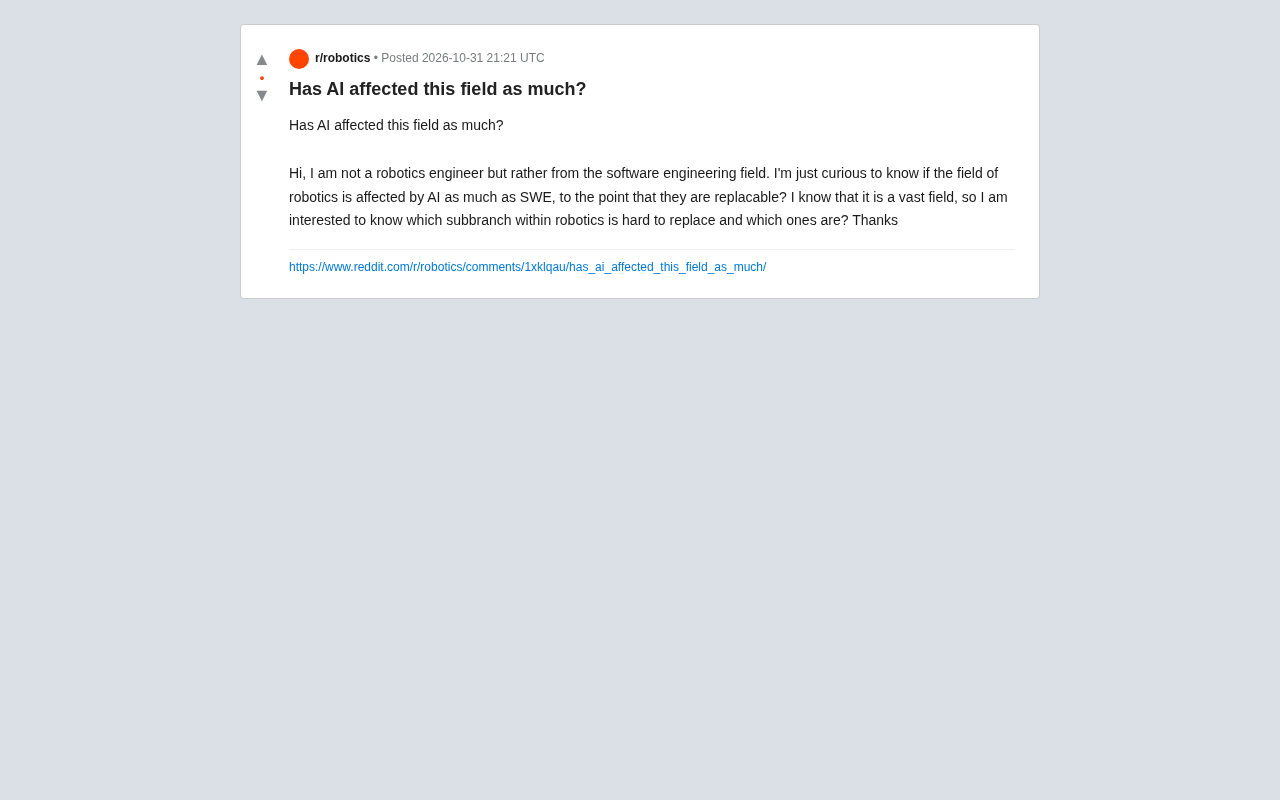
A software engineer asked on Reddit: Is AI's impact on robotics engineering as great as its impact on software engineering, to the point that robotics engineers will also be replaced? This question touches on the core anxiety about engineers' career security in the AI era. Robotics relies far more on the physical world than writing code does, and the way AI permeates the field is therefore fundamentally different.
Robotics Is Not One Job, but a Set of Highly Divergent Subfields
The questioner themselves realized that robotics "is a vast field." From industrial robotic arms to humanoid robots, from autonomous driving to medical surgical robots, different branches differ enormously in tech stack, safety requirements, and pace of deployment. One consensus in the discussion is that AI's replacement effect on robotics shows a clear "layered" character, rather than the across-the-board effect it has on some purely software tasks.
According to the views of multiple practitioners in the Reddit discussion, the more a task depends on perception, planning, control, and hardware coupling, the harder it is for AI to directly replace human engineers; the more a task leans toward data processing, simulation modeling, and repetitive code generation, the more direct AI's impact is.
Which Subfields Are Relatively "Replacement-Resistant"?
Hardware and Mechatronic Design
Robotics engineers not only write algorithms but also deal with physical constraints such as actuator selection, structural stiffness, thermal management, and wiring. This work relies heavily on experience and intuition about real hardware. What AI currently offers is mainly assistance with calculations and solution retrieval, not end-to-end replacement. One comment noted that in hardware debugging, the part where you "can smell the burning," AI is always absent.
Safety-Critical Control and Verification
In industrial and medical robots, control law design, functional safety certification, and failure mode analysis carry legal and personal liability. Multiple discussants believe that even if AI can generate control code, ultimate accountability and on-site verification still require a human engineer's sign-off, which forms a natural barrier to replacement.
Functional safety certification is a mandatory threshold for industrial and medical robots to enter the market. The industrial sector typically relies on IEC 61508 (generic functional safety) and its derivative standards ISO 13849 (safety-related control systems for machinery) and IEC 62061; medical robots must satisfy IEC 62304 (medical device software lifecycle) and ISO 14971 (risk management). These standards require strict requirements traceability for control software, failure mode and effects analysis (FMEA), and verification testing classified by Safety Integrity Level (SIL) or Performance Level (PL).
The key point is that the certification process emphasizes "demonstrable safety"—every design decision must have a documented evidence chain and be signed by qualified personnel. Even if AI-generated code is functionally correct, its black-box nature and inexplicability are almost impossible to pass review directly under existing certification frameworks. This is precisely the technical and institutional root of the article's statement that "accountability and on-site verification still require human sign-off": the barrier to replacement is not only technical difficulty but also legal liability and the compliance system.
System Integration and On-Site Deployment
When robots are deployed, the unstructured environments, sensor calibration deviations, and production line takt issues they face often have no standard answers. One practitioner described this kind of work as "making engineering decisions in chaos." AI can offer suggestions, but it cannot bear the consequences of on-site judgment.
Which Areas Are Being Significantly Changed by AI?
Perception and Algorithm Development
Fields such as computer vision, SLAM, and grasp pose estimation already depend deeply on deep learning. Some in the discussion believe that the daily work of people in this area is shifting from "hand-writing features" to "tuning models and data." While efficiency improves greatly, the demand structure for pure algorithm implementation roles is also changing.
SLAM (Simultaneous Localization and Mapping) is the core technology for autonomous navigation of mobile robots: a robot estimates its own pose through sensors (LiDAR, cameras, IMU) while incrementally building a map of the environment. Traditional SLAM relies on hand-designed feature extractors and geometric optimization (such as Kalman filtering and factor graph optimization), while in recent years deep learning-based approaches (such as learned features, end-to-end pose regression, and neural implicit map representations) have significantly changed the implementation path. This shift is exactly what the article means by "from hand-writing features to tuning models and data"—engineers' focus moves from deriving geometric formulas to designing network structures, building training sets, and tuning parameters.
The same is true for grasp pose estimation: it must solve, given an object's geometry and sensor observations, the position and orientation at which a gripper can stably grasp it. Early methods relied on analytical geometry and force-closure analysis; today's mainstream approaches (such as deep learning models based on point clouds or RGB-D) learn grasp feasibility directly from data. What these two types of tasks have in common is that the barrier to algorithm implementation has been greatly lowered by pretrained models and open-source frameworks, while the demand for judgment about data quality, scene generalization, and deployment tuning has actually increased.
Simulation and Data Generation
Training policies in simulation environments with reinforcement learning and using synthetic data to make up for insufficient real data—these practices were repeatedly mentioned in the discussion. Here AI is more of a tool, but it does compress some of the manpower needed for simulation modeling and test script writing.
Reinforcement learning learns policies by having an agent repeatedly trial and error in an environment with the goal of maximizing cumulative reward. Training directly on real robots is extremely costly—every fall may damage hardware, and sample efficiency is low. Simulation environments (such as Isaac Sim, MuJoCo, and Gazebo) provide low-cost, parallelizable, resettable training grounds that make millions of interactions possible.
However, sim-to-real involves a "reality gap": friction, mass, and sensor noise in simulation deviate from the real world, and policy transfer often fails. Therefore, domain randomization has become a key technique—randomly perturbing physical parameters and visual appearance during training to force the policy to learn behavior robust to deviations. Synthetic data generation is similar: using simulation rendering or generative models to mass-produce labeled training samples to offset the high cost of real collection. Although these processes are AI-driven, environment setup, parameter calibration, and validation of effectiveness still consume a great deal of engineering manpower; the focus of that manpower merely shifts from "writing test scripts" to "designing simulation domains and evaluating transfer performance."
Disagreement: "Replacement" or "Redivision of Labor"?
There is clear disagreement in the discussion. Some believe that the spread of AI-assisted programming in software engineering will sooner or later enter robotics in a similar way, especially in upper-level task planning and code generation; others emphasize that robotics is "software that touches the physical world," and the cost of trial and error and safety constraints mean AI can only be a co-pilot.
The more consistent judgment is that AI's change to robotics engineering is more a redivision of labor than an overall replacement. Demand for entry-level repetitive coding may shrink, while demand actually rises for systems-oriented engineers who can span algorithms, hardware, and the field.
Implications for Practitioners
For people with a software background who want to move into robotics, the advice in the discussion tends to converge: build up physical intuition about hardware and control, go deep into a safety-critical or system-integration subdirection, and treat AI as a tool for improving efficiency rather than as a competitor. Robotics' moat is not in the code itself, but in the hard-to-articulate judgments at the interface between code and the physical world.
(This article's views are synthesized from statements by multiple practitioners in the relevant Reddit discussion, with disagreements presented as they are.)
Related articles

AI Tools Quietly Altering Settings: Postman Silently Installs Plugin, Codex Sharing Option Auto-Resets
AI Daily reports: Postman silently installs a Mac plugin and self-approves startup hooks, logged as auto-existing upgrade; Hacker News developers say Codex data-sharing opt-out flips back. Plus Simon Willison's raw float weight experiment with QEN 3.8-27B.

AI Learns to Rewrite AI: MIT's "Weightspace Programming" Redraws the Path to Recursive Self-Improvement
MIT team proposes weightspace programming: GPT-6 Astra reads and edits AI model weights directly. Math scores jump several-fold, hand-written networks beat trained models. Eight experiments analyzed, plus Anthropic's same-day warning and the real boundaries of recursive self-improvement.

Running Qwen 3.8 on a Laptop to Read Raw Weights: 46 Minutes Per Answer
Simon Willison reproduced weight space programming with Qwen 3.8 27B on a laptop: a 17GB model file, 46 minutes per answer, 43,506 reasoning tokens, Pong over an hour, Freeway failed. Suited for interpretability researchers.