AI SDK Adds Z.ai Provider Support, Releases Version 2.0.20

@ai-sdk/zai 2.0.20 patch release reflects the trend toward unified interfaces in the AI development toolchain.
The article uses the GitHub release of @ai-sdk/zai 2.0.20 as a starting point to analyze the AI development toolchain's evolution toward unified interfaces. This version is a patch update following semantic versioning, keeping the major version at 2 with no breaking changes. The core change is dependency upgrades: @ai-sdk/provider-utils to 4.0.65 and @ai-sdk/openai-compatible to 2.0.92, triggered automatically by github-actions. The article explains the roles of these two dependencies—the former handles common logic like request construction, error handling, and streaming response parsing; the latter enables quick integration of OpenAI-compatible services. For developers, this means calling Z.ai models can reuse almost the same code path as OpenAI and Anthropic, significantly lowering multi-model switching and routing costs. The article concludes that such automated maintenance reflects a healthy open-source ecosystem, and unified calling interfaces are becoming standard practice in AI application development.
How a Single Patch Release Reflects the Evolution of the AI Development Toolchain
@ai-sdk/zai has released version 2.0.20 on GitHub. It looks like an unremarkable patch update, but behind it lies a fast-moving trend: AI development toolchains are rapidly consolidating services from various major model providers. Z.ai, as Zhipu AI's brand for overseas markets, lets developers switch between different models more easily through the unified interface of AI SDK.
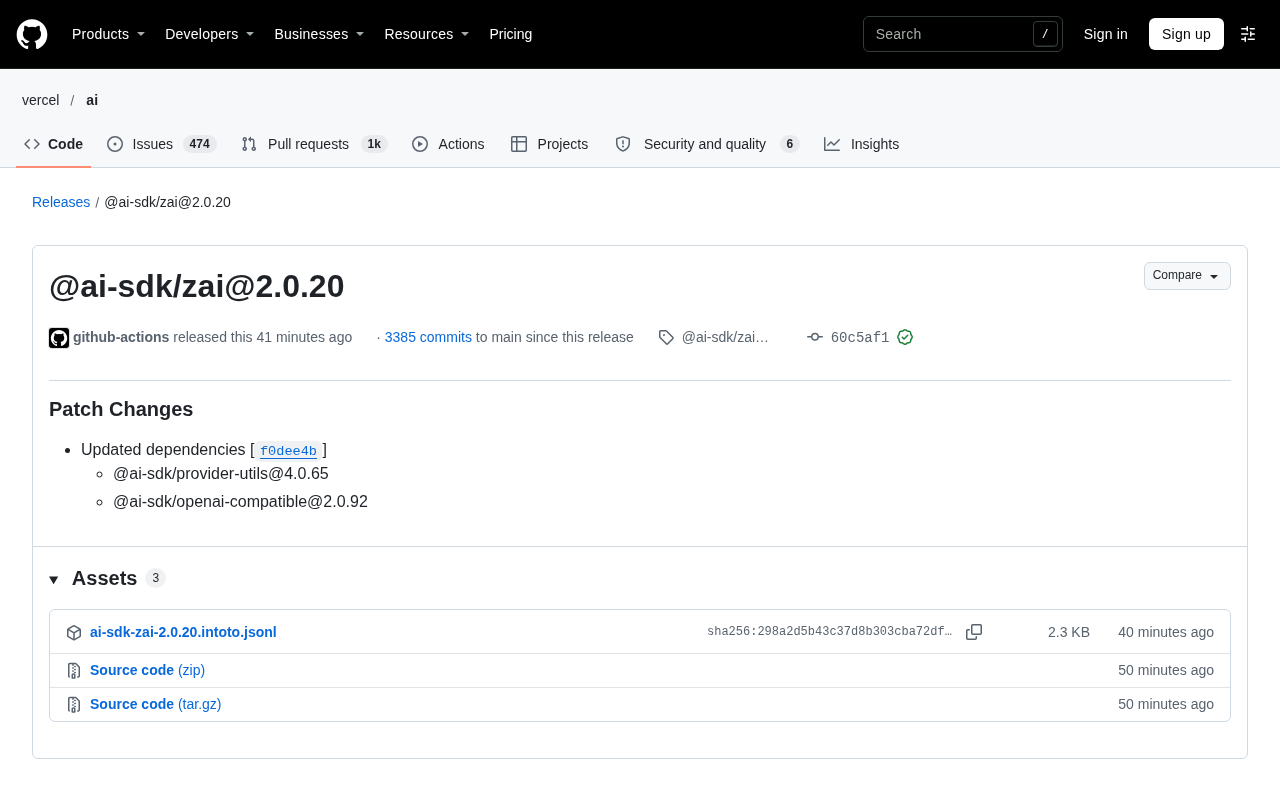
This update falls under Patch Changes, and the main change is a dependency upgrade: @ai-sdk/provider-utils bumped to 4.0.65, and @ai-sdk/openai-compatible bumped to 2.0.92. Judging from the commit history, this is an automated dependency sync release triggered by github-actions, involving a large number of commits on the main branch.
Technical Details and Scope of Impact
What the Version Number Means
@ai-sdk/zai follows semantic versioning. 2.0.20 means the major version is still 2, the API remains stable, and there are no breaking changes. The patch number jumped from 19 to 20, indicating only minor fixes. For developers already using Z.ai, the upgrade risk is extremely low.
Semantic Versioning (SemVer) splits a version number into three parts—major.minor.patch—each carrying a different compatibility commitment. A major version increment signals incompatible API changes, and upgrading usually requires modifying calling code; a minor version increment signals new functionality added in a backward-compatible way; a patch increment contains only backward-compatible bug fixes. The community mnemonic is "breaking changes bump major, new features bump minor, bug fixes bump patch." This convention is not a mandatory standard, but it is widely adopted by package managers like npm and a large number of open-source projects, and it has become the basis for dependency resolution tools to decide whether automatic upgrades are safe. Understanding the meaning of the three numbers lets you quickly judge upgrade risk from the version number alone—which is also the premise for concluding that 2.0.20 is a low-risk maintenance release.
Linked Updates Across the Dependency Chain
@ai-sdk/provider-utils is the package in AI SDK that handles common provider logic, such as request construction, error handling, and streaming response parsing. @ai-sdk/openai-compatible allows model services compatible with the OpenAI interface to be integrated quickly. Z.ai's API design is itself compatible with the OpenAI format, so this package is a core dependency. Both packages receiving patches at the same time suggests there may be small bug fixes or compatibility adjustments underneath.
"Compatible with the OpenAI interface" means the server aligns as closely as possible with OpenAI's API conventions in terms of request paths, authentication headers, message structures, and streaming response formats, so that existing SDK and client code can point to the new service address with only minor configuration. Since OpenAI's chat completion interface has become the de facto industry-standard form, many model vendors provide this layer of compatibility adaptation, thereby reusing the mature client ecosystem and reducing integration costs. Packages like @ai-sdk/openai-compatible abstract this convention into a reusable provider implementation; a new service only needs its base URL, API key, and model name filled in to be integrated, with no need to write an adaptation layer from scratch. The trade-off is that the compatibility layer usually covers only a common subset, and vendor-specific parameters or capabilities may require additional extensions.
What It Actually Means for Developers
If you are building applications with the Vercel AI SDK and plan to integrate Zhipu or Z.ai models, this release means you can call Z.ai through almost the same code path as other providers (such as OpenAI and Anthropic). Switching costs drop significantly, which is critical for application scenarios that require model routing or multi-model comparison.
One detail worth noting: dependency updates may seem trivial, but continuous maintenance is a sign of a healthy open-source ecosystem. The AI SDK team keeps provider packages in sync through automated workflows—a model worth emulating for other toolchain projects.
Model routing refers to the strategy of dynamically dispatching requests to different models or providers at the application layer based on task type, cost budget, latency requirements, or availability. For example, simple classification tasks go to a cheap small model, complex reasoning goes to a more capable large model, and when a service times out or is rate-limited, the system automatically switches to a backup provider. The prerequisite for routing is that all providers share a unified calling interface; otherwise you would have to write a separate adaptation layer for each one, making switching costs extremely high. Unified abstractions like AI SDK are designed precisely for this: the same calling code only needs its model identifier swapped to point to a different backend, making multi-model comparison, canary releases, and failover feasible.
Conclusion
This is not a feature update but a maintenance release. However, for teams currently evaluating options or already depending on Z.ai, keeping up with patch versions can help avoid potential compatibility issues. AI SDK's provider ecosystem is still expanding, and a unified calling interface is becoming standard practice in AI application development.
One-line Summary
@ai-sdk/zai 2.0.20 patch release reflects the trend toward unified interface integration in the AI development toolchain.
Paragraph Summary
Using the release of @ai-sdk/zai 2.0.20 on GitHub as an entry point, this article analyzes the evolution of the AI development toolchain toward unified interfaces. This version is a patch update that follows semantic versioning, keeps the major version at 2, and has no breaking changes; the core change is dependency upgrades: @ai-sdk/provider-utils to 4.0.65 and @ai-sdk/openai-compatible to 2.0.92, triggered automatically by github-actions. The article explains the roles of these two dependency packages—the former handles common logic such as request construction, error handling, and streaming response parsing, while the latter enables quick integration of services compatible with the OpenAI interface. For developers, this means calling Z.ai models can reuse almost the same code path as OpenAI and Anthropic, significantly lowering the cost of multi-model switching and routing. The article concludes that this kind of automated maintenance is a sign of a healthy open-source ecosystem, and that unified calling interfaces are becoming standard practice in AI application development.
Related articles
 Tech Frontiers
MuJoCo: An Analysis of DeepMind's Open-Source General-Purpose Physics Simulator
An in-depth analysis of Google DeepMind's open-source physics simulator MuJoCo: high-performance C++ kernel, MJCF modeling format, contact solving principles, MJX GPU acceleration, and robot reinforcement learning use cases.
 Tech Frontiers
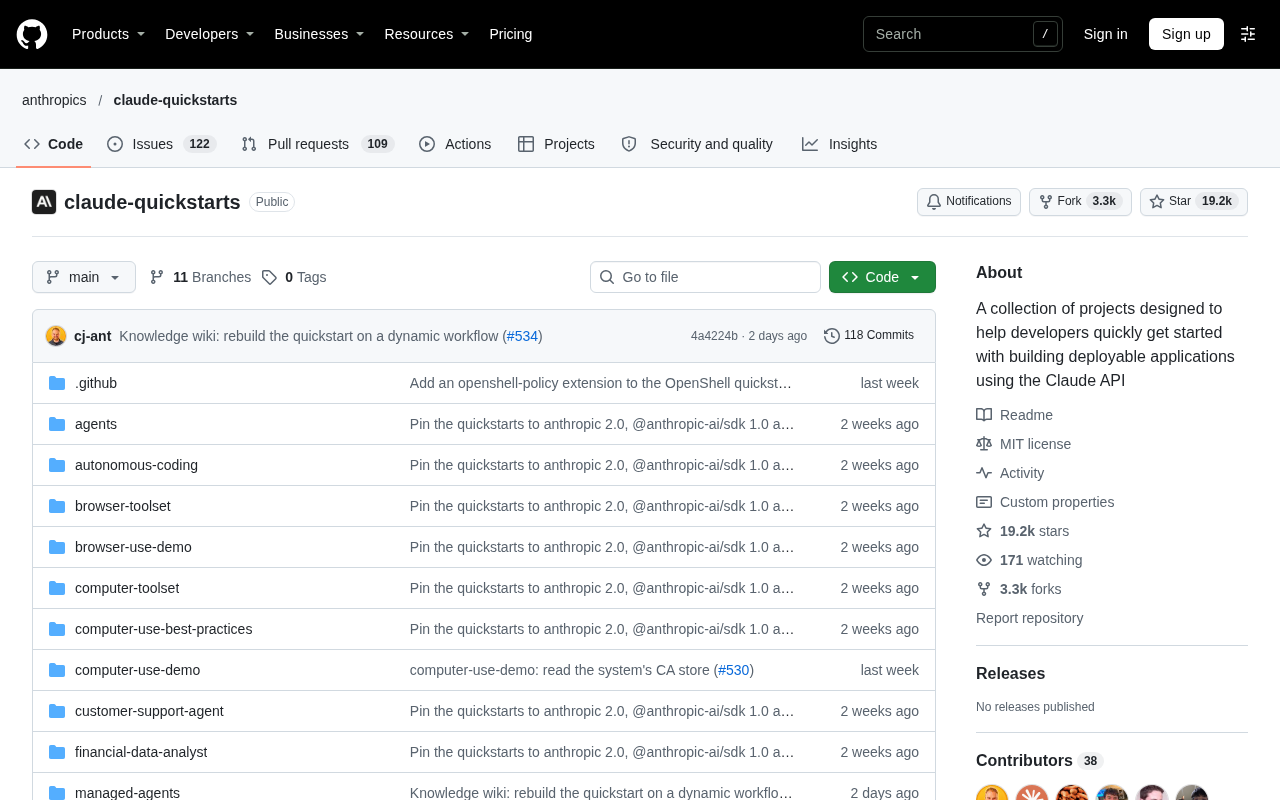
Claude API Quick Start: The Official Quickstarts Project Collection
Anthropic's official claude-quickstarts project collection helps developers quickly build deployable apps with the Claude API. Nearly 20k stars, Python-based, great for beginners and prototyping.
 Tech Frontiers
AI Agents Connecting Directly to APIs: Which Calls Can Be Safely Allowed?
AI agents can call any API, but the real challenge is deciding which calls can be safely allowed. This article analyzes allowance decisions from three dimensions—intent matching, least privilege, and controllable impact—and argues that the control layer should sit outside the agent, combined with audit traceability to build a trustworthy API call governance mechanism.