AI SDK Adds Z.ai Support Update: @ai-sdk/zai 2.0.13 Released

AI SDK's Z.ai adapter package releases patch 2.0.13, only upgrading upstream dependencies, reflecting the ecosystem's compatibility layer strategy.
@ai-sdk/zai has released version 2.0.13, a backward-compatible patch-level update whose core change is bumping the dependency @ai-sdk/openai-compatible to 2.0.85 and @ai-sdk/provider-utils to 4.0.61, with no new features or breaking changes. The article uses this to illustrate the architectural philosophy of the AI SDK ecosystem: the core package defines abstract interfaces, each Provider package handles specific adaptation, and Z.ai chose to build on openai-compatible rather than implementing the protocol from scratch, taking an efficiency-first route that reuses the OpenAI ecosystem and lowers integration costs. For developers, such updates require no business code changes — simply upgrading the dependency provides upstream fixes — but it is recommended to upgrade multiple @ai-sdk/* packages in the same project uniformly to avoid type mismatches caused by multiple versions of provider-utils coexisting.
A Quiet Patch Upgrade, Backed by the AI SDK Ecosystem's Continued Expansion
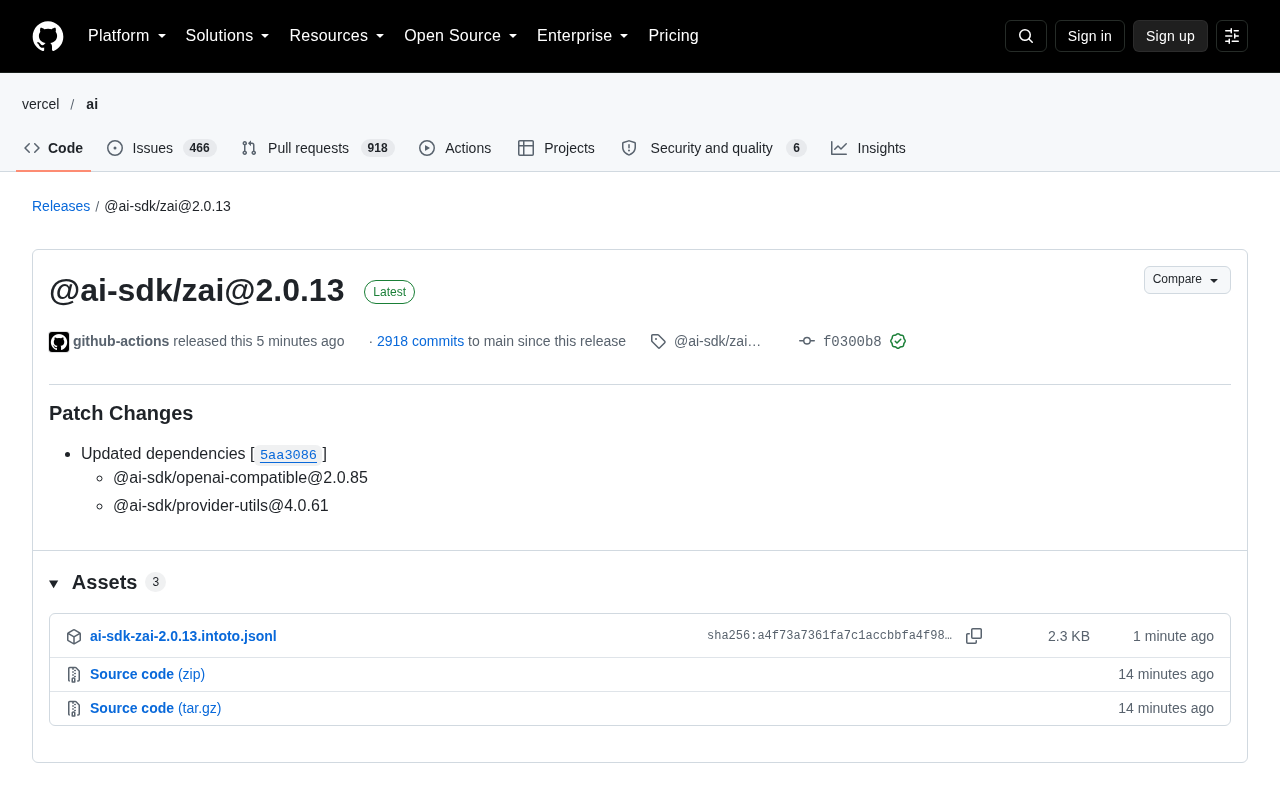
In the AI SDK ecosystem maintained by Vercel, another Provider package has completed a version iteration. @ai-sdk/zai@2.0.13 was released as a patch version. The changes are not complex, but they reveal the AI SDK's consistent approach to multi-model integration.
What Changed in 2.0.13
According to the GitHub Release page, this update falls under the Patch Changes level — a backward-compatible minor fix. The core content is a version bump for dependencies:
@ai-sdk/openai-compatibleupdated to 2.0.85@ai-sdk/provider-utilsupdated to 4.0.61
Both dependencies are foundational modules within the AI SDK system. The former is responsible for uniformly integrating third-party services that comply with the OpenAI API specification, while the latter provides common utility functions for the Provider layer. Z.ai's adapter package is built on top of openai-compatible, indicating that it follows the OpenAI-compatible API route rather than maintaining a separate protocol implementation.
This transitive dependency update approach is common in the AI SDK ecosystem. When upstream fixes a parsing edge case or field mapping issue, all downstream Provider packages benefit without needing individual modifications.
Semantic Versioning (SemVer) is the convention behind this versioning scheme: the three segments MAJOR.MINOR.PATCH correspond respectively to incompatible breaking changes, backward-compatible feature additions, and backward-compatible bug fixes. Therefore, the increment of the third digit in 2.0.13 amounts to a promise to users — existing API behavior remains unchanged after upgrading, only internal issues have been fixed. AI SDK Provider packages generally follow this rule strictly, which is why patch versions can be confidently allowed to float automatically with the dependency tree.
The AI SDK Provider architecture is the prerequisite for understanding this type of update. The ai core package only defines abstract interfaces such as language models and embedding models, while the specific invocation details for a particular model service are implemented by independent Provider packages, such as @ai-sdk/openai and @ai-sdk/anthropic. If a third-party service has an API similar to the OpenAI specification, it typically does not need to be implemented from scratch; instead, it reuses @ai-sdk/openai-compatible as a foundation and only overrides the baseURL, authentication method, and a few differing fields. This division of labor keeps the core package stable and isolates frequently changing integration details within their respective Provider packages.
Why Patch Versions Are Also Worth Paying Attention To
Looking at just the version number, 2.0.13 has accumulated thirteen patches since 2.0.0. This pace is normal among AI SDK Provider packages — model service providers frequently make subtle API adjustments, and the SDK needs to keep up with details like fields, error codes, and streaming response formats.
For developers using @ai-sdk/zai, the significance of such updates is that no business code changes are needed — simply upgrading the dependency provides upstream fixes. The premise is following semantic versioning rules, where patch-level changes do not introduce breaking changes.
From community practice, AI SDK Provider packages tend to maintain a certain degree of version linkage with the core ai package. If a project locks multiple @ai-sdk/* packages simultaneously, it is recommended to upgrade them uniformly to avoid type mismatches caused by multiple versions of provider-utils coexisting.
The Trade-offs of the OpenAI-Compatible Route
Z.ai chose to integrate through openai-compatible rather than writing an implementation from scratch using @ai-sdk/provider. This itself is an efficiency-first strategy.
The benefits are straightforward: reusing the request structures, streaming parsing, and tool-calling handling logic already refined in the OpenAI ecosystem, resulting in low integration costs. The trade-off is that when Z.ai has unique capabilities beyond the OpenAI specification, the compatibility layer may need additional adapter code to expose these features.
AI SDK making openai-compatible a standalone package essentially encourages this kind of reuse. A large number of domestic model services and self-hosted inference frameworks in the community have integrated with AI SDK through this package, forming a de facto compatibility layer standard.
OpenAI-compatible APIs refer to third-party services replicating OpenAI's /v1/chat/completions and similar endpoints as closely as possible in terms of paths, request bodies, and response bodies, including the messages array structure, the tools function-calling format, and the SSE streaming response convention ending with data: [DONE]. This is not any official standard, but rather a de facto convention formed through extensive community practice. Its value lies in the fact that clients only need to change a baseURL to migrate, without rewriting request and parsing logic; the trade-off is that the compatibility layer can only cover semantics that OpenAI already has, and the service provider's unique capabilities are either ignored or need to be exposed through additional non-standard fields.
Practical Impact on Developers
If your project is using @ai-sdk/zai, this update can be handled in the usual way:
- Check the versions of
@ai-sdk/openai-compatibleand@ai-sdk/provider-utilsin the lockfile - Run the package manager's upgrade command to align the dependency tree to 2.0.85 and 4.0.61
- Run through the call tests involving Z.ai models, focusing on streaming output and error handling paths
If you choose not to upgrade for now, there will be no missing functionality. The characteristic of patch updates is that you can wait and upgrade together with the next feature version. However, staying on an old version long-term may mean missing compatibility fixes brought by certain server-side API changes.
Lockfiles are files like package-lock.json, pnpm-lock.yaml, and yarn.lock that record exact dependency versions, ensuring that the dependency tree installed within a team and in CI environments is completely consistent. Checking the actual resolved versions of @ai-sdk/openai-compatible and @ai-sdk/provider-utils in the lockfile is the direct basis for determining whether an upgrade is truly needed — because package managers like npm may have already automatically installed a higher patch version through the ^ range, in which case no local action is required. Upgrade commands differ by package manager: npm uses npm update @ai-sdk/zai, pnpm uses pnpm update @ai-sdk/zai, and yarn uses yarn up @ai-sdk/zai.
Type mismatches caused by multiple versions coexisting are a common pitfall in monorepos or projects with deep dependency trees. If provider-utils exists as two copies — 4.0.61 and an older version — TypeScript will treat them as different types, causing errors when passing objects produced by one package to functions in another. The typical troubleshooting method is npm ls @ai-sdk/provider-utils or pnpm why to confirm that only one version remains in the tree, and if necessary, using the resolutions / overrides field to force unification.
Summary
@ai-sdk/zai@2.0.13 itself does not introduce new features; its value lies in maintaining the health of the entire dependency chain. The iteration logic of the AI SDK ecosystem is exactly this: the core package defines abstractions, Provider packages handle adaptation, and each patch brings the integration experience across different model services closer to consistency. For users, paying attention to version linkage is more meaningful than focusing on a single version number.
One-line Summary
AI SDK's Z.ai adapter package releases patch 2.0.13, only upgrading upstream dependencies, reflecting the ecosystem's compatibility layer strategy.
Paragraph Summary
@ai-sdk/zai has released version 2.0.13, a backward-compatible patch-level update whose core change is bumping the dependency @ai-sdk/openai-compatible to 2.0.85 and @ai-sdk/provider-utils to 4.0.61, with no new features or breaking changes. The article uses this to illustrate the architectural philosophy of the AI SDK ecosystem: the core package defines abstract interfaces, each Provider package handles specific adaptation, and Z.ai chose to build on openai-compatible rather than implementing the protocol from scratch, taking an efficiency-first route that reuses the OpenAI ecosystem and lowers integration costs. For developers, such updates require no business code changes — simply upgrading the dependency provides upstream fixes — but it is recommended to upgrade multiple @ai-sdk/* packages in the same project uniformly to avoid type mismatches caused by multiple versions of provider-utils coexisting.
Related articles

Chain of Thought Isn't Just for AI: How Humans Can Use CoT to Improve Thinking Quality
Chain of Thought isn't just a prompt trick for large models. Starting from a Hacker News discussion, this article analyzes why CoT works for human thinking too, breaks down actionable ways to transfer it, and highlights the key differences between human CoT and machine CoT.
Cloudflare Teams Up with OpenAI: Closi…
Cloudflare Teams Up with OpenAI: Closing the Loop from Vulnerability Discovery to Defense with AI
Cloudflare uses OpenAI Daybreak to investigate security vulnerabilities and generate reviewable remediation plans, while developers use Codex to boost coding efficiency and quality.

Orca Multi-Agent Orchestration in Practice: A Guide to Parallel Collaboration with Claude and Codex
Orca is Stable AI's free open-source agent workbench supporting 34 agents like Claude Code and Codex in parallel. Learn its Git worktree isolation, multi-model orchestration, and mobile management.