AI SDK Ecosystem Update: @ai-sdk/zai Patch Released
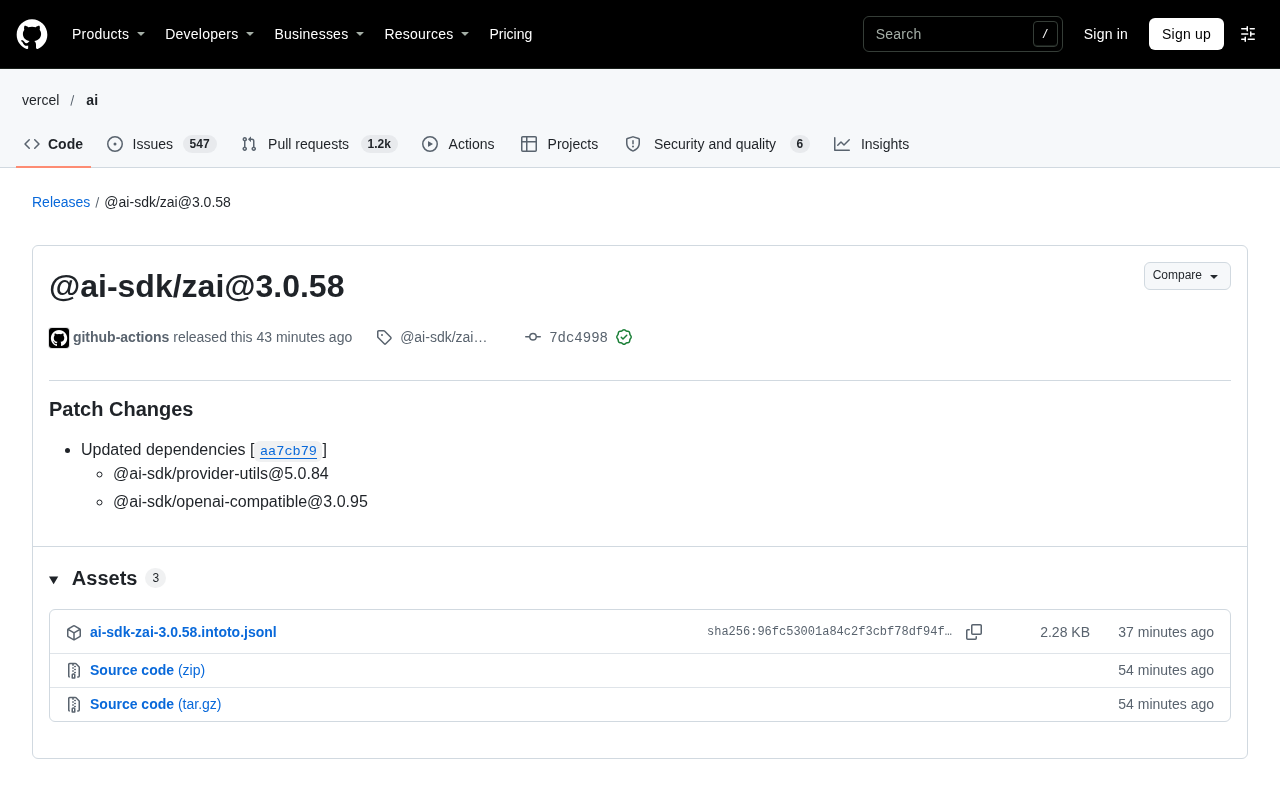
@ai-sdk/zai releases patch 3.0.58, synchronously upgrading two underlying dependencies; a low-risk update.
`@ai-sdk/zai` released patch version 3.0.58. The core change is the synchronized update of two downstream dependencies in commit aa7cb79: `@ai-sdk/provider-utils` to 5.0.84 and `@ai-sdk/openai-compatible` to 3.0.95. The article notes that this reflects the modular layered design of the Vercel AI SDK—zai, as an adapter layer, has very thin logic itself and depends on the underlying utility packages and compatibility layer for stability, so the patch release is essentially the propagation of upstream fixes. Each package evolves independently under semantic versioning, and developers can upgrade adapters individually as needed. This release was completed automatically by github-actions with a verified signature, making the process traceable. For users, it is a low-risk upgrade, but dependency chain changes may indirectly affect streaming responses and tool calls, so it is recommended to verify in a test environment first and keep lock files updated.
AI SDK ecosystem updates often roll out quietly in the form of patches, but the dependency chains they set in motion are worth paying attention to. Recently, @ai-sdk/zai released version 3.0.58, a typical patch change whose core action is updating dependencies.
Patch Contents: Synchronized Upgrade of the Dependency Chain
According to the release records on GitHub, version 3.0.58 is a Patch Changes release, primarily triggered by commit aa7cb79, which synchronizes updates to two downstream dependencies: @ai-sdk/provider-utils was bumped to 5.0.84, and @ai-sdk/openai-compatible was bumped to 3.0.95.
This kind of update is very common in the modular architecture of the Vercel AI SDK. As an adapter layer targeting a specific model provider, @ai-sdk/zai does not carry much business logic itself, and its stability depends heavily on the underlying utility packages and compatibility layer. A patch release means that upstream fixes or adjustments have been propagated down, and projects using this adapter can obtain consistent underlying behavior after upgrading.
The Modular Architecture of the Vercel AI SDK: The Vercel AI SDK is not a single monolithic package but a set of npm packages split by responsibility. The core layer consists of @ai-sdk/provider (which defines the model provider interface specification) and @ai-sdk/provider-utils (which provides common capabilities such as streaming parsing and tool-call parameter validation); the compatibility layer, such as @ai-sdk/openai-compatible, abstracts the OpenAI-style Chat Completions protocol so that many model service providers compatible with that protocol can reuse the same request/response handling logic; at the top layer are the adapter packages for each provider, such as @ai-sdk/zai, which are only responsible for bridging vendor-specific differences (endpoint, authentication, model name mapping) to the compatibility layer. This layering means that the upper-layer adapters themselves contain very little code, and behavioral consistency is guaranteed by the underlying packages, so a patch release of an adapter often just "pulls in the new version of the underlying layer."
Semantic Versioning and Patch Changes: The npm ecosystem follows the SemVer convention, where the version number MAJOR.MINOR.PATCH corresponds to breaking changes, backward-compatible new features, and backward-compatible bug fixes, respectively. Changesets is the version management tool used by the AI SDK repository. It requires each commit to include a change description and automatically classifies it as major/minor/patch. "Patch Changes level" in this article means that the release is judged to be patch-level and, by convention, should not contain breaking API changes. It should be noted that SemVer only constrains a single package's own public API, while a package's dependency upgrade may indirectly change runtime behavior—for example, if provider-utils internally corrects the parsing order of streaming chunks, upper-layer callers may not have changed their code, but actual behavior will still change. This is also the reason the article recommends verifying in a test environment first.
The Modular Design Behind the Version Numbers
From the version numbers, we can see the AI SDK's layering strategy: provider-utils is on the 5.x mainline, openai-compatible is on the 3.x mainline, and the zai adapter is also on 3.x. Different packages evolve independently and ensure compatibility through semantic versioning. For developers, this means individual adapters can be upgraded as needed without having to migrate the entire SDK.
This release was completed automatically by github-actions, and the commit carries a GitHub verified signature, indicating that the release process has achieved automation and traceability. This engineering practice reduces the risk of errors in manual releases.
The Meaning of Different Major Version Lines Coexisting: provider-utils is on 5.x, while openai-compatible and zai are on 3.x. This "inconsistent major version numbers within the same ecosystem" is a normal result of independent version evolution and does not indicate incompatibility. Each package accumulates its own count of breaking changes, so the major version number only reflects that package's own evolution history. The real compatibility constraint comes from the version ranges in dependency declarations (such as ^3.0.95), based on which npm resolves versions that satisfy the conditions. When troubleshooting issues, developers should check the actually installed versions in package-lock.json or pnpm-lock.yaml rather than only looking at the declared ranges in package.json, because multiple adapters may share the same provider-utils, and the resolution result determines the runtime behavior of the entire project.
Practical Impact on Developers
For projects currently using @ai-sdk/zai, 3.0.58 is a low-risk upgrade. Since it is only a dependency synchronization, it usually does not introduce breaking API changes. It is recommended to first verify in a test environment whether the behavior of calls related to provider-utils and openai-compatible meets expectations before merging into the main branch.
It is worth noting that although the patch version is small, changes in the dependency chain may indirectly affect capabilities that rely on provider-utils, such as streaming responses and tool calls. Keeping dependency lock files updated and paying attention to the changelogs of upstream packages is a prudent approach.
Summary
@ai-sdk/zai@3.0.58 is a routine dependency synchronization patch that reflects the automated, modular release cadence of the AI SDK ecosystem. For most users, this is a minor version update that can be safely followed.
Related articles

Prospero: A Lightweight Native AI Coding Tool Built with ImGui
Prospero is a bloat-free native AI coding tool built with ImGui, emphasizing lightweight design, high performance, and low dependencies. This article analyzes its design philosophy, technical choices, and the divergence between platformization and toolization in AI coding tools.

WebRTC Abused: New Variant of Credit Card Skimming Scripts on Shopping Sites
Security researchers found skimming scripts on popular shopping sites using WebRTC data channels to exfiltrate credit card data. This article analyzes the technical原理, differences from traditional Magecart attacks, and defense strategies for e-commerce platforms in third-party script governance and CSP policies.

Single GB10 Card Hits 101 tok/s: Inkling 2 Mini Performance Tested on vLLM
A developer shared on Hacker News running Inkling 2 Mini with vLLM on a single GB10 at 101 tok/s. This article analyzes the technical context, the significance of vLLM with small models on single cards, and caveats for interpreting tok/s metrics.