AI SDK Ecosystem Update: Valibot Adapter Package 3.0.60 Released

@ai-sdk/valibot releases 3.0.60 patch, only syncing the provider-utils dependency with no feature changes.
@ai-sdk/valibot released version 3.0.60, a Patch Changes-level update whose core change is merely syncing the dependency @ai-sdk/provider-utils@5.0.60, with no new features or breaking changes. This package is the AI SDK's adapter layer for the Valibot validation library, mainly used in structured output scenarios to convert between Valibot schemas and the AI SDK's internal validation format. This dependency-driven release pattern stems from the AI SDK's monorepo architecture, aiming to ensure version consistency across the ecosystem. Developers using this package typically don't need to upgrade immediately, but upgrading may help if they encounter peer dependency warnings or type inconsistencies. It also signals that the AI SDK's structured output adapter layer covers mainstream validation libraries.
As the bridge connecting large language models with frontend applications, every sub-package update in the AI SDK ecosystem can affect developers' integration experience. Recently, @ai-sdk/valibot released version 3.0.60, a small patch update that maintains the synchronicity of the entire dependency chain.
Patch Contents: A Typical Dependency Sync
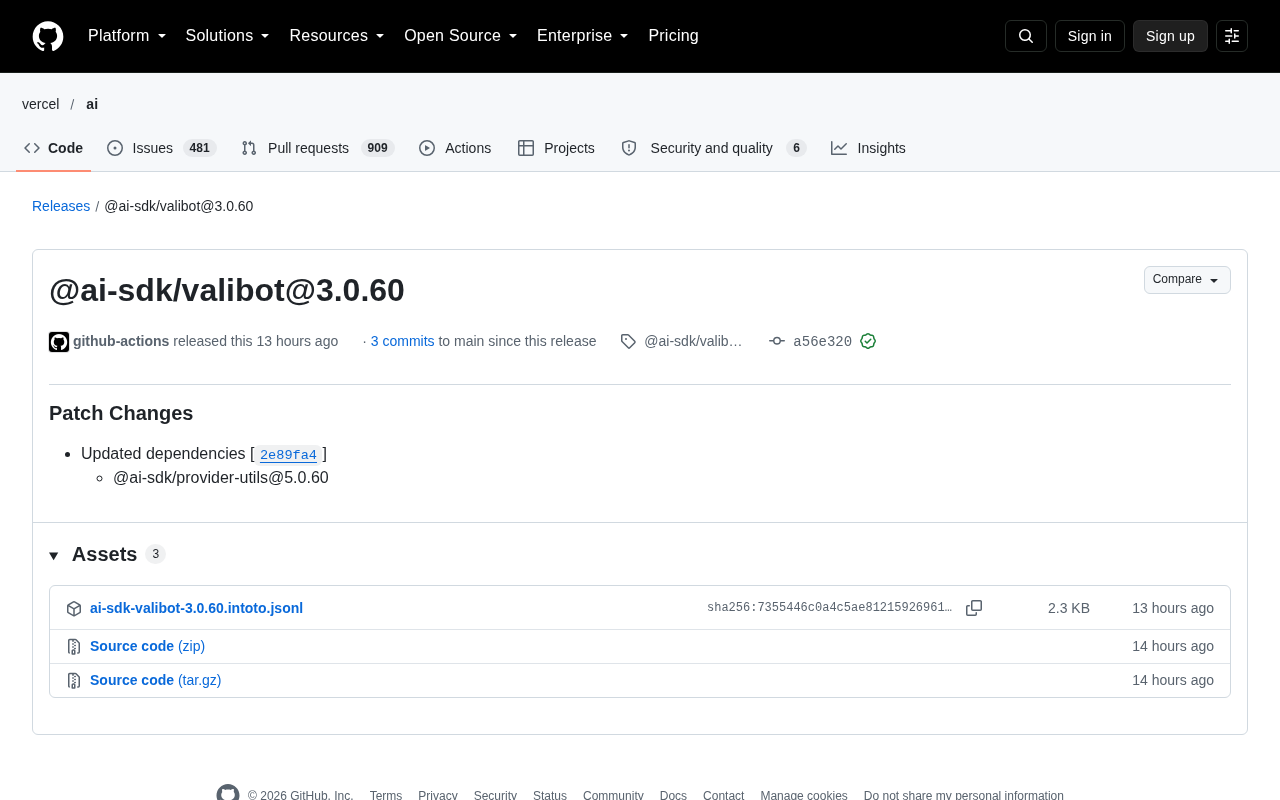
According to the commit records on GitHub, @ai-sdk/valibot@3.0.60 is a Patch Changes-level update. Its core change consists of just one item: updating the dependency on @ai-sdk/provider-utils@5.0.60.
Judging from the version number, provider-utils handles the general utility functions in the AI SDK for interacting with model providers, including low-level logic such as streaming response parsing, tool call formatting, and error handling. When this package releases a new patch version, downstream adapter packages (such as @ai-sdk/valibot) need to follow suit to ensure that users don't encounter type errors or runtime exceptions due to version conflicts during installation.
This dependency-driven release pattern is very common in AI SDK projects with a monorepo architecture. It means that @ai-sdk/valibot@3.0.60 itself introduces no new features or breaking changes; rather, it exists to ensure version consistency across the entire SDK ecosystem.
Monorepo is an engineering practice of managing multiple related software packages within a single code repository, as opposed to the traditional "one package, one repository" approach. The AI SDK adopts exactly this architecture: the core package, model provider adapter packages, validation library adapter packages (such as @ai-sdk/valibot), and others share the same build, test, and release pipeline. Its key mechanism is the workspace protocol: dependencies between packages often don't hardcode specific versions but instead reference local versions within the repository, which are then automatically resolved to actual version numbers by tools (such as pnpm or Changesets) at release time. Therefore, when @ai-sdk/provider-utils increments its version, all downstream packages that depend on it are uniformly triggered for a patch release, ensuring the entire ecosystem points to the same underlying implementation. This also explains why version updates that "change only one line of dependency" occur—they are not feature iterations but rather a natural product of the Monorepo's version alignment mechanism. Understanding this helps developers avoid misreading such patches as noteworthy feature changes.
The Role of Valibot in the AI SDK
@ai-sdk/valibot is the AI SDK's adapter package for the Valibot validation library. Valibot is a lightweight, modular TypeScript schema validation library that, compared to Zod, places greater emphasis on tree-shaking friendliness and smaller bundle sizes.
In the context of the AI SDK, such adapter packages are typically used in structured output scenarios. Developers can use Valibot to define data models, then leverage the AI SDK to have large models return structured data according to the specified schema. The adapter package is responsible for converting between Valibot schemas and the validation format used internally by the AI SDK, so developers don't need to write conversion logic by hand.
For teams that have already chosen Valibot as their project's validation solution, the continuous updates to this package mean that the AI SDK's official maintenance of the Valibot ecosystem is active.
Structured Output refers to making large models return data that can be directly parsed by programs—such as JSON objects with fixed fields—strictly according to a predefined schema, rather than free-form text. It typically relies on the model provider's native capabilities: OpenAI's JSON Schema mode, function calling, or tool calling, where the model side guarantees that output field names and types conform to the constraints. The AI SDK provides a unified wrapper at this layer, abstracting different providers' mechanisms into a consistent interface, and translating schemas defined by developers using Valibot or Zod into the JSON Schema format that models can accept. Adapter packages (such as @ai-sdk/valibot) take on exactly the responsibility of converting "Valibot schema → internal validation format." Tree-shaking refers to bundlers eliminating unreferenced code at build time; Valibot adopts a modular design with per-function imports, so unused validators don't end up in the final output—this is also its main advantage over Zod in size-sensitive frontend scenarios.
The Maintenance Rhythm Behind the Version Number
From the version number 3.0.60, we can observe that the AI SDK ecosystem iterates at a fairly dense pace. The third digit reaching 60 indicates that the project adopts a high-frequency, small-step release strategy.
This approach is not uncommon in the developer tools space. The benefit of high-frequency patch releases is that fixes reach users quickly; the downside is that version numbers inflate rapidly, and developers need to rely on lock files or semantic version ranges to control upgrades. For teams using @ai-sdk/valibot, it's advisable to pay attention to the Patch Changes section in the release notes to determine whether there are compatibility requirements with the provider and provider-utils versions currently in use.
Semantic Versioning (SemVer) specifies that version numbers take the form major.minor.patch: an increment in the major version indicates incompatible breaking changes, an increment in the minor version indicates backward-compatible new features, and an increment in the patch number indicates backward-compatible bug fixes. Accordingly, 3.0.60 means this is the 60th patch-level release in the 3.x series, introducing neither new features nor breaking changes. A peer dependency is a type of declaration in the npm dependency system: a package doesn't install the dependency directly but instead requires the consumer to provide a compatible version in its own project. AI SDK adapter packages often use this to constrain @ai-sdk/provider-utils, avoiding the installation of multiple copies of the same utility library that could lead to type mismatches. This is precisely the root cause of peer dependency warnings or type conflicts when versions are out of sync, which explains the logic behind the article's recommendation to upgrade patch versions to eliminate such issues.
Practical Impact on Developers
If you're currently using the AI SDK with Valibot to build AI applications, this update doesn't require you to take immediate action. However, if you've encountered peer dependency warnings for @ai-sdk/provider-utils during dependency installation, or if type definitions are inconsistent across packages, upgrading to 3.0.60 may help eliminate these issues.
For developers who haven't yet adopted Valibot, this update also serves as a reminder: the AI SDK's structured output adapter layer already covers mainstream validation libraries. When choosing a schema validation solution, you can confidently factor in the AI SDK's adapter support as a consideration.
One-line Summary
@ai-sdk/valibot releases 3.0.60 patch, only syncing the provider-utils dependency with no feature changes.
Paragraph Summary
@ai-sdk/valibot released version 3.0.60, a Patch Changes-level update whose core change is merely syncing the dependency @ai-sdk/provider-utils@5.0.60, introducing no new features or breaking changes. This package is the AI SDK's adapter layer for the Valibot validation library, primarily used in structured output scenarios, responsible for converting between Valibot schemas and the AI SDK's internal validation format. This dependency-driven release pattern stems from the AI SDK's monorepo architecture, aiming to ensure version consistency across the entire ecosystem. The article notes that the AI SDK adopts a high-frequency, small-step release strategy, with version numbers having iterated to 3.0.60; developers using this package typically don't need to upgrade immediately, but if they encounter peer dependency warnings or type inconsistency issues, upgrading to this version may help eliminate them. For developers who haven't yet adopted Valibot, this also indicates that the AI SDK's structured output adapter layer already covers mainstream validation libraries.
Related articles

Chain of Thought Isn't Just for AI: How Humans Can Use CoT to Improve Thinking Quality
Chain of Thought isn't just a prompt trick for large models. Starting from a Hacker News discussion, this article analyzes why CoT works for human thinking too, breaks down actionable ways to transfer it, and highlights the key differences between human CoT and machine CoT.
Cloudflare Teams Up with OpenAI: Closi…
Cloudflare Teams Up with OpenAI: Closing the Loop from Vulnerability Discovery to Defense with AI
Cloudflare uses OpenAI Daybreak to investigate security vulnerabilities and generate reviewable remediation plans, while developers use Codex to boost coding efficiency and quality.

Orca Multi-Agent Orchestration in Practice: A Guide to Parallel Collaboration with Claude and Codex
Orca is Stable AI's free open-source agent workbench supporting 34 agents like Claude Code and Codex in parallel. Learn its Git worktree isolation, multi-model orchestration, and mobile management.