AI SDK Ecosystem Update: Voyage Patch Release and Provider Dependency Evolution

@ai-sdk/voyage 2.0.62 patch update synchronizes underlying dependencies to maintain compatibility.
@ai-sdk/voyage released patch version 2.0.62, introducing no new features but upgrading underlying dependencies @ai-sdk/provider to 4.0.29 and @ai-sdk/provider-utils to 5.0.62. The version was auto-published by GitHub Actions with a verified signature, representing a standardized official release. The Voyage provider connects to Voyage AI's text embedding and rerank capabilities, commonly used in RAG and semantic search. This update ensures its type definitions, validation, and error handling stay in sync with the main framework, reducing compatibility risks. For production, it can be followed directly, but projects with strict version locking should still run integration tests.
A Quiet but Significant Patch Update
In the AI SDK ecosystem led by Vercel, @ai-sdk/voyage has released version 2.0.62. This is a patch update marked as Patch Changes, published on October 16th. For developers focused on AI application infrastructure, such seemingly minor version iterations often hide signals of coordinated evolution across the entire toolchain.
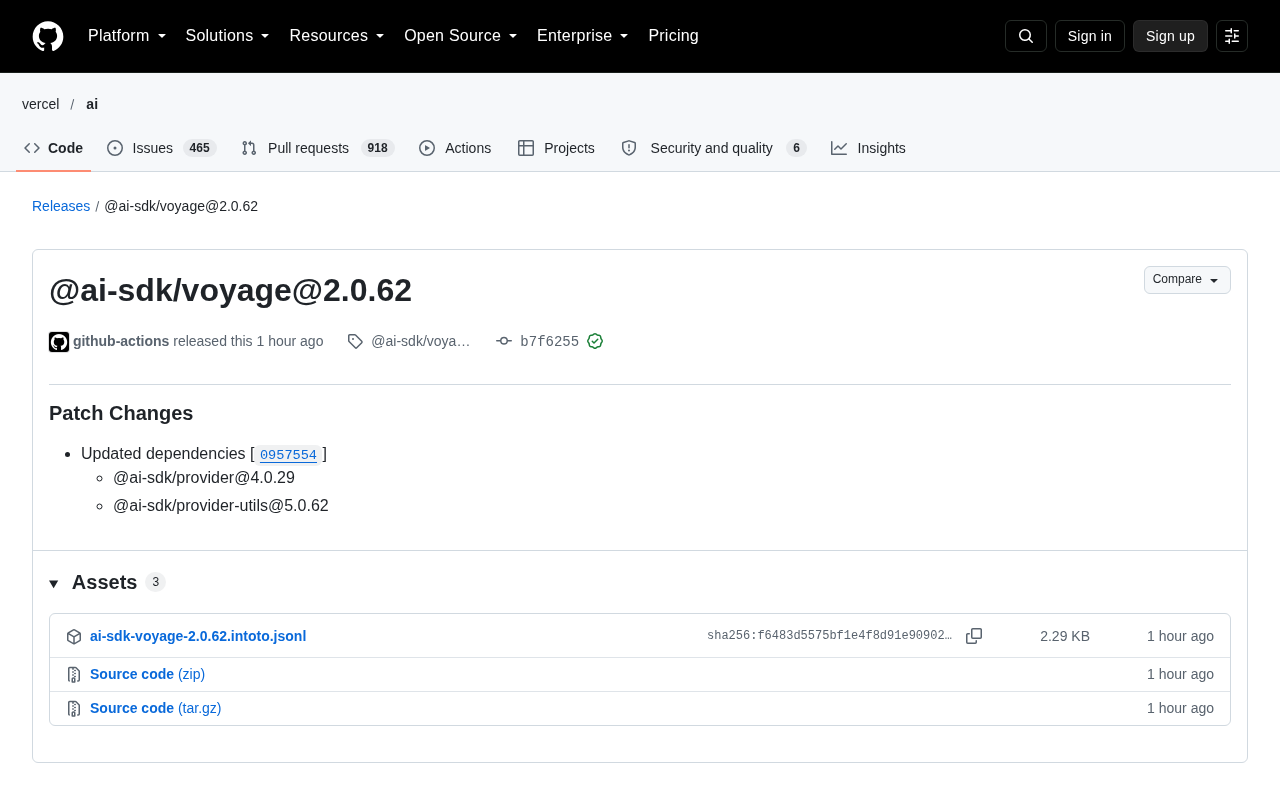
According to the changelog, this release did not introduce new feature APIs, but instead aligned underlying dependencies: @ai-sdk/provider was upgraded to 4.0.29, and @ai-sdk/provider-utils was upgraded to 5.0.62. The commit record shows this version was automatically published by GitHub Actions with a GitHub verified signature (GPG key ID: B5690EEEBB952194), indicating this is a standardized, traceable routine release from the official repository.
Voyage's Position in the AI SDK
To understand the significance of this update, we first need to see what role @ai-sdk/voyage plays in the overall architecture. AI SDK is Vercel's unified model invocation abstraction layer, allowing developers to access models from different vendors through a single interface. And @ai-sdk/voyage is precisely the official provider package for connecting to the Voyage AI service.
Voyage AI is known for its high-quality text embedding and rerank capabilities, often used in scenarios such as RAG retrieval-augmented generation and semantic search. Therefore, the value of this provider package lies not in dialogue generation, but in providing a more precise retrieval foundation for AI applications. When it follows updates to the provider core library, it means its type definitions, request parameter validation, error handling, and other aspects remain synchronized with the main framework.
Text embedding is the technique of mapping text into high-dimensional numerical vectors, where semantically similar texts are closer together in vector space. It is the foundation for applications such as semantic search, clustering, and recommendation. Rerank is the process of re-scoring and re-ordering results using a more refined model after initial document retrieval, typically significantly improving retrieval precision. The two are often used together: embedding for coarse recall, then rerank for fine ranking.
Voyage AI focuses on these two stages, and its models perform excellently on multiple retrieval benchmarks, making it a common choice as a retrieval foundation in RAG pipelines.
Version Strategy Behind Dependency Upgrades
The most notable aspect of this Patch Changes is that it simultaneously upgrades two underlying packages: @ai-sdk/provider and @ai-sdk/provider-utils. These two form the common foundation of the AI SDK provider system—the former defines the provider interface specification, while the latter encapsulates general utility functions.
The approach of incrementing patch numbers and synchronously aligning dependencies is a common maintenance strategy in open-source SDK ecosystems. It prevents third-party providers from forking due to minor changes in the core library, and also reduces compatibility risks when developers upgrade. For applications in production environments, such updates can typically be followed directly; however, if a project has strict version locking, it is still recommended to run integration tests related to embedding or retrieval after upgrading.
Semantic Versioning (SemVer) specifies version numbers in the format MAJOR.MINOR.PATCH: major version changes represent incompatible breaking changes, minor version changes represent backward-compatible new features, and patch numbers represent backward-compatible bug fixes. This 2.0.62 only incremented the patch number, meaning the API and behavior remain compatible.
Provider core contract refers to the interface specification defined by @ai-sdk/provider, including input/output types for model invocation, error structures, etc. Third-party provider packages can only be uniformly orchestrated by the AI SDK by following this contract. Therefore, when the core library updates, surrounding providers need to align synchronously to avoid type mismatches or runtime errors.
Practical Impact on Developers
From a practical standpoint, 2.0.62 will not change existing invocation methods, nor will it bring behavioral breaking changes. It is more like "pipeline maintenance": ensuring the Voyage provider is consistent with the latest provider core contract.
For teams building RAG systems, this means they can safely include this version in their dependencies without worrying about hidden interface drift. For library authors, this release also provides a reference sample—how to keep downstream packages following upstream evolution with minimal changes.
Summary
@ai-sdk/voyage@2.0.62 is not an eye-catching release, but it embodies the daily rhythm of a mature SDK ecosystem: the core library takes a step forward, surrounding providers align synchronously, and developers get a stable and predictable upgrade path. In an era of rapid AI toolchain iteration, this restrained and regular maintenance approach is itself an engineering practice worth noting.
One-line Summary
@ai-sdk/voyage 2.0.62 patch update synchronizes underlying dependencies to maintain compatibility.
Paragraph Summary
@ai-sdk/voyage released version 2.0.62, a patch that introduces no new features but primarily upgrades underlying dependencies @ai-sdk/provider to 4.0.29 and @ai-sdk/provider-utils to 5.0.62. This version was automatically published by GitHub Actions with a verified signature, representing a standardized official release. The Voyage provider handles Voyage AI's text embedding and rerank capabilities, commonly used in RAG and semantic search scenarios. This update ensures its type definitions, parameter validation, and error handling remain synchronized with the main framework, reducing compatibility risks. For production environments, it can be followed directly, but projects with strict version locking should still run embedding or retrieval integration tests.
Related articles

Chain of Thought Isn't Just for AI: How Humans Can Use CoT to Improve Thinking Quality
Chain of Thought isn't just a prompt trick for large models. Starting from a Hacker News discussion, this article analyzes why CoT works for human thinking too, breaks down actionable ways to transfer it, and highlights the key differences between human CoT and machine CoT.
Cloudflare Teams Up with OpenAI: Closi…
Cloudflare Teams Up with OpenAI: Closing the Loop from Vulnerability Discovery to Defense with AI
Cloudflare uses OpenAI Daybreak to investigate security vulnerabilities and generate reviewable remediation plans, while developers use Codex to boost coding efficiency and quality.

Orca Multi-Agent Orchestration in Practice: A Guide to Parallel Collaboration with Claude and Codex
Orca is Stable AI's free open-source agent workbench supporting 34 agents like Claude Code and Codex in parallel. Learn its Git worktree isolation, multi-model orchestration, and mobile management.