AI SDK for Python Adds Jev: Real-Time Language Detection and Incremental Code Generation Experiments

Jev integrates into Python AI SDK, enabling real-time text classification and step-by-step code generation.
The AI SDK for Python now includes Jev integration, letting developers bring model inference into projects with a simple `uv add ai` command. Two official experiments highlight its core capabilities: real-time detection of whether typed input is Python or English, testing low-latency inference, and incremental Python code generation that mirrors a programmer's step-by-step decision process for improved controllability. The integration reflects a broader industry shift where AI moves from standalone APIs to a native part of the development toolchain.
AI SDK for Python Welcomes Jev Integration
The AI SDK ecosystem is rapidly expanding into the Python community. According to recent updates on Twitter, Jev has been integrated into the AI SDK for Python, installable with the simple command uv add ai. This means Python developers can now bring model inference capabilities into their local projects far more easily, without wrestling through complex environment setup.
Notably, the team chose uv — a high-speed Python package manager that has gained rapid traction in the community in recent years — as the recommended installation entry point. This pairing lowers the barrier to getting started and reflects a deliberate choice to make AI capabilities as frictionless to adopt as any ordinary library dependency.
uv is a Python package manager written in Rust by the Astral team (the same team behind the Ruff code formatter). Released in early 2024, it quickly earned community attention for offering order-of-magnitude improvements in dependency resolution and package installation speed compared to traditional pip, while maintaining interface compatibility with pip conventions and supporting virtual environment management and pyproject.toml project standards. Its rise signals a broader modernization wave sweeping through the Python toolchain — one focused on performance and developer experience. The official choice of uv add ai as the recommended install path signals that this SDK was designed from the ground up to align with this emerging toolchain, rather than defaulting to more cumbersome legacy workflows.
Two Experiments: Validating Real-Time Model Capabilities
The team designed two representative experiments around the Jev integration to showcase its real-world performance.
Experiment 1: Detecting Python vs. English While You Type
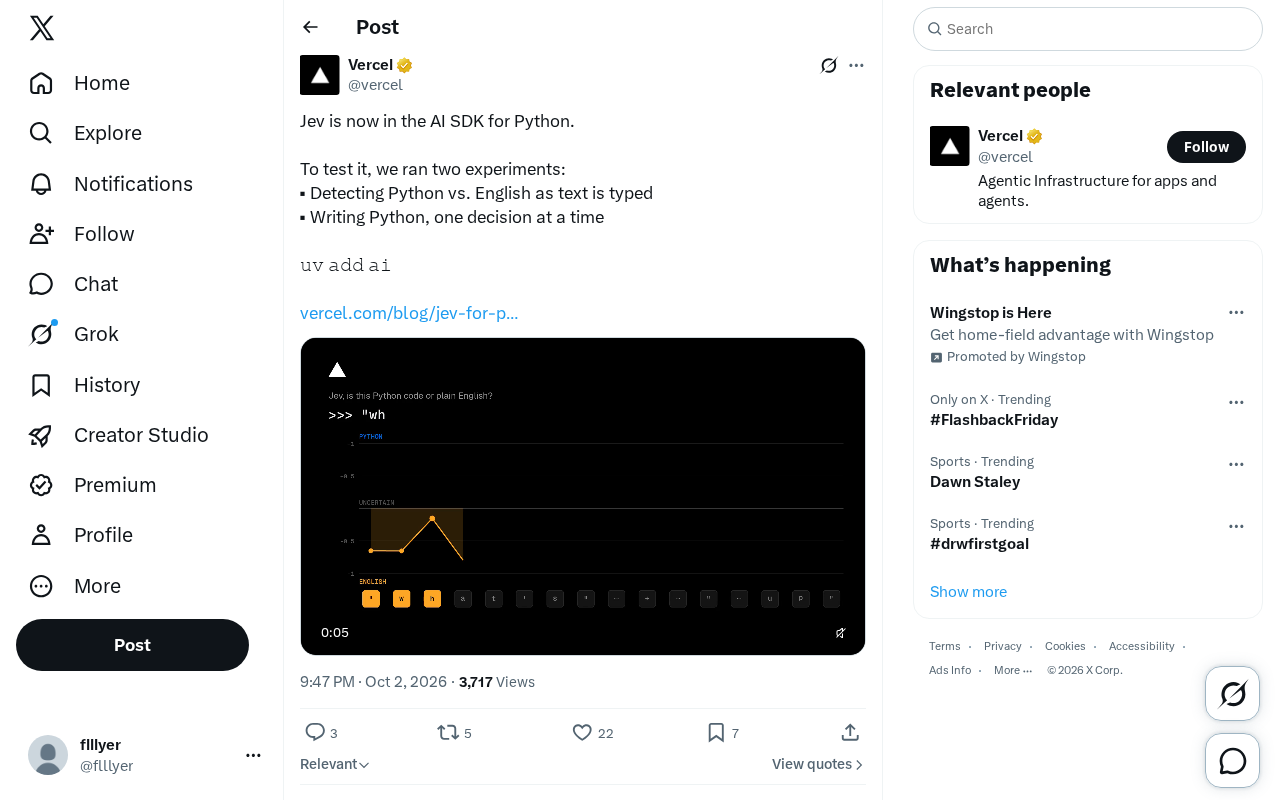
The first experiment focuses on real-time text classification: as a user types character by character, the system must instantly determine whether the input is Python code or plain English. This may sound straightforward, but it places demanding requirements on low-latency inference — the model must continuously update its judgment as characters stream in, rather than waiting for complete input before making a one-shot classification.
The value of this scenario lies in how closely it mirrors real editor experiences. Modern code editors need to understand context the instant a key is pressed in order to deliver appropriate syntax highlighting, autocomplete suggestions, or input mode switching. "Classify as you type" language detection is a foundational capability for this kind of intelligent experience.
At a technical level, real-time text classification typically relies on streaming inference: rather than waiting for complete input, the model begins outputting probability judgments after receiving a partial token sequence and continuously refines its results as new characters arrive. This places demands on both model architecture — which must produce meaningful judgments over short context windows — and the inference engine, which must compress Time To First Token (TTFT) below the threshold of human perception (typically around 100 milliseconds). In code editor contexts, these capabilities are often paired with the Language Server Protocol (LSP), forming the underlying foundation for features like intelligent autocomplete and dynamic syntax highlighting.
Experiment 2: Writing Python One Decision at a Time
The second experiment goes a step further, demonstrating incremental code generation: rather than producing an entire program in one shot, the model writes Python code "one decision at a time." This progressive generation style more closely resembles how human programmers think — first choosing variables, then working through logical branches, and finally filling in the details.
Step-by-step generation also improves controllability and interpretability. Compared to opaque, all-at-once output, staged generation gives developers the opportunity to intervene, review, or course-correct at each step — reducing the rework cost when a model goes off track.
Why This Kind of Integration Matters
Embedding AI capabilities deeply into a Python SDK reflects a larger trend: AI is moving from standalone service to a native component of the development toolchain. In the past, calling a model typically required a separate API layer and complex wrapper code. Now, a single uv add ai command is all it takes to pull inference capabilities into a project as an ordinary dependency — dramatically shortening the path from idea to prototype.
The two experiments are also deliberately chosen: one tests real-time responsiveness and low latency, the other tests generation quality and controllability. Together, they point toward a shared goal — making AI genuinely useful in the high-frequency editing and coding workflows developers live in every day, rather than remaining a demo-only capability.
Summary
Given the limited source material available, technical details, performance benchmarks, and underlying model information about Jev remain sparse. But the two experiments that have been made public make the integration's priorities clear: real-time interaction and incremental generation. For developers following the evolution of AI coding tools, this is a direction worth tracking. Once more documentation and benchmark data become available, its practical value will come into much sharper focus.
Related articles

Felix Rieseberg Personal Homepage
Felix Rieseberg's personal homepage sparks attention on Hacker News. This article covers the Slack engineer's technical background, the rise and fall of nativefier, and the value of a developer homepage as a tech calling card.

@ai-sdk/vue 3.0.306 Patch Release Syncs with [email protected] Update
@ai-sdk/vue 3.0.306 released, synced with [email protected]. A routine patch release for the Vercel AI SDK ecosystem with no public API changes; the Vue adapter layer stays version-aligned with the core package.

Gemini 4 Argon API Launches: The Era of Million-Token Output Begins
Google launches Gemini 4 Argon with sparse MoE architecture, up to 1M output tokens, and a 68.90% Vals Index score, available across API, AI Studio, and the Gemini app.