AI SDK for Vue Releases Patch Update 4.0.119

@ai-sdk/vue@4.0.119 released as a pure dependency-sync patch with no breaking changes.
Vercel's Vue adapter for AI SDK, `@ai-sdk/vue`, has released version 4.0.119 — a routine patch update focused on dependency synchronization with no breaking changes or new APIs. This release coordinates upgrades to core package `ai@7.0.119` and utility library `@ai-sdk/provider-utils@5.0.50`, inheriting upstream bug fixes by re-binding to updated dependencies. Teams in active development should consider upgrading to stay aligned with upstream fixes, while stable production environments may want to review the core package changelog first.
Vercel's AI SDK ecosystem has received a routine patch update, with @ai-sdk/vue@4.0.119 now officially released. This is a maintenance release focused primarily on dependency synchronization. While the scope of changes is modest, developers integrating large language model capabilities into Vue projects will still benefit from staying current.
Version Overview
This release was automatically triggered by GitHub Actions from Vercel's ai repository, with commits verified through GitHub's signature verification — making it an official release through proper channels. Based on the release notes, @ai-sdk/vue@4.0.119 centers on dependency updates (Patch Changes) and introduces no breaking changes.
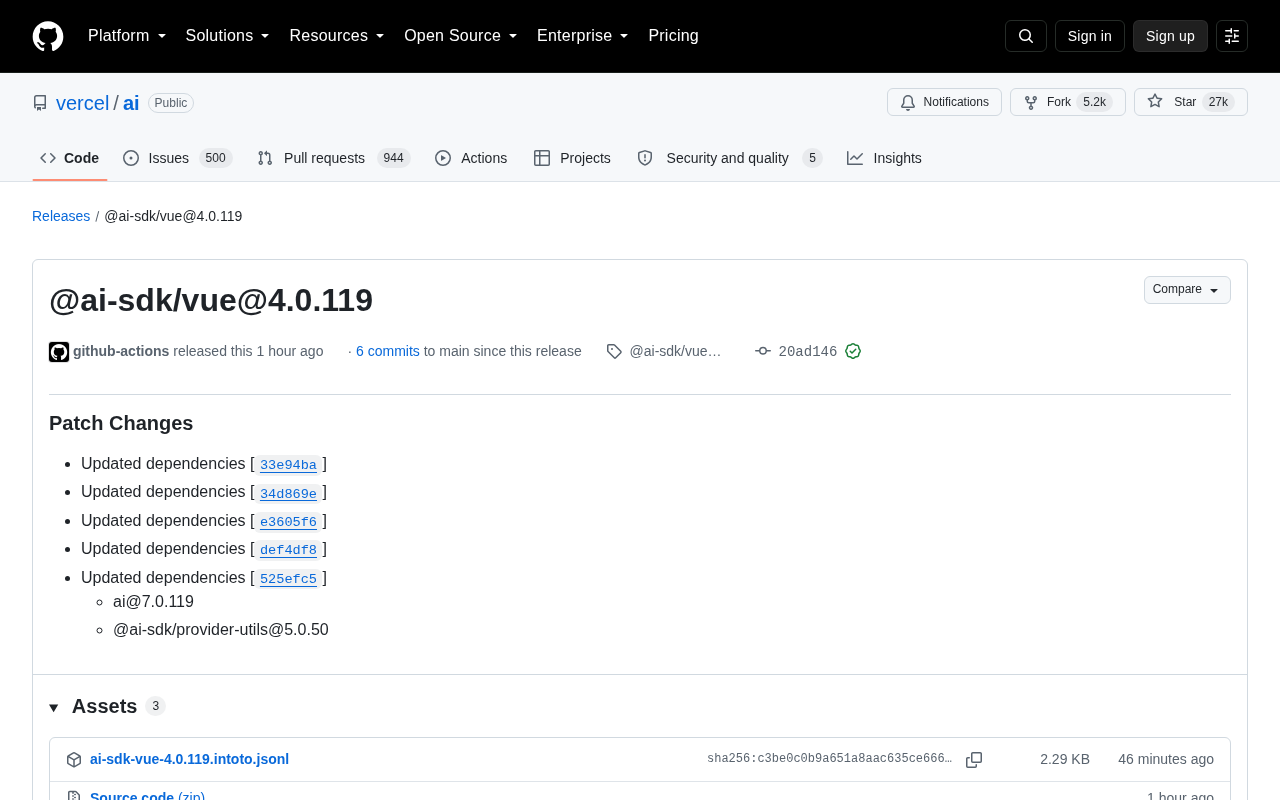
The release is accompanied by synchronized updates to the underlying core package ai@7.0.119 and the utility library @ai-sdk/provider-utils@5.0.50. This kind of coordinated upgrade is a hallmark of AI SDK's monorepo structure — once upstream core logic is adjusted, the framework-specific adapter layers (Vue, React, Svelte, etc.) receive corresponding patches to keep the entire ecosystem version-consistent.
What's in This Update
The release notes list multiple Updated dependencies entries, referencing commit hashes including 33e94ba, 34d869e, e3605f6, def4df8, and 525efc5. This means the Vue adapter package itself hasn't gained any new APIs — instead, it inherits upstream fixes and improvements by re-binding to the upgraded core dependencies.
For developers, the Semantic Versioning convention for Patch releases means this is a backward-compatible fix update, and upgrades should be safe to apply. If your project already uses @ai-sdk/vue, upgrading to 4.0.119 alongside the core packages is a sensible way to stay aligned with upstream fixes.
Semantic Versioning (SemVer) defines version numbers in a
MAJOR.MINOR.PATCHstructure: MAJOR changes introduce incompatible breaking API changes; MINOR changes add backward-compatible new features; PATCH changes contain only backward-compatible bug fixes. The119in@ai-sdk/vue@4.0.119is the PATCH segment, which theoretically guarantees that existing code won't encounter compatibility issues after upgrading. It's worth noting that "dependency updates" also fall under the PATCH category — when an upstream package fixes a bug affecting runtime behavior and publishes a new PATCH version, downstream packages re-lock their dependency versions to propagate that fix. This is a common "patch pass-through" pattern in monorepo ecosystems.
AI SDK and the Vue Ecosystem
Vercel AI SDK is one of the more mainstream toolkits for building large language model applications. It provides a unified interface for connecting to multiple model providers and ships framework-specific hooks and composables for different frontend frameworks. @ai-sdk/vue is the adapter layer for Vue developers, enabling them to quickly build chat interfaces, streaming responses, and other common AI interactions using the Composition API.
As the version numbers suggest, the Vue adapter package (4.x) and the core ai package (7.x) follow independent versioning cadences, but maintain release synchronization through matching trailing numbers (both at .119). The repository has accumulated over 27k stars and 5.2k forks on GitHub, reflecting a healthy and active community — a worthwhile factor when evaluating whether to adopt this SDK.
The core design philosophy of Vercel AI SDK is a "Provider Abstraction Layer" — developers call unified top-level functions like
generateTextandstreamText, while seamlessly switching between model providers such as OpenAI, Anthropic, Google Gemini, and Mistral without modifying business logic.@ai-sdk/vuebuilds on this foundation by providing composables likeuseChatanduseCompletion, abstracting the complexity of streaming response state management, error handling, and message history into reactive data — fully aligned with the Vue 3 Composition API paradigm. On the monorepo side, AI SDK uses Turborepo for multi-package management. Framework adapters like@ai-sdk/vue,@ai-sdk/react, and@ai-sdk/svelteare published as independent npm packages with their own version numbers, but share the same underlyingaicore package's type system and runtime logic. This is precisely why the core package and adapter layers need to maintain synchronized trailing-number releases.
Should You Upgrade Now?
Since this is a purely dependency-synchronized patch update with no meaningful functional changes, whether to upgrade depends on your specific situation. Teams in active development who want immediate access to upstream bug fixes can go ahead and update. Production environments running stably may prefer to review the upstream commits referenced in the changelog before making a decision.
It's recommended to check the specific change log for the ai@7.0.119 core package, as the actual benefits for the Vue adapter layer mainly originate there. Reviewing the details of those corresponding commits will help you more accurately determine whether this update touches any functionality your project depends on.
Related articles

JobRunner MCP Server: AI Agents Can Now Fix Failed Java Jobs
JobRunner launches an open-source MCP server enabling AI agents to view cluster status, diagnose failures, and recover Java jobs—incident response from any cloud coding environment or existing agent.

MLAI Digital Launches 9 Security Agents: MCP Server Safeguards the Full Lifecycle of Agentic AI
MLAI Digital launches Security MCP Server with nine built-in specialized security agents covering vulnerability discovery, attack simulation, prompt injection detection, API and infrastructure assessment, and accelerated remediation—embedding security validation across the full Agentic AI lifecycle from development to production.

Running Isaac Lab on H100 GPUs: Exploring Better Approaches
Exploring optimization methods for running Isaac Lab on NVIDIA H100 GPUs, including MIG configuration, mixed precision, TensorRT acceleration, and community experience to improve robotics simulation and reinforcement learning efficiency.