AI SDK OpenAI 3.0.121 Released: Adds GPT-6.1 Sol Model Support

Vercel AI SDK patch release adds support for calling OpenAI's GPT-6.1 Sol model.
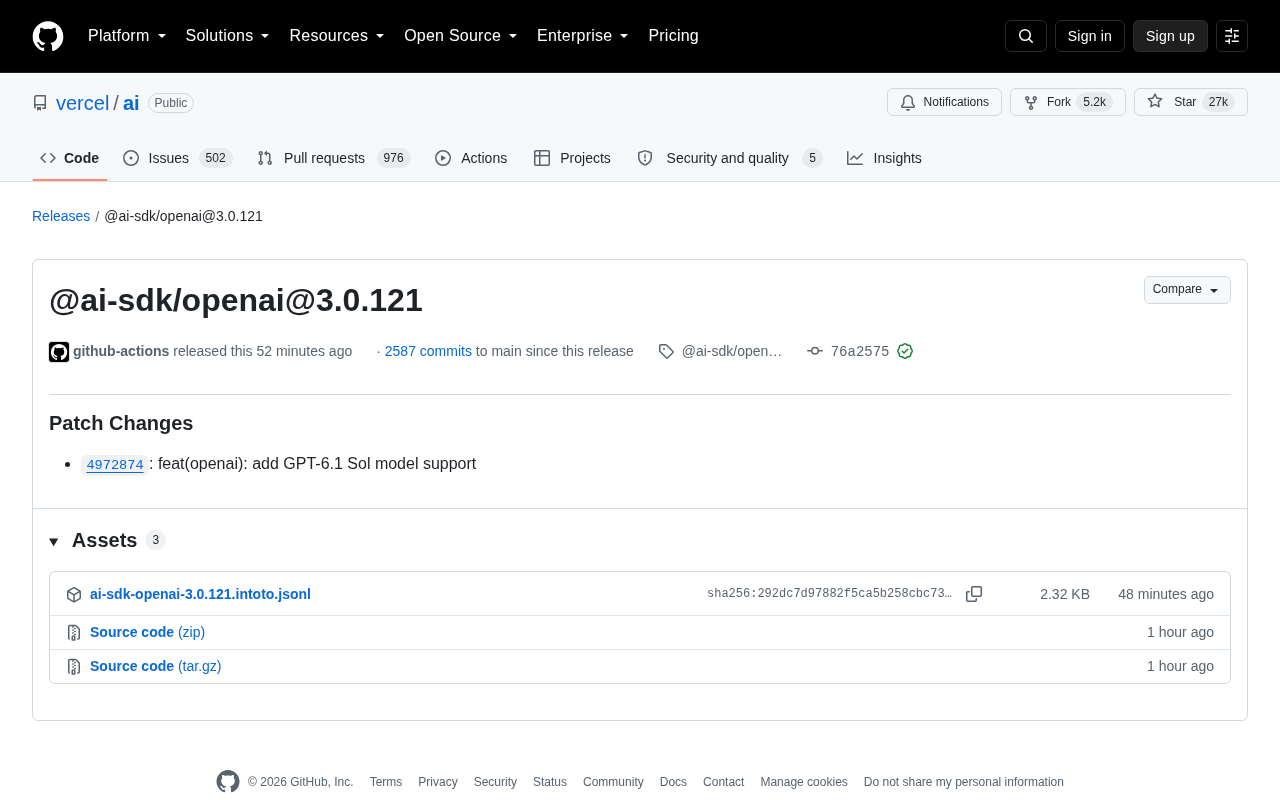
Vercel's AI SDK OpenAI provider package (`@ai-sdk/openai`) has released patch version 3.0.121, with the core change being added support for the GPT-6.1 Sol model. The release was automatically published via GitHub Actions with GPG signature verification. Thanks to the SDK's provider-split architecture, developers only need to upgrade the sub-package to access new models — no major version update required. Note that actual model availability still depends on OpenAI opening API access on their end.
Vercel's AI SDK has received a seemingly minor but noteworthy version update. @ai-sdk/openai@3.0.121 has been released as a patch update with a single core change: added support for the GPT-6.1 Sol model. For developers building applications on the Vercel AI SDK, this update means yet another new OpenAI model can be integrated directly through the standard interface.
What's in This Update
According to the release notes in Vercel's ai repository, version 3.0.121 is a patch-level update with commit hash 4972874, described as feat(openai): add GPT-6.1 Sol model support. This means developers can access the new model in existing projects without waiting for a major version bump.
The release was automatically published by GitHub Actions at 01:20 UTC on September 30, with a verified signature using GPG key ID B5690EEEBB952194, ensuring the authenticity of the published package.
The version number reflects that the AI SDK is well into its 3.x lifecycle, with a high release cadence — the repository has accumulated 2,587 commits since the previous version, underscoring the project's active development pace.
About the Vercel AI SDK
Vercel's ai repository is one of the most popular AI application development toolkits in the JavaScript/TypeScript ecosystem, with approximately 27k stars and over 5.2k forks. It provides a unified abstraction layer that allows developers to access large language models from different providers using a consistent API. @ai-sdk/openai is the official provider package within this ecosystem specifically designed for OpenAI models.
The provider-split architecture offers a key advantage: updates on the model provider side can be released independently without touching the main SDK package. Adding new model support exclusively to the OpenAI provider — as in this release — is a direct demonstration of this architectural benefit. Users only need to upgrade the relevant sub-package to gain access to new capabilities.
The engineering implementation of this provider-split architecture works as follows: the main SDK package (ai) defines only core interfaces and runtime logic — such as streaming, tool call orchestration, and message format specifications — while provider-specific integration details are encapsulated in independent sub-packages like @ai-sdk/openai, @ai-sdk/anthropic, and @ai-sdk/google. These sub-packages follow the same LanguageModelV1 protocol specification, enabling upper-layer application code to switch between models seamlessly, often without modifying business logic. This design draws inspiration from classic adapter patterns like JDBC, and in the context of rapidly evolving AI toolchains, it significantly reduces the maintenance burden of keeping up with new models.
What GPT-6.1 Sol Support Means
This update adds support for the GPT-6.1 Sol model. While the release notes don't detail the model's specific capabilities, adding support for a new model at the SDK level typically involves registering the model identifier, mapping parameters, and potentially adapting specific features such as streaming output and tool calling.
For developers, the actual usage experience is usually straightforward: after upgrading @ai-sdk/openai to 3.0.121, you can specify the new model name when initializing the provider. Patch updates like this almost never introduce breaking changes, making the upgrade cost minimal.
One important note: whether you can actually call this model depends on whether OpenAI has officially opened API access to it. SDK-level support only establishes the client-side call path.
Looking at OpenAI's model naming conventions, the "Sol" suffix is a relatively recent addition to their naming system. The general consensus in the community is that it refers to a variant optimized for a specific use case or fine-tuned for particular purposes — similar to how suffixes like "Turbo", "Mini", and "Nano" signal different positioning. At the SDK level, adding support for a new model typically involves registering the new model ID string in the model identifier enum, handling any parameter whitelist differences (e.g., some models don't support temperature or top_p), and declaring capability flags such as support for function calling, vision input, or structured output. If you encounter parameter errors after upgrading, consult the official OpenAI documentation to confirm the full set of supported parameters for that model.
What Developers Should Do
For teams currently using the Vercel AI SDK, two things are worth checking: first, confirm whether your account has access to GPT-6.1 Sol; second, pay attention to semantic versioning in provider packages — patch versions are generally safe to upgrade without concern.
This pattern of frequent small version releases also demonstrates that staying in sync with mainstream AI SDK release cycles is an effective way to keep your application aligned with the broader model ecosystem. For product teams looking to quickly adopt the latest models, keeping provider packages up to date is a low-cost, high-value practice.
Related articles

Chain of Thought Isn't Just for AI: How Humans Can Use CoT to Improve Thinking Quality
Chain of Thought isn't just a prompt trick for large models. Starting from a Hacker News discussion, this article analyzes why CoT works for human thinking too, breaks down actionable ways to transfer it, and highlights the key differences between human CoT and machine CoT.
Cloudflare Teams Up with OpenAI: Closi…
Cloudflare Teams Up with OpenAI: Closing the Loop from Vulnerability Discovery to Defense with AI
Cloudflare uses OpenAI Daybreak to investigate security vulnerabilities and generate reviewable remediation plans, while developers use Codex to boost coding efficiency and quality.

Orca Multi-Agent Orchestration in Practice: A Guide to Parallel Collaboration with Claude and Codex
Orca is Stable AI's free open-source agent workbench supporting 34 agents like Claude Code and Codex in parallel. Learn its Git worktree isolation, multi-model orchestration, and mobile management.