AI SDK React 3.0.333 Patch Update: Stability Considerations Behind the Dependency Upgrade

@ai-sdk/react releases patch 3.0.333, syncing only the core package ai@6.0.330 with no interface changes.
The article explains the essence of the @ai-sdk/react@3.0.333 patch release: it has no code-level feature changes itself, and its only change is updating the dependent ai core package to 6.0.330. The author points out that the React binding layer keeps its API stable, but fixes in the core package to underlying logic such as streaming responses, tool call parsing, and message serialization propagate through the dependency chain to the runtime behavior of Hooks like useChat and useCompletion—so "no new features" does not mean "no runtime changes." For migration, it is recommended to first check the ai package version in your project to avoid a mismatch between the binding layer and the core layer, and to run regression verification in the two scenarios of streaming conversation and tool calls. The article also explains the high-frequency, small-step release strategy behind the three-digit patch number, reminding teams to judge risk by change type rather than version digits.
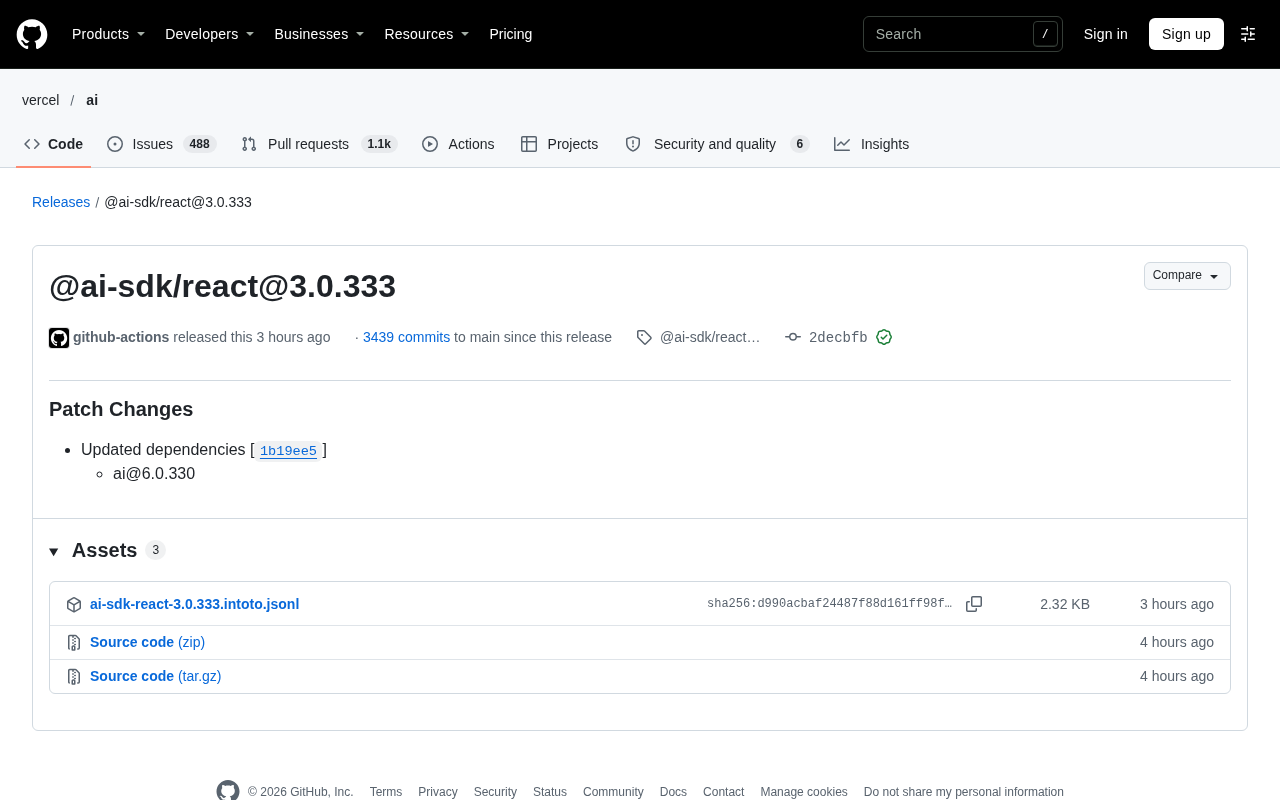
The React bindings package for the AI SDK has received a patch version update. @ai-sdk/react@3.0.333 was automatically published by GitHub Actions, and judging from the version number and change type, this is a typical maintenance update rather than a feature iteration. For frontend teams building React applications with the Vercel AI SDK, understanding the practical meaning of such patch versions is more valuable than chasing version numbers themselves.
What the Patch Change Actually Contains
According to the GitHub Release page, this version is explicitly marked as Patch Changes, and the only change is an updated dependency: ai@6.0.330.
This means @ai-sdk/react itself has no code-level feature changes—its change comes entirely from the version progression of the underlying core package ai. In the npm ecosystem, this kind of dependency linkage is common practice: the React binding layer keeps its API stable while following the patch-fix cadence of the core SDK, passing upstream low-level fixes down to downstream users.
The release information shows that the commit was published by the github-actions account on November 11 and carries a GitHub verified signature; the repository has accumulated 3439 commits since this version. These details indicate that the release process is highly automated, and signature verification ensures the traceability of the artifact's origin.
Why Dependency Updates Deserve Attention
Many developers ignore dependency updates in patch versions, assuming "no new features means no risk." But in fast-evolving libraries like the AI SDK, patches to the core package ai often involve fixes to underlying logic such as streaming response handling, tool call parsing, and message serialization—fixes that directly affect the runtime behavior of Hooks like useChat and useCompletion on the React side.
In other words, just because the React package writes no code doesn't mean runtime behavior is unchanged. Changes upstream in the dependency chain propagate through the runtime.
The essence of this update is: keep the interface surface of
@ai-sdk/reactstable while letting you receive the latest patch-level fixes from theaicore package.
The Underlying Dependencies of useChat and Streaming Responses
useChat is the most commonly used Hook in the AI SDK React bindings. It maintains the message list, initiates requests, and incrementally appends streaming tokens returned by the server to the UI. Internally, it relies on the core package to parse the SSE/Data Stream protocol, handle chunk boundaries, and assemble and backfill tool call parameter streams and results. Once these logics are adjusted in a patch—for example, fixing JSON truncation across chunks or changing the advancement order of the tool call state machine—the React component layer's code may not change by a single line, yet the typewriter effect users see and the timing of tool result rendering may change. Therefore, regression verification should focus on two points: whether messages are complete across multi-turn conversations, and whether tool call parameters and results appear in pairs in streaming scenarios.
Migration Recommendations for Existing Projects
For projects already using the AI SDK in production, upgrading to 3.0.333 is usually low-cost. The recommended order of operations is:
- First confirm the current version of the
aipackage in your project. If it is already at 6.0.330 or higher, upgrading the React bindings will not introduce additional dependency conflicts. - If an older core package is pinned, you need to check the
aiversion in sync when upgrading to avoid a mismatch between the binding layer and the core layer. - After upgrading, run a regression verification in two scenarios: streaming conversation and tool calls. These two scenarios are most sensitive to changes in underlying parsing logic.
For projects not yet integrated, starting with 3.0.333 is a relatively safe choice, because it pins a dependency combination that has gone through patch iterations.
What Semantic Versioning Actually Means in 0.x / High-Frequency Patch Projects
Standard SemVer specifies the MAJOR.MINOR.PATCH three-part scheme, where PATCH is used only for backward-compatible bug fixes. But in the actual npm ecosystem, many libraries do not strictly follow this convention. When a package advances to a three-digit patch number like 3.0.333 in a short time, it indicates extremely fine release granularity—almost every merged PR triggers a PATCH increment. At this point, the third segment of the version number no longer carries semantic information about "what was fixed"; it only indicates "there is a new artifact." The prudent engineering approach to such projects is: use lockfiles (package-lock.json, pnpm-lock.yaml) to pin the actually installed version; enable dependency update PRs in CI and configure automated tests; and base the choice between ^ and ~ on regression test coverage rather than intuition about version number digits.
Peer Dependency Issues Between the Core Package and the Binding Package
@ai-sdk/react depends on the ai core package, and the two share the same set of type definitions and runtime protocol. If npm resolves two incompatible ai versions during installation, problems such as duplicate types, type mismatches (type conflicts), or inconsistent runtime protocol versions may occur. Typical symptoms are TypeScript reporting that types like Message and ToolInvocation are not assignable, or the structure of objects returned by Hooks not matching the documentation. Troubleshooting methods include: running npm ls ai to check whether multiple copies of ai exist in the dependency tree; checking the version range declared in the peerDependencies field of @ai-sdk/react; and, if necessary, using overrides/resolutions to force a unified version. Only by understanding this relationship can you understand why this article repeatedly emphasizes "check the ai core package version before upgrading."
The Release Cadence Behind the Version Number
A three-digit patch number like 3.0.333 is uncommon in conventional semantic versioning practice. It reflects the AI SDK team's high-frequency, small-step release strategy: each merged PR may trigger a patch release. The benefit of this cadence is that fixes reach users quickly; the cost is rapid version number inflation, requiring users to rely more on lockfiles than on version numbers themselves to judge stability.
For teams, a more pragmatic approach is to focus on the change type rather than the version digits. Releases like this one, marked as Patch Changes and involving only dependency updates, are low-risk updates; only when patches contain API-level fixes or behavior changes do you need more cautious regression testing.
Summary
@ai-sdk/react@3.0.333 itself introduces no new capabilities; its value lies in bringing the latest patches of the core package to React users. Treating it as a dependency sync rather than a feature upgrade is the right way to understand this kind of version.
One-line Summary
@ai-sdk/react releases patch 3.0.333, syncing only the core package ai@6.0.330 with no interface changes.
Paragraph Summary
The article explains the essence of the @ai-sdk/react@3.0.333 patch release: it has no code-level feature changes itself, and its only change is updating the dependent ai core package to 6.0.330. The author points out that the React binding layer keeps its API stable, but fixes in the core package to underlying logic such as streaming responses, tool call parsing, and message serialization propagate through the dependency chain to the runtime behavior of Hooks like useChat and useCompletion—so "no new features" does not mean "no runtime changes." For migration, it is recommended to first check the ai package version in your project to avoid a mismatch between the binding layer and the core layer, and to run regression verification in the two scenarios of streaming conversation and tool calls. The article also explains the high-frequency, small-step release strategy behind the three-digit patch number, reminding teams to judge risk by change type rather than version digits.
Related articles

Abnormal Error Rate Spike in Claude Mythos 5.2 and Fable 5.2
Claude Mythos 5.2 and Claude Fable 5.2 show an abnormal spike in request error rates, marked as investigating on the official status page. This article covers the incident overview, practical impact on developers, and recommended responses.

ReAct Runtime Context Trimming: Why Claude Code Acts at 70%
A deep dive into ReAct runtime context trimming: why Claude Code compresses at ~70% usage, why tool calls dominate, why messages must be dropped in pairs, and why codebases don't need RAG.

AI Agent vs LLM: How Cursor and Claude Code Actually Work
An in-depth analysis of the essential difference between AI Agents and LLMs: LLMs generate code suggestions, while Agents modify files and run tests via tool calls. Using a Spring Boot bug fix as an example, it breaks down the workflows, permission control, and verification mechanisms of Cursor and Claude Code.