AI SDK Release Update: sandbox-just-bash Component Overview

AI SDK sandbox-just-bash releases patch v1.0.147, synced with harness in a routine automated update.
`@ai-sdk/sandbox-just-bash@1.0.147` is a patch-level release in the AI SDK ecosystem, automatically triggered by GitHub Actions and verified via GPG signature. The component name suggests it handles bash script execution in an isolated sandbox for AI Agent toolchains. This update syncs the related `@ai-sdk/harness@1.0.147` dependency, reflecting a monorepo unified versioning strategy. As the source material is purely automated release metadata with no changelog, developers should review official diffs for specifics. The patch-level change is low-risk and safe to upgrade.
This is an automated release record from GitHub involving the @ai-sdk/sandbox-just-bash component in the AI SDK ecosystem, versioned at 1.0.147. Since the original source material consists only of release tag metadata with no substantive feature descriptions or technical details, the following content is limited to what the available information allows.
Release Overview
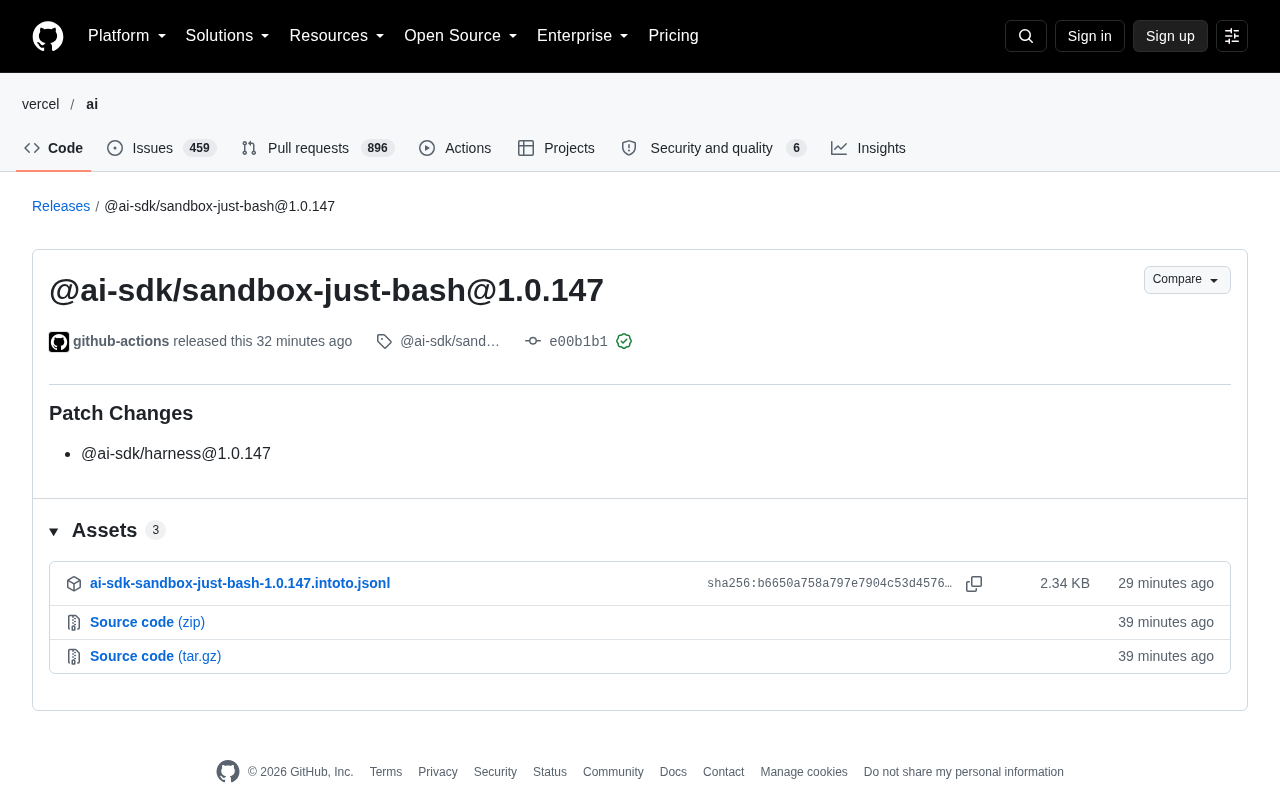
According to the GitHub release record, @ai-sdk/sandbox-just-bash@1.0.147 was automatically published by the github-actions bot on October 9th at 00:39 UTC. The commit (e00b1b1) carries a verified GitHub signature (GPG key ID: B5690EEEBB952194), making this a trusted release.
From its name, this component belongs to the AI SDK project family. The sandbox-just-bash naming suggests it's related to some kind of sandbox execution environment — likely used to run bash scripts or commands in an isolated context, a common pattern in AI Agent toolchains that require secure code execution.
What Changed in This Version
This release is labeled as a Patch Change, meaning it's a minor revision that typically doesn't involve breaking changes or significant new features — it's intended for bug fixes, dependency synchronization, or general maintenance.
The release notes explicitly mention an associated dependency update: @ai-sdk/harness@1.0.147. This indicates that sandbox-just-bash and harness are kept in version sync, which is a typical reflection of monorepo management and unified versioning strategies — when one package is updated, related packages are published together to ensure compatibility.
What is a Monorepo? A monorepo is an engineering strategy where multiple related projects or packages are managed within a single repository, as opposed to the polyrepo model where each package lives in its own repo. In ecosystems like AI SDK — composed of many sub-packages — a monorepo combined with unified versioning tools (such as Changesets or Lerna) ensures that inter-package dependencies stay aligned. When a foundational package like
harnesschanges, all packages that depend on it are updated and published together in the same release cycle, preventing version drift and compatibility issues. The fact thatsandbox-just-bashandharnessshare the same version number (1.0.147) is a direct result of this strategy.
What This Means for Users
For developers building applications with AI SDK, patch-level updates are generally safe to apply. These updates follow Semantic Versioning (SemVer) conventions — an incremented patch number indicates a backward-compatible fix, making the upgrade low-risk.
However, since the original release record doesn't include a detailed changelog, exactly what was fixed and whether it affects existing integrations will require developers to review the project's full changelog or compare commit diffs. It's recommended to validate sandbox execution functionality in a test environment before applying updates to production.
What is Semantic Versioning (SemVer)? SemVer is the widely adopted convention for software package versioning, using the format
MAJOR.MINOR.PATCH. An increment to the major version indicates breaking changes, a minor version increment means new backward-compatible features were added, and a patch increment represents only backward-compatible bug fixes or internal adjustments. In1.0.147, the patch number going from 146 to 147 means — per SemVer — that users can upgrade without worrying about API-level compatibility breaks. That said, this guarantee only holds if the publisher strictly follows SemVer semantics. For automated bulk releases, it's still worth confirming against the actual diff.
A Note on Information Limitations
To be transparent: this source material is essentially an automated build artifact release notification, not a technically substantive announcement. The available information cannot speak to the component's core purpose, API design, performance characteristics, or its role within the broader AI SDK toolchain.
Developers interested in this component are encouraged to visit the official AI SDK GitHub repository and documentation directly for first-hand feature descriptions and usage examples, enabling more informed technical decisions.
Related articles

Chain of Thought Isn't Just for AI: How Humans Can Use CoT to Improve Thinking Quality
Chain of Thought isn't just a prompt trick for large models. Starting from a Hacker News discussion, this article analyzes why CoT works for human thinking too, breaks down actionable ways to transfer it, and highlights the key differences between human CoT and machine CoT.
Cloudflare Teams Up with OpenAI: Closi…
Cloudflare Teams Up with OpenAI: Closing the Loop from Vulnerability Discovery to Defense with AI
Cloudflare uses OpenAI Daybreak to investigate security vulnerabilities and generate reviewable remediation plans, while developers use Codex to boost coding efficiency and quality.

Orca Multi-Agent Orchestration in Practice: A Guide to Parallel Collaboration with Claude and Codex
Orca is Stable AI's free open-source agent workbench supporting 34 agents like Claude Code and Codex in parallel. Learn its Git worktree isolation, multi-model orchestration, and mobile management.