AI SDK Releases @ai-sdk/topaz@2.0.4 Patch Update

@ai-sdk/topaz@2.0.4 released, essentially a dependency patch syncing provider-utils to 4.0.61.
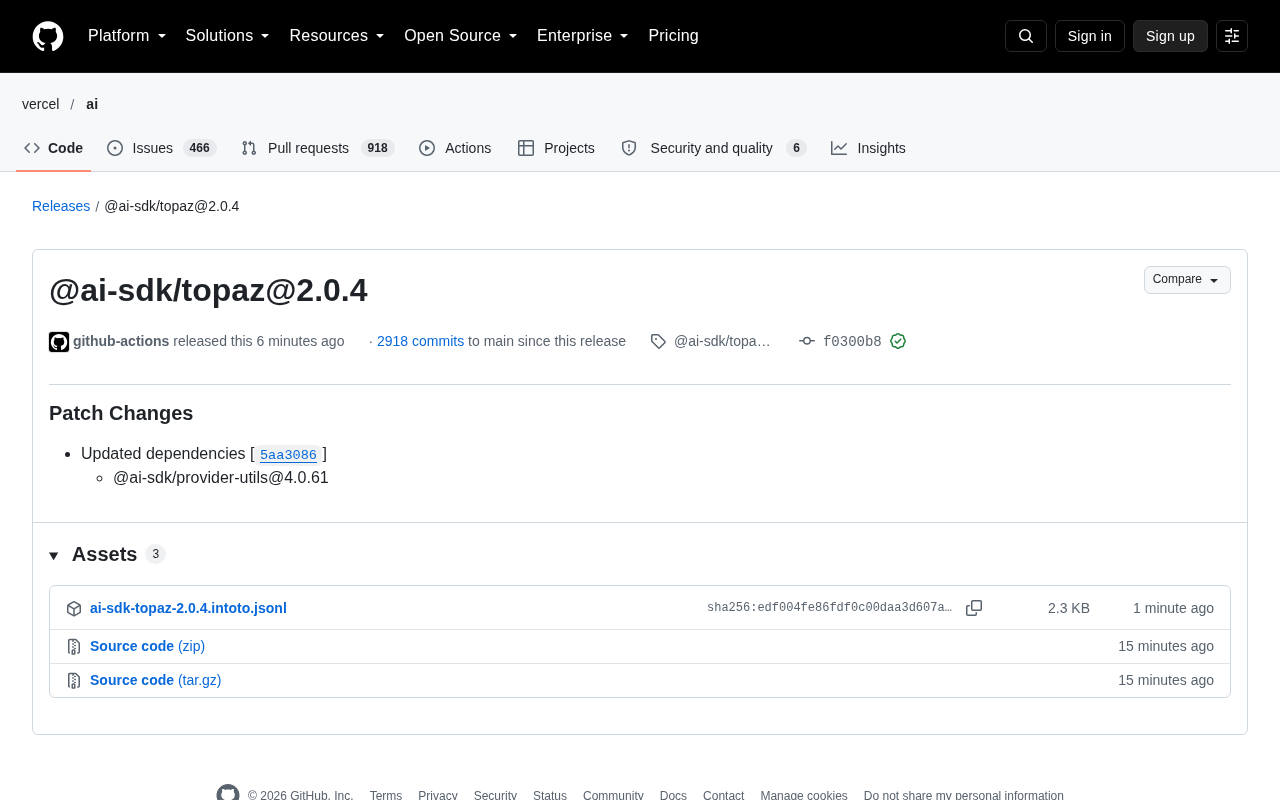
`@ai-sdk/topaz@2.0.4` is a typical patch-level release, only updating the underlying dependency `@ai-sdk/provider-utils` to `4.0.61` (commit `5aa3086`), without new APIs or features. In the AI SDK monorepo, such updates are dependency graph synchronization: upstream `provider-utils` handles request wrapping, streaming parsing, and error handling, and its fixes propagate to all dependent packages. The release is automated by github-actions with GPG signatures for supply chain traceability. The 2918 commits on main since the last release reflect overall repo activity. Upgrade risk is minimal, mainly avoiding version drift.
The AI SDK ecosystem has once again received a maintenance update. On GitHub, version @ai-sdk/topaz@2.0.4 has been officially released. This is a typical patch-level upgrade, with the core action being an update to its dependency on the underlying toolkit @ai-sdk/provider-utils, pinned at commit 5aa3086, corresponding to version 4.0.61.
A Small but Clear Patch Release
Judging from the release record, this update introduces virtually no new APIs or features. The commit history shows 2918 commits accumulated on the main branch since the previous version, but @ai-sdk/topaz@2.0.4 itself does only one thing — advancing @ai-sdk/provider-utils from the old version to 4.0.61. The version number stops at 2.0.4, indicating it belongs to the 2.0.x maintenance line. In semantic versioning, a change in the third digit signifies a backward-compatible fix or dependency refresh.
This release pattern is common in the AI SDK monorepo. Rather than an independent product action, it's more of a result of dependency graph synchronization: when the upstream provider-utils releases a fix, downstream adapter layers (here, topaz) need to follow suit to ensure that projects using that adapter layer get consistent underlying behavior.
Semantic Versioning (SemVer) is a widely adopted version numbering convention in the open-source ecosystem, with the format MAJOR.MINOR.PATCH. An increment in the major version means breaking API changes, a minor version increment represents backward-compatible feature additions, and a patch increment corresponds to backward-compatible bug fixes or dependency refreshes. @ai-sdk/topaz advancing to 2.0.4 with major and minor numbers unchanged and only the patch digit changed is exactly the minimal impact level defined by SemVer.
In a monorepo, such patch number changes are often not triggered by the package's own code changes but driven by dependency graph changes. When a downstream dependency pinned by a package is refreshed, even if its own source code hasn't changed a single line, a new version still needs to be released to solidify the new dependency combination. This is precisely the behavioral pattern of 2.0.4, and it's the key to understanding the nature of this release.
Why the provider-utils Update Deserves Attention
@ai-sdk/provider-utils is the module in the AI SDK that carries common provider logic, typically involving request wrapping, streaming response parsing, error handling, and parameter validation. Changes in the 4.0.61 version propagate through the dependency chain to all packages that reference it.
For developers, this means: if your project pins @ai-sdk/topaz@2.0.4, you indirectly get the behavior of provider-utils@4.0.61. Patch-level updates usually don't change public interfaces, but they may fix streaming handling in edge cases, type definitions, or compatibility issues. Before upgrading, it's recommended to check the changes in the corresponding provider-utils commit to confirm whether it touches the provider you're using.
In the npm ecosystem, lockfile (such as package-lock.json, yarn.lock, pnpm-lock.yaml) is used to precisely record the actual version of each package in the dependency tree, ensuring that installations on different machines at different times produce exactly the same result. When a package indirectly depends on @ai-sdk/provider-utils, even if your package.json only declares @ai-sdk/topaz, the lockfile will also pin the specific version of provider-utils.
So-called "multi-package version drift" refers to the appearance of multiple incompatible copies of the same package in the same dependency tree, leading to inconsistent runtime behavior. Monorepos avoid drift by having downstream packages follow upstream version releases, converging the entire dependency chain to a single version. After upgrading topaz, developers should check whether the provider-utils entry in the lockfile has been updated accordingly, to prevent the situation where the project is actually still using the old version.
The Information Behind the Numbers
There's an easily overlooked number in the release record: 2918 commits on the main branch since the last release. This doesn't mean topaz itself underwent 2918 modifications, but rather reflects the activity level of the entire repository — the AI SDK is a multi-package parallel engineering effort, with a large number of commits coming from other packages, documentation, tests, and CI configuration.
Meanwhile, this release was executed by the github-actions bot, with commits bearing a GitHub verified signature (GPG key ID B5690EEEBB952194), indicating that the release process is highly automated and integrity-verified. For teams sensitive to supply chain security, such signature information is a direct basis for judging the trustworthiness of a package's origin.
GPG signatures (GNU Privacy Guard signatures) verify the origin and integrity of commits or release packages through asymmetric encryption. Even if an attacker tampers with the content, they cannot forge a valid signature. GitHub attaches verified signatures to commits generated by automated builds. The key ID B5690EEEBB952194 appearing in this release is such a public key identifier.
In the field of software supply chain security, signatures only solve two problems: "trustworthy origin" and "content not tampered with." They do not guarantee that the code itself is harmless. Therefore, they are often used in conjunction with measures such as SBOM (Software Bill of Materials) and dependency auditing (e.g., npm audit). For teams with higher compliance requirements, comparing signature fingerprints and retaining release records are standard practices for tracing dependency origins.
How Developers Should Respond
If you're using @ai-sdk/topaz, the cost of upgrading to 2.0.4 is essentially negligible. The main benefit is staying consistent with provider-utils@4.0.61, avoiding hidden bugs caused by multi-package version drift. If your project locks dependencies via a lockfile, a routine dependency refresh is all that's needed.
It's worth noting that the specific provider corresponding to the topaz adapter layer is not elaborated in this release note; the Release page only lists dependency changes. Therefore, the actual impact of this update depends on what provider-utils@4.0.61 itself fixes. In the absence of a detailed changelog, treating it as a routine synchronization is more prudent than over-interpreting it.
Summary
@ai-sdk/topaz@2.0.4 is a standard dependency synchronization patch: small in action, narrow in scope, but it ensures internal consistency within the AI SDK multi-package system. For ordinary users, the risk of following the upgrade is extremely low; for maintainers, such releases are a necessary rhythm for keeping the monorepo healthy. The truly noteworthy signal still lies in the details of the provider-utils changes.
One-line Summary
@ai-sdk/topaz@2.0.4 released, essentially a dependency patch syncing provider-utils to 4.0.61.
Paragraph Summary
@ai-sdk/topaz@2.0.4 is a typical patch-level release, only updating the underlying dependency @ai-sdk/provider-utils to 4.0.61 (corresponding commit 5aa3086), without introducing new APIs or features. Such updates are dependency graph synchronization in the AI SDK monorepo: the upstream provider-utils carries common provider logic such as request wrapping, streaming response parsing, and error handling, and its fixes propagate along the dependency chain to all packages that reference it. The release is automatically executed by github-actions with GPG signatures, making the supply chain traceable. Since the previous version, 2918 commits have accumulated on the main branch, reflecting the activity of the entire repository rather than topaz alone. The upgrade cost for developers is extremely low, with the main benefit being avoidance of multi-package version drift.
Related articles

Chain of Thought Isn't Just for AI: How Humans Can Use CoT to Improve Thinking Quality
Chain of Thought isn't just a prompt trick for large models. Starting from a Hacker News discussion, this article analyzes why CoT works for human thinking too, breaks down actionable ways to transfer it, and highlights the key differences between human CoT and machine CoT.
Cloudflare Teams Up with OpenAI: Closi…
Cloudflare Teams Up with OpenAI: Closing the Loop from Vulnerability Discovery to Defense with AI
Cloudflare uses OpenAI Daybreak to investigate security vulnerabilities and generate reviewable remediation plans, while developers use Codex to boost coding efficiency and quality.

Orca Multi-Agent Orchestration in Practice: A Guide to Parallel Collaboration with Claude and Codex
Orca is Stable AI's free open-source agent workbench supporting 34 agents like Claude Code and Codex in parallel. Learn its Git worktree isolation, multi-model orchestration, and mobile management.