AI SDK Releases @ai-sdk/zai@1.0.10 Patch Update

@ai-sdk/zai releases 1.0.10 patch, only synchronizing two core dependencies, with no new features.
@ai-sdk/zai releases patch version 1.0.10, with the core change being synchronized upgrades of the dependency chain: @ai-sdk/openai-compatible bumped to 1.0.61 and @ai-sdk/provider-utils bumped to 3.0.44, both driven by the same commit. This version introduces no new APIs or feature capabilities, and is a maintenance release for version alignment with the AI SDK core toolchain. The article notes that provider-utils iterations typically involve foundational capabilities such as streaming response handling and request wrapping, while openai-compatible maps Zhipu's capabilities to the AI SDK's unified invocation paradigm. Developers are advised to upgrade according to the standard patch process, verify model invocation and streaming output paths in a small scope, and watch for type mismatch issues from multiple versions coexisting in the dependency tree.
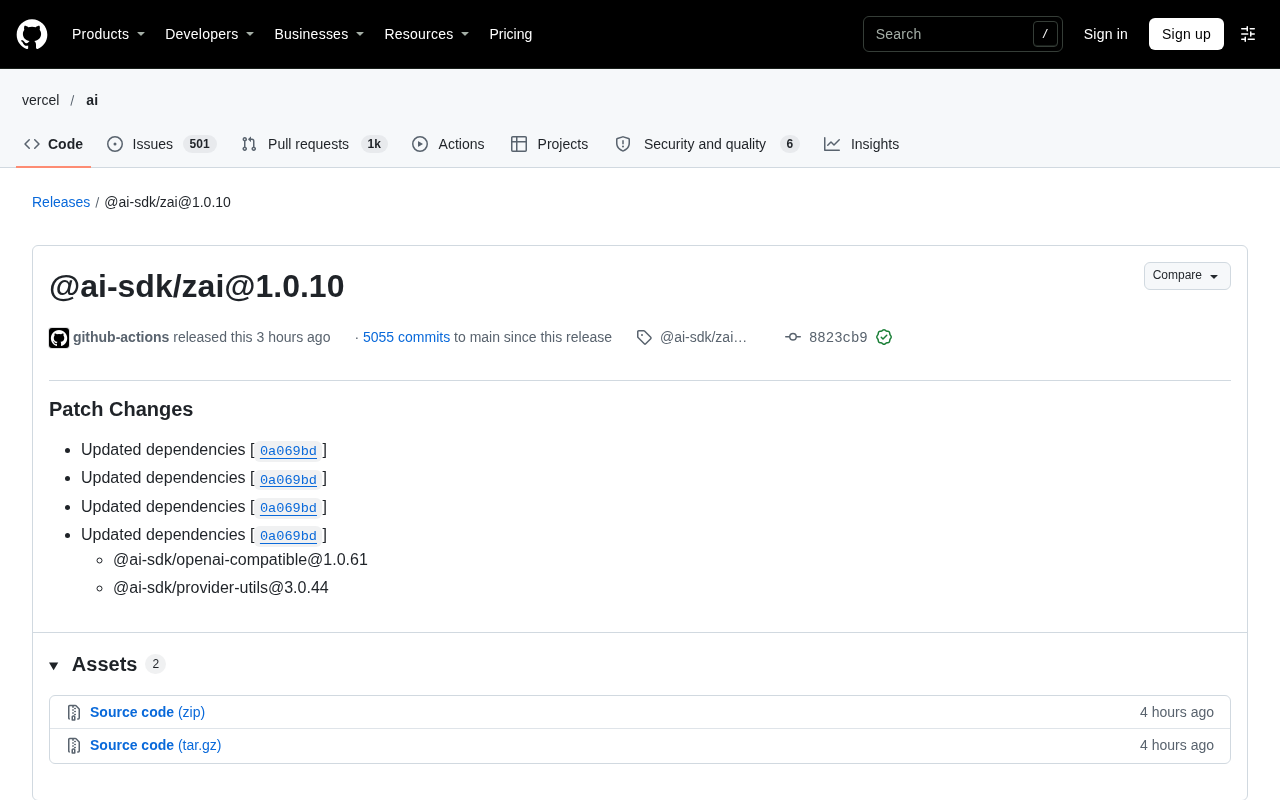
The Zhipu AI adapter package @ai-sdk/zai in the AI SDK ecosystem has received a 1.0.10 update. This is a patch release, with the core changes centered on synchronized upgrades of the dependency chain.
Patch Content: Transitive Dependency Updates
According to the GitHub release notes, the change type for @ai-sdk/zai@1.0.10 is marked as Patch Changes, with the commit message reading "Updated dependencies." Specifically, this update bumps @ai-sdk/openai-compatible to version 1.0.61 and @ai-sdk/provider-utils to version 3.0.44.
Based on the release notes, this version does not introduce new APIs or feature capabilities, but instead keeps version alignment with the AI SDK core toolchain through dependency upgrades. Commit 0a069bd is referenced multiple times, indicating that multiple dependencies were driven by the same commit.
The role of @ai-sdk/openai-compatible: This is an "adapter" layer in the AI SDK ecosystem, whose purpose is to wrap any third-party model service that follows an OpenAI Chat Completions-style interface (Zhipu AI, DeepSeekAd, Moonshot, etc.) into a Provider interface consistent with the official @ai-sdk/openai. Developers can therefore reuse unified APIs such as generateText and streamText without writing different invocation code for each vendor. Its version iterations typically follow interface adjustments in the upstream openai provider, with patch-level changes mostly involving request parameter mapping, response field parsing, and error format compatibility.
The role of @ai-sdk/provider-utils: This is the underlying utility package shared by all Providers, encapsulating common logic such as request construction, response stream parsing, SSE chunk processing, and error normalization. The reason "streaming output" in the AI SDK behaves consistently across different vendors largely depends on this package's abstraction of asynchronous iterators and ReadableStream. It is a typical "transitive dependency"—developers generally do not import it directly, but its behavioral changes affect actual invocations through upper-layer providers.
Practical Impact on Developers
For developers using @ai-sdk/zai, this type of patch update typically means fixes to underlying compatibility and utility functions. As the common utility package of the provider abstraction layer, @ai-sdk/provider-utils version iterations often involve adjustments to foundational capabilities such as streaming response handling and request wrapping.
The synchronized upgrade of @ai-sdk/openai-compatible is worth noting. Zhipu AI's interface is designed in a style similar to OpenAI compatibility, and this package is responsible for mapping Zhipu's capabilities to the AI SDK's unified invocation paradigm. Patch-level version changes generally do not break existing invocation code, but it is recommended to verify key paths such as model invocation and streaming output after upgrading.
Versioning Strategy and Upgrade Recommendations
This release was automatically triggered by github-actions, and the commit count shows that 5055 commits have entered the main branch since the previous version, reflecting that the AI SDK repository as a whole is in a state of high-frequency iteration.
Dependency version numbers use patch-level increments, in line with semantic versioning conventions. For production environments, it can be handled according to the standard patch upgrade process: first verify in a small-scale environment, confirm that the new versions of @ai-sdk/openai-compatible and @ai-sdk/provider-utils do not conflict with existing code, and then roll out fully.
If you are using the AI SDK to build Zhipu AI-related applications, it is recommended to check the actual versions of these two packages in the dependency tree to avoid type mismatch issues caused by multiple versions coexisting in the same project.
Semantic versioning and "Updated dependencies" releases: In the npm ecosystem, a patch-level (third digit) increment indicates a backward-compatible fix, a minor-level increment indicates new functionality, and a major-level increment indicates a breaking change. Dependency bots (such as Renovate, Dependabot) or a monorepo's automated release process often generate a changeset containing only "Updated dependencies" for downstream packages after a core package upgrade, thereby triggering a patch release.
Multiple version coexistence and type mismatch: When a project indirectly depends on multiple versions of @ai-sdk/provider-utils, npm/pnpm may install them separately in nested node_modules. In this case, the type definitions used by different Provider instances (especially genericized streaming response types) may come from different versions, causing TypeScript compilation to pass but structural inconsistency at runtime, or reporting "two types with the same name are incompatible" during type checking. Using npm ls @ai-sdk/provider-utils or pnpm's why command to check the dependency tree, and forcing version unification through overrides/resolutions when necessary, are common means of troubleshooting such issues.
Summary
@ai-sdk/zai@1.0.10 is a maintenance release focused primarily on dependency synchronization, with no new features at the functional level. Its value lies in keeping the Zhipu adapter layer in sync with the latest AI SDK toolchain, reducing hidden friction during cross-version integration.
One-line Summary
@ai-sdk/zai releases 1.0.10 patch, only synchronizing two core dependencies, with no new features.
Paragraph Summary
@ai-sdk/zai releases 1.0.10 patch version, with the core change being synchronized upgrades of the dependency chain: @ai-sdk/openai-compatible bumped to 1.0.61 and @ai-sdk/provider-utils bumped to 3.0.44, both driven by the same commit. This version introduces no new APIs or feature capabilities, and is a maintenance release for version alignment with the AI SDK core toolchain. The article notes that provider-utils iterations typically involve foundational capabilities such as streaming response handling and request wrapping, while openai-compatible is responsible for mapping Zhipu's capabilities to the AI SDK's unified invocation paradigm. Developers are advised to upgrade according to the standard patch process, verify model invocation and streaming output paths in a small scope, and pay attention to type mismatch issues that may arise from multiple versions coexisting in the dependency tree.
Related articles

AI Tools Quietly Altering Settings: Postman Silently Installs Plugin, Codex Sharing Option Auto-Resets
AI Daily reports: Postman silently installs a Mac plugin and self-approves startup hooks, logged as auto-existing upgrade; Hacker News developers say Codex data-sharing opt-out flips back. Plus Simon Willison's raw float weight experiment with QEN 3.8-27B.

AI Learns to Rewrite AI: MIT's "Weightspace Programming" Redraws the Path to Recursive Self-Improvement
MIT team proposes weightspace programming: GPT-6 Astra reads and edits AI model weights directly. Math scores jump several-fold, hand-written networks beat trained models. Eight experiments analyzed, plus Anthropic's same-day warning and the real boundaries of recursive self-improvement.

Running Qwen 3.8 on a Laptop to Read Raw Weights: 46 Minutes Per Answer
Simon Willison reproduced weight space programming with Qwen 3.8 27B on a laptop: a 17GB model file, 46 minutes per answer, 43,506 reasoning tokens, Pong over an hour, Freeway failed. Suited for interpretability researchers.