AI SDK Releases @ai-sdk/zai 2.0.17 Patch Update
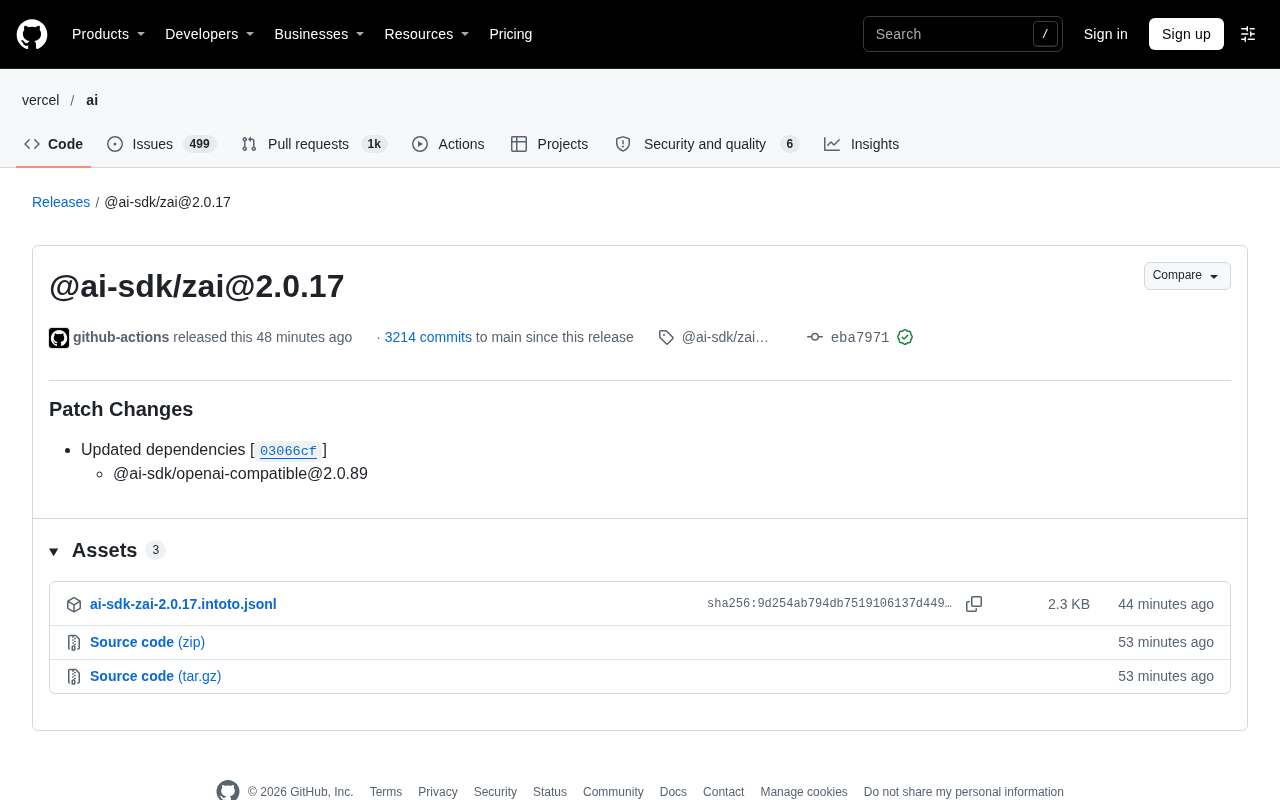
@ai-sdk/zai 2.0.17 is released, only syncing the upstream openai-compatible dependency to 2.0.89; it is a maintenance patch update.
Vercel's AI SDK project has released version 2.0.17 of `@ai-sdk/zai`, the official Provider package for Zhipu AI, with only one change: syncing the dependency `@ai-sdk/openai-compatible` to 2.0.89. The article notes that the package reuses the openai-compatible adapter layer to connect to Zhipu's OpenAI-compatible API, avoiding duplicate implementation of request construction and streaming parsing. Although the changelog is minimal, dependency alignment lets downstream users automatically obtain upstream fixes for streaming boundaries, parameter pass-through, and fault tolerance—a typical form of "plumbing maintenance" in a multi-Provider ecosystem. For users, upgrading is low-risk and does not involve public interface changes; if evaluating integration with Zhipu models, the focus should be on verifying how well the general adapter covers private parameters and multimodal formats.
A Low-Key Dependency Sync
The AI SDK project under Vercel recently released version 2.0.17 of @ai-sdk/zai. Judging from the GitHub Release page, this is a standard patch update (Patch Changes) with only one change: syncing the dependency @ai-sdk/openai-compatible to version 2.0.89.
There are no new features, no API change notes, and no breaking change warnings. For developers following the AI SDK ecosystem, releases like this are more a reflection of maintenance cadence than a feature milestone worth extensive coverage.
What Problem This Package Solves
@ai-sdk/zai is the official Provider package that AI SDK provides for Zhipu AI (Z.ai). The core design of AI SDK is to unify the calling interfaces of different model vendors into a single abstraction, so developers can switch underlying models using the same set of APIs such as generateText and streamText. Provider packages are responsible for adapting each vendor's HTTP protocol, authentication method, and streaming response format to this abstraction.
The reason this package depends on @ai-sdk/openai-compatible is that Zhipu's API is designed to be compatible with OpenAI's interface shape. Reusing the openai-compatible adapter layer avoids reimplementing common logic such as request construction, streaming parsing, and error handling, and also allows upstream fixes and optimizations to propagate automatically.
AI SDK's Provider mechanism: AI SDK (formerly Vercel AI SDK) uses a layered architecture. The core layer only defines vendor-agnostic abstract interfaces, such as LanguageModelV1, generateText, streamText, and tool calls. The code that actually communicates with a specific model service is isolated in separate Provider packages, such as @ai-sdk/openai, @ai-sdk/anthropic, and @ai-sdk/google. Each Provider package implements two things: translating unified API call parameters into HTTP requests for the target vendor, and parsing vendor responses (especially SSE streaming chunks) back into unified streaming events. This design keeps upper-layer business code from being tied to a specific model; switching Providers only requires replacing an instance. Provider packages are usually published as independent npm packages and iterate with independent version numbers, which is why patch releases like the one in this article occur—where the package itself has no code changes and only follows upstream dependencies.
OpenAI-compatible protocol and the openai-compatible adapter layer: "OpenAI-compatible interface" means that a vendor exposes an HTTP service following the request/response structure of OpenAI Chat Completions, including the messages array format, choices[].delta streaming chunks, finish_reason semantics, and the function-calling conventions of tools/tool_calls. @ai-sdk/openai-compatible is the general adapter provided for such services: it is not tied to a single vendor but exposes configuration such as baseURL, apiKey, and headers, which users point to compatible endpoints. Many services, including Zhipu, DeepSeekAd, Groq, and Together, can be integrated through it. Because this layer is shared by multiple Providers, every fix in it propagates downstream along the dependency chain—this is also the technical premise that gives the patch update in this article practical value. Note that the compatibility layer can only cover the common parts of the protocol; vendor-private fields require additional extensions.
The Maintenance Logic Behind the Patch Update
Looking only at a changelog entry that says "update dependency," it is easy to feel that this release contains little information. But within the release cadence of AI SDK, this kind of sync actually has practical significance.
@ai-sdk/openai-compatible is a low-level package shared by many vendors compatible with the OpenAI protocol. Whenever it has a minor version iteration, it often involves edge cases in streaming parsing, corrections to request parameter pass-through, or fault tolerance for certain non-standard responses. Downstream Provider packages keeping up with the version number in a timely manner means that developers using @ai-sdk/zai can obtain these fixes without having to patch things themselves at the business layer.
In other words, the value of a patch update lies not in the length of the changelog, but in the convergence of the dependency chain. For teams using AI SDK in production, keeping Provider package versions consistent with upstream adapter versions is a routine way to reduce difficult issues that "only reproduce on a specific model."
Semantic versioning and dependency convergence: The npm ecosystem follows SemVer, and an increment in the patch number (the third digit) means backward-compatible bug fixes. @ai-sdk/openai-compatible moving from some version in the 2.0.x line to 2.0.89 indicates that upstream has accumulated many small fixes within a single major version line. For downstream Provider packages, if package.json specifies a range constraint such as ^2.0.0, installation may already resolve to a newer version; but explicitly bumping and publishing a new version number still matters—it locks in a "tested and verified dependency combination," so that users outside the lockfile, as well as teams using fixed-version strategies, can clearly obtain the guarantee of this combination and avoid behavioral inconsistency caused by differences in the dependency tree.
How Developers Should View This Release
If you are using @ai-sdk/zai in a project, upgrading to 2.0.17 is a low-risk operation—the only change is the dependency version, with no involvement of this package's public interfaces. A conventional dependency update process is sufficient.
If you are still evaluating whether to introduce Zhipu models as an integration target for AI SDK, this release itself is not a basis for decision-making. What deserves more attention is how well the openai-compatible adapter layer covers Zhipu's interface: although compatible protocols save effort, vendor-private parameters, special multimodal input formats, or unique tool-calling details may not be fully expressible through a general adapter. When integrating in practice, it is recommended to first validate key capabilities with small traffic.
The Release page shows that this release was completed automatically by github-actions, with a GitHub-verified signature, which is a standard CI-driven release process. This also explains why the changelog is so concise—automation tools only record dependency changes and do not add background explanations.
Summary
@ai-sdk/zai@2.0.17 is a maintenance release centered on dependency syncing. It reminds us that in the multi-Provider AI SDK ecosystem, many day-to-day updates are this kind of "invisible plumbing maintenance," and what truly determines project stability is often these inconspicuous version alignments.
One-line Summary
@ai-sdk/zai 2.0.17 is released, only syncing the upstream openai-compatible dependency to 2.0.89; it is a maintenance patch update.
Paragraph Summary
@ai-sdk/zai (the official Provider package for Zhipu AI) from Vercel's AI SDK project has released version 2.0.17, with only one change: syncing the dependency @ai-sdk/openai-compatible to 2.0.89. The article notes that this package reuses the openai-compatible adapter layer to connect to Zhipu's OpenAI-compatible API, avoiding duplicate implementation of request construction and streaming parsing. Although the changelog is extremely brief, dependency alignment allows downstream users to automatically obtain upstream fixes related to streaming boundaries, parameter pass-through, and fault tolerance—a typical form of "plumbing maintenance" in a multi-Provider ecosystem. For users, upgrading is a low-risk operation that does not involve public interface changes; if evaluating integration with Zhipu models, the focus should instead be on verifying how well the general adapter covers private parameters and multimodal formats.
Related articles

DeepSeek Harness in Detail: DIY Your Own Software Like Building with LEGO
What is DeepSeek Harness? Using the metaphor of a car assembly platform, this article explains this equipment system of freely combinable functional modules, analyzes its spatiotemporal composability technical foundation, and shows how ordinary users can DIY exclusive software that does not exist on the market at extremely low cost.

DeepSeek Harness Step-by-Step Tutorial: Master DSH and Its Plugin Ecosystem in 50 Minutes
DeepSeek Harness step-by-step install tutorial: from Node.js environment setup to client installation, covering three plugin install methods — chat, marketplace, and command line — plus practical uses of local file access and plugin extensions.

DeepSeek Open-Sources Super-agent Architecture: A Turning Point for Proactive AI
DeepSeek's open-source Super-agent architecture proposes a new proactive AI paradigm: a central Agent dispatches tasks, sub-Agents execute autonomously, and humans only decide and accept. This article analyzes the watershed between passive and proactive AI, and the implementation logic of proactive Agents in scenarios like short-video lead generation.