AI SDK Releases Voyage 1.0.38 Patch: Dependency provider-utils Update Explained

@ai-sdk/voyage 1.0.38 is a dependency-driven patch—the only substantive change is in upstream provider-utils.
@ai-sdk/voyage has released patch 1.0.38 with no new features and no breaking changes; the only substantive change is upgrading dependency @ai-sdk/provider-utils to 4.0.61. The article explains that provider-utils is the shared foundation for all Vercel AI SDK provider adapters, handling request construction, error handling, and streaming parsing, with fixes propagating to every adapter as patches. This "silent release" reflects the AI SDK's layered, dependency-driven automation. Since the public API is unchanged, users typically just need a routine upgrade and a lockfile refresh. The piece advises watching provider-utils changes rather than each adapter's changelog, as that is the real source of behavioral differences.
A Seemingly Minor Patch Reveals AI SDK's Modular Rhythm
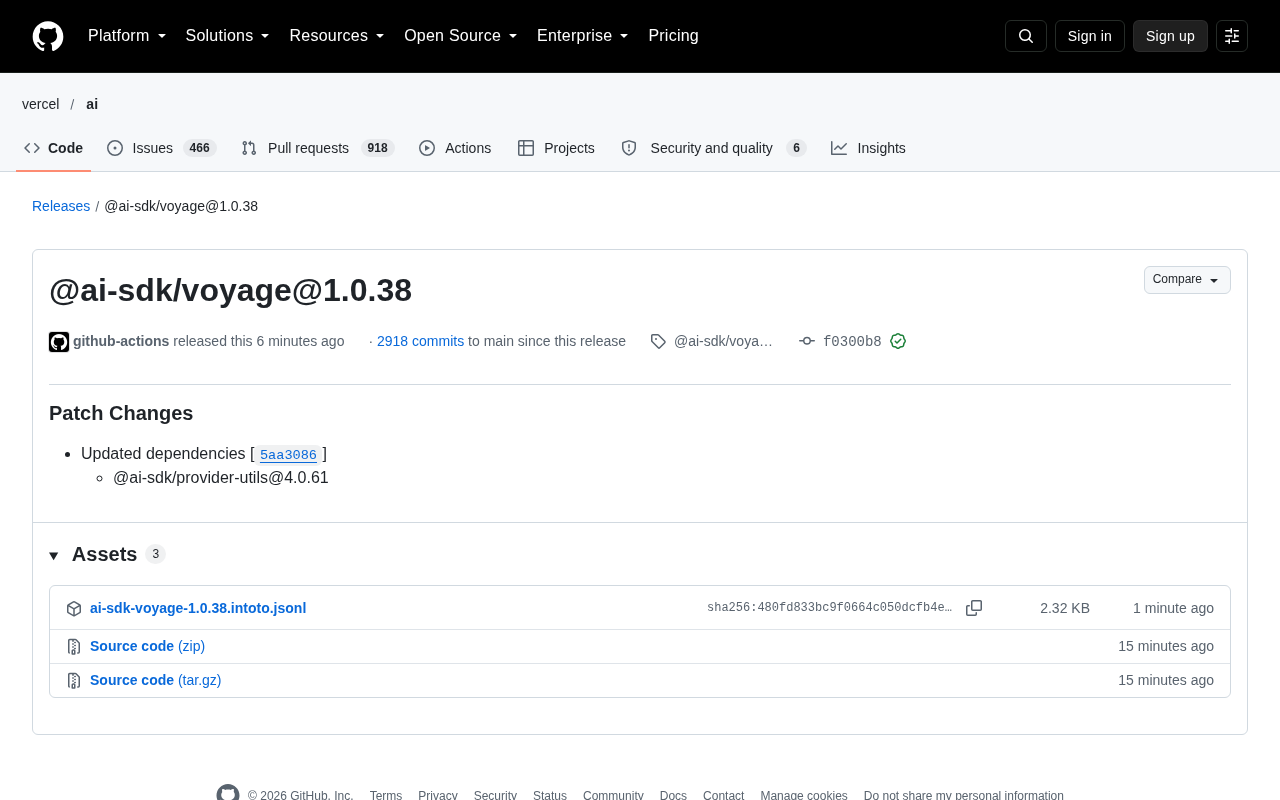
The Voyage adapter package in the AI SDK ecosystem, @ai-sdk/voyage, has released version 1.0.38. Judging by the version number, this is a standard patch update with no new features and no breaking changes. The only substantive item in the release notes is that the dependency @ai-sdk/provider-utils has been bumped to 4.0.61.
For developers familiar with the Vercel AI SDK ecosystem, this kind of "dependency-driven patch" is nothing new. As an embedding model provider, Voyage's adapter layer relies on the request construction, error handling, and streaming parsing logic encapsulated in provider-utils. Once the upstream provider-utils fixes some edge-case behavior, downstream Voyage packages need to follow up by pinning the version to ensure consistent behavior across providers.
The Dependency Chain: Why provider-utils Updates Ripple Through to Voyage
provider-utils Is the Common Foundation of the AI SDK
In the AI SDK's architecture, provider-utils handles the "provider-agnostic" portion of the work: unified fetch wrapping, retry strategies, header construction, response validation, and more. Every @ai-sdk/* adapter package (including Voyage) is built on top of this layer. This means a single fix at the base layer propagates to all adapter packages in the form of patches.
Vercel AI SDK is an open-source TypeScript toolkit for building AI applications, with a core design based on a layered "core + provider adapters" structure. The core package ai provides unified high-level APIs such as generateText, streamText, and embed, while each model provider (OpenAI, Anthropic, Google, Voyage, etc.) has its own @ai-sdk/* adapter package responsible for translating each vendor's distinct HTTP interface into a unified protocol.
@ai-sdk/provider-utils is the shared utility library across all adapter packages, providing type definitions (such as the LanguageModelV1 and EmbeddingModelV1 specification interfaces) along with runtime helper functions (such as postJsonToApi and createJsonErrorResponseHandler). It is essentially the concrete implementation of the "provider interface specification," ensuring consistent behavior across adapter packages for network requests, error code mapping, and streaming chunk parsing.
An "embedding model" refers to a model that maps text into dense vectors, whose output can be used for semantic search, clustering, RAG retrieval, and similar scenarios. Voyage is one of the providers focused on embedding models, so @ai-sdk/voyage only needs to implement embedding-related interfaces, making its footprint smaller than that of language model adapter packages.
A Patch-First, Version-Pinned Release Strategy
The commit f0300b8 attached to this release carries a GitHub verified signature (GPG key ID: B5690EEEBB952194), indicating the release process is executed by a trusted automated pipeline. Looking back at the 16 Oct release date, this repository has accumulated 2,918 commits merged into the main branch since its previous release—this is a highly active monorepo, and patch releases are often just routine actions to "keep pace with the main branch" rather than independent feature iterations.
Patch versions correspond to the final digit in Semantic Versioning (SemVer), x.y.Z, and by convention are reserved only for backward-compatible bug fixes—they should not introduce new features or breaking changes. This is the basis for the article's assessment that 1.0.38 is a "safe upgrade."
A lockfile is a lock file used by a package manager to record the exact versions in the dependency tree. npm uses package-lock.json, pnpm uses pnpm-lock.yaml, and Bun uses bun.lockb (or bun.lock in newer versions). It ensures that everyone on the team and every CI build installs exactly the same dependency versions.
When provider-utils is upgraded but @ai-sdk/voyage's package.json still specifies a looser range (such as ^4.0.60), if the lockfile is not refreshed, the actual install may still resolve to an older version of provider-utils, producing mismatches such as "works locally, fails in CI" or vice versa. Therefore, in projects outside the monorepo, the recommended practice for upgrading such patch packages is to explicitly run npm update @ai-sdk/voyage or pnpm up so the entire sub-dependency tree advances together.
Practical Impact on Users
For the vast majority of projects, this update can be completed through a routine dependency upgrade with no changes to any calling code. The public API of @ai-sdk/voyage has not changed, and the way you call Voyage embeddings, the parameter structure, and the return format all remain the same.
If you are using a lockfile (package-lock.json, pnpm-lock.yaml, or bun.lockb), it is advisable to explicitly refresh the dependency tree so that provider-utils and the Voyage adapter package are on the combined state from the same release, avoiding subtle behavioral differences caused by version mismatches. For teams that freeze dependencies in CI, such patch updates are typically merged into the next routine dependency sync window.
AI SDK's Maintenance Mode as Seen Through Release Logs
The release page itself contains no explanatory text—just a single line in the changelog recording the dependency change. This kind of "silent release" is common in mature open-source provider adapter layers: maintainers assume users will become aware of updates through their package managers rather than reading release notes line by line.
What it reflects is a layered maintenance philosophy—consolidating common logic into provider-utils so that each provider package becomes sufficiently thin and predictable. The cost is increased release noise: dozens of seemingly meaningless patch version numbers may appear over a quarter, but each one corresponds to a real behavioral adjustment somewhere upstream.
The takeaway for developers is this: rather than chasing the patch logs of @ai-sdk/voyage one by one, pay attention to changes in @ai-sdk/provider-utils—that is where behavioral differences truly originate.
The AI SDK is organized as a monorepo, with all @ai-sdk/* packages and provider-utils living in the same Git repository, typically managed with Turborepo or pnpm workspace. The advantage of this structure is that a single upstream fix commit can simultaneously trigger patch releases for multiple downstream packages, with version numbers automatically generated by tools like changesets.
The cost, as the article notes, is a significant increase in release noise. On the same timeline, @ai-sdk/openai, @ai-sdk/anthropic, @ai-sdk/voyage, and others may produce batches of patch versions, most of which merely "sync the pinned provider-utils version." For downstream users, the key to deciding whether an immediate upgrade is needed is not the adapter package's own changelog, but whether the diff in @ai-sdk/provider-utils touches the code paths you actually use (for example, whether you rely on retries or streaming parsing).
One-line Summary
@ai-sdk/voyage 1.0.38 is a dependency-driven patch—the only substantive change is in upstream provider-utils.
Paragraph Summary
@ai-sdk/voyage has released patch version 1.0.38 with no new features and no breaking changes; the only substantive change is upgrading the dependency @ai-sdk/provider-utils to 4.0.61. The article notes that provider-utils is the common foundation for all provider adapter packages in the Vercel AI SDK, handling request construction, error handling, and streaming parsing, and its fixes propagate to all adapter packages as patches. This release adopts a "silent release" strategy, with release notes containing only a single line recording the dependency change, reflecting the AI SDK's layered maintenance and dependency-driven automation rhythm. For users, the public API is unchanged, so a routine dependency upgrade typically suffices without modifying calling code; refreshing the lockfile is recommended to avoid version mismatches. The article concludes by suggesting that rather than chasing each adapter package's logs, developers should watch provider-utils changes, which are the true source of behavioral differences.
Related articles

Chain of Thought Isn't Just for AI: How Humans Can Use CoT to Improve Thinking Quality
Chain of Thought isn't just a prompt trick for large models. Starting from a Hacker News discussion, this article analyzes why CoT works for human thinking too, breaks down actionable ways to transfer it, and highlights the key differences between human CoT and machine CoT.
Cloudflare Teams Up with OpenAI: Closi…
Cloudflare Teams Up with OpenAI: Closing the Loop from Vulnerability Discovery to Defense with AI
Cloudflare uses OpenAI Daybreak to investigate security vulnerabilities and generate reviewable remediation plans, while developers use Codex to boost coding efficiency and quality.

Orca Multi-Agent Orchestration in Practice: A Guide to Parallel Collaboration with Claude and Codex
Orca is Stable AI's free open-source agent workbench supporting 34 agents like Claude Code and Codex in parallel. Learn its Git worktree isolation, multi-model orchestration, and mobile management.