AI SDK Releases workflow-harness Patch Version 1.0.152

@ai-sdk/workflow-harness releases 1.0.152 patch, a routine maintenance update with no new features.
The @ai-sdk/workflow-harness in the AI SDK toolchain has released patch version 1.0.152, with the core package @ai-sdk/harness updated in sync. This version was automatically published by github-actions with GPG signature verification, conforming to SemVer patch-level changes without new features or breaking API adjustments. The workflow-harness provides testing and execution scaffolding for AI workflows, helping developers verify workflow behavior in a more controllable and reproducible way. Although the release notes for this release do not detail specific fixes, for teams already using this toolchain in production, patch updates typically mean improved stability in edge cases. It is recommended to run your existing test suite after upgrading, and to keep the two packages' versions aligned.
The AI SDK ecosystem has another minor iteration. @ai-sdk/workflow-harness has released patch version 1.0.152, with the core package @ai-sdk/harness updated in sync. This is a maintenance release that introduces no new features, focusing instead on minor fixes to existing implementations.
A Standard Patch Release
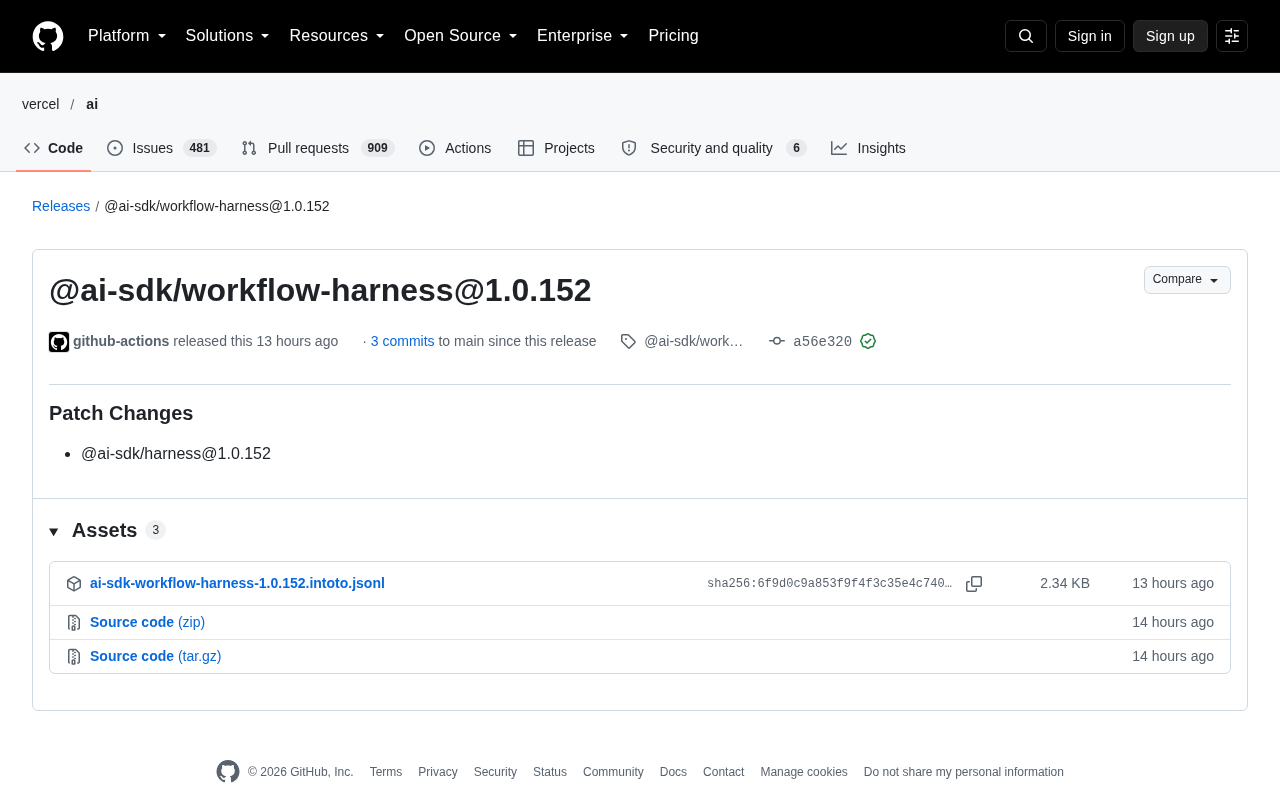
According to the GitHub Releases page, this version was automatically published by github-actions, with commit hash a56e320, and carries GitHub's verified signature (GPG key ID: B5690EEEBB952194). This means the entire release process runs through an automated pipeline, with traceable code origins and verifiable signatures, aligning with current mainstream open-source practices for supply chain security.
The version number 1.0.152 indicates this is a patch-level change. Under the Semantic Versioning (SemVer) system, the patch position is typically used for backward-compatible bug fixes, without API changes or new features.
Semantic Versioning (SemVer) is a widely adopted versioning specification in the open-source ecosystem, with the format MAJOR.MINOR.PATCH. The MAJOR position increments when incompatible API changes occur, the MINOR position increments when features are added in a backward-compatible manner, and the PATCH position is used for backward-compatible bug fixes. Therefore, when the version number changes from 1.0.151 to 1.0.152, one can safely infer that the upgrade will not break existing call patterns, nor require changes to business code. This convention matters because it allows dependents to quickly assess upgrade risk levels without reading through changelogs one by one—for automated dependency update tools (such as Dependabot, Renovate), patch-level updates can typically be merged directly.
GPG signature verification is a source trust mechanism provided by GitHub. Maintainers sign commits or tags with a private key, the platform verifies with the corresponding public key, and upon passing, displays a verified badge along with the key ID. It proves that the commit was indeed produced by the person or automated account holding the private key, rather than being tampered with by a man-in-the-middle. Against the backdrop of frequent npm supply chain attacks, signatures and automated release pipelines together form a basic line of defense.
The Position of workflow-harness in the AI SDK
@ai-sdk/workflow-harness is part of the AI SDK toolchain, and its responsibility is evident from the name: providing a testing and execution harness for AI workflows. When building LLM-based applications, workflow orchestration, state management, and reproducibility are often engineering pain points, and a dedicated harness package helps developers verify workflow behavior in a more controllable way.
The companion @ai-sdk/harness is the lower-level general testing infrastructure. The two are released with the same version number cadence, indicating they share the same build and release pipeline, and version alignment helps developers reduce dependency management complexity.
Test harness is a common pattern in software engineering, referring to a set of infrastructure for building a controlled environment around the system under test. Its core value lies in isolating uncertainty: in LLM applications, model outputs are inherently stochastic, and multi-step calls, tool selection, and state transitions in workflows depend on external services. If every debugging session required actual model calls, the cost would be high and problem reproduction difficult. A harness typically provides simulated model responses, a controllable clock, injectable failure points, and execution trace recording, allowing developers to write deterministic tests for specific branches. Its difference from unit testing frameworks is that a harness focuses more on the "runtime environment" rather than the "assertion library," and often needs to be deeply coupled with the framework under test to be effective.
Small Patch, But Worth Noting
Looking at this release alone, the information is indeed limited: no changelog details, no breaking change notes, and even the specific fix contents are not elaborated in the release notes. But for teams already using AI SDK workflow capabilities in production, such patch versions still have practical significance.
First, patch updates typically mean improved stability in edge cases—if you've previously encountered occasional execution anomalies or timeout behavior, it's worth re-verifying after upgrading. Second, signature verification and automated release processes themselves are supply chain security signals, indicating that the project maintains consistency in engineering standards.
How Developers Should Handle This Update
For projects depending on @ai-sdk/workflow-harness, the following approach is recommended:
- Check the currently locked version in
package.json; if it's stuck at a patch version before 1.0.152, consider upgrading - Since it's a patch-level change, no business code modifications should theoretically be needed—just run your existing test suite after upgrading to confirm compatibility
- If you use a monorepo and depend on
@ai-sdk/harnessas well, be careful to keep both versions aligned
It's worth noting that behavioral differences can exist between patch versions too, especially in modules susceptible to timing effects, such as async scheduling and retry logic. If your workflow is sensitive to execution order, verifying once in a staging environment before upgrading would be safer.
Summary
@ai-sdk/workflow-harness@1.0.152 is a routine patch update with few technical highlights, but as evidence of the AI SDK toolchain's continued maintenance, it still holds reference value for developers concerned with workflow testing infrastructure. What's truly worth noting is this kind of small, rapid iteration cadence—it means the upstream team is continuously converging on boundary issues, rather than accumulating risk to release all at once in a major version.
One-line Summary
@ai-sdk/workflow-harness releases 1.0.152 patch, a routine maintenance update with no new features.
Paragraph Summary
The @ai-sdk/workflow-harness in the AI SDK toolchain has released patch version 1.0.152, with the core package @ai-sdk/harness updated in sync. This version was automatically published by github-actions with GPG signature verification, conforming to SemVer patch-level changes without new features or breaking API adjustments. The workflow-harness's responsibility is to provide testing and execution scaffolding for AI workflows, helping developers verify workflow behavior in a more controllable and reproducible way. Although the release notes for this release do not detail specific fixes, for teams already using this toolchain in production, patch updates typically mean improved stability in edge cases. It is recommended to run your existing test suite after upgrading, and to keep the two packages' versions aligned.
Related articles

RAG Getting Started in Practice: From Principles to Building an Enterprise Knowledge Base
Bilibili RAG course highlights: from retrieval-augmented generation principles, document chunking and vectorization, to five accuracy factors and enterprise knowledge base boundaries, with fine-tuning vs RAG selection advice.

AI Model Selection Guide: DeepSeek vs. Qwen3 in Practice
How should AI developers choose models? Based on a Bilibili tutorial, this article breaks down the Function Calling differences between DeepSeek V3 and R1, Qwen3's programmatic thinking mode switching and agent capabilities, and outlines a multi-model learning path and practical selection logic.

Anchoring, Loss Aversion, and Nudges: 5 Psychological Tactics Retailers Use to Make You Spend
Behavioral economics reveals how retailers use anchoring, framing, loss aversion, and nudge theory to manipulate your spending decisions. This article breaks down 5 common psychological tactics and offers counterstrategies like slowing down decisions and setting your own anchors to see through the pricing design behind discounts.