@ai-sdk/rsc@3.0.136 Released: Routine Patch Update with Dependency Upgrade

@ai-sdk/rsc@3.0.136 patch release syncs dependency to ai@7.0.136 with no breaking changes.
@ai-sdk/rsc@3.0.136 is a routine patch update in the Vercel AI SDK ecosystem, focused solely on syncing the internal core dependency to ai@7.0.136 with no new features or standalone bug fixes. The package bridges LLM streaming responses with React Server Components in frameworks like Next.js. The release reflects monorepo coordinated publishing, verified via GitHub GPG signature. Developers should upgrade both ai and @ai-sdk/rsc together and rely on lock files and CI tests to manage the SDK's rapid release cadence.
Version Overview
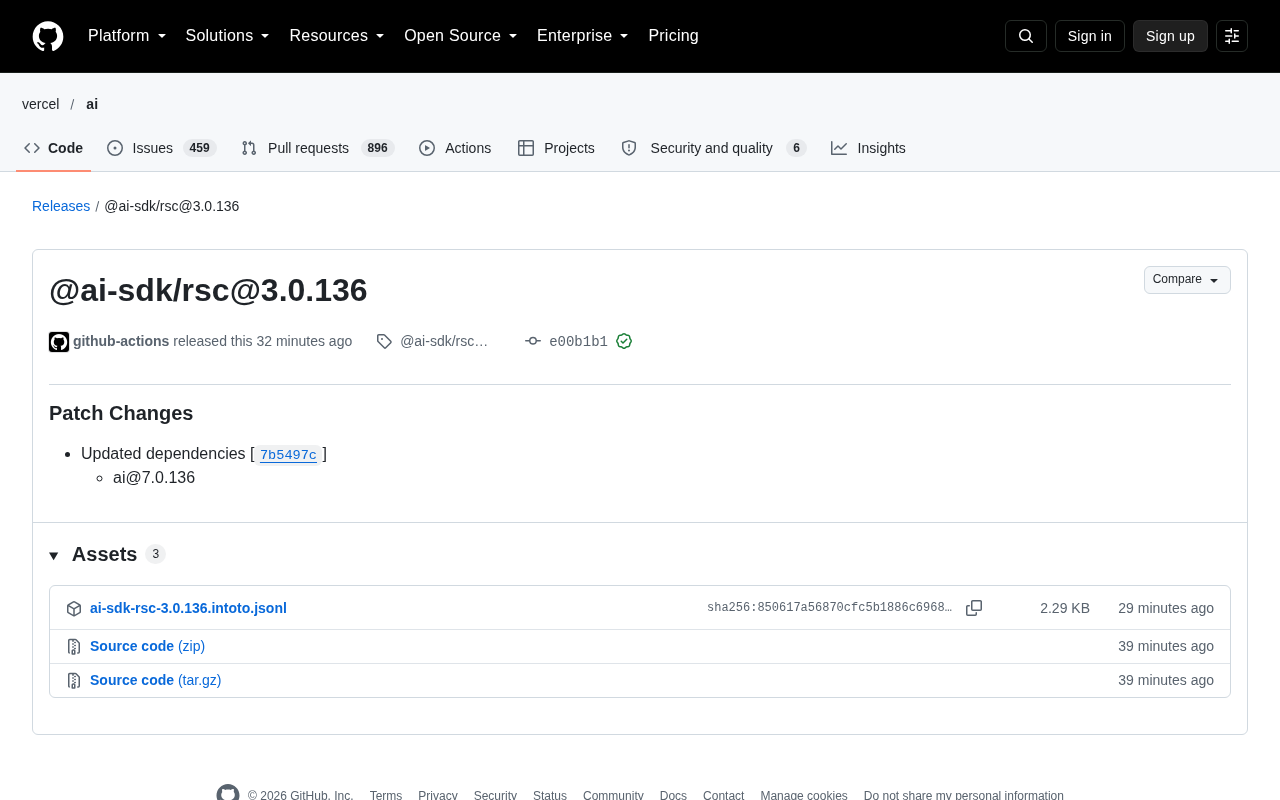
Vercel's AI SDK ecosystem has received another minor update — @ai-sdk/rsc@3.0.136 has been published via an automated GitHub Actions workflow. This is a patch-level update focused entirely on dependency synchronization, with no breaking API changes introduced.
@ai-sdk/rsc is the AI SDK module specifically designed for React Server Components (RSC). It handles AI streaming responses and state management within server component contexts, allowing developers to seamlessly integrate LLM-generated content with React component rendering in RSC-compatible frameworks like Next.js.
According to the release record, this update consists of a signed commit (e00b1b1) that passed GitHub's verified signature check, with a GPG key ID of B5690EEEBB952194, providing a traceable and trustworthy provenance.
React Server Components (RSC) is an architectural feature introduced in React 18 that allows components to render on the server and directly access backend resources without exposing that logic to the client. In AI application scenarios, RSC's value lies in the fact that LLM API calls are inherently server-side operations (involving API key management and network latency). Handling them in server components protects sensitive credentials while enabling streaming to progressively push generated content to the client, improving perceived response speed. @ai-sdk/rsc is purpose-built as a bridge layer for this use case, encapsulating the coordination logic between streaming state management, Server Actions, and React Suspense — so developers don't have to manually deal with raw ReadableStream objects and component suspension boundaries.
What's in This Update
The actual Patch Changes in this release are narrowly focused — a synchronization of internal dependencies:
- Updated dependencies [
7b5497c] ai@7.0.136
This means @ai-sdk/rsc itself has no new features or standalone bug fixes. It simply follows the core ai@7.0.136 package in lockstep. The closely aligned version numbering — 3.0.136 corresponding to the 136 in ai@7.0.136 — is a hallmark of monorepo multi-package coordinated releases: when the main package updates, related adapter layers and framework integration packages are automatically published in sync, ensuring version consistency across the entire SDK ecosystem.
For developers using the AI SDK, these kinds of updates are typically low-risk. Patch versions follow Semantic Versioning (SemVer), meaning they should not break existing code, and the cost of upgrading is minimal.
A monorepo (single repository) is an engineering pattern where multiple related packages are managed together in the same Git repository. The Vercel AI SDK uses this structure — the core ai package, framework adapters like @ai-sdk/rsc, and model provider integrations (e.g., @ai-sdk/openai) all live in the same repo. Using tools like Changesets or Turborepo, a monorepo can automatically trigger synchronized releases for all dependent sub-packages whenever the main package is published. The trailing number in the version (e.g., 136) typically corresponds to a shared release batch sequence, visually reflecting the relationship between packages. The benefit of this approach is reduced version drift risk — though it also means sub-packages get new version numbers even when they have no substantive changes of their own, resulting in a noticeably higher release frequency compared to traditional multi-repo setups.
What This Means for Developers
If your project is using @ai-sdk/rsc, you can safely upgrade to 3.0.136 and simultaneously update the core ai dependency to 7.0.136. Keeping these two packages on matching versions is the best practice for avoiding potential compatibility issues.
From a broader perspective, the AI SDK maintains a remarkably high release cadence — essentially continuous delivery on a per-commit basis. On one hand, this reflects an active project with strong maintenance investment. On the other hand, it requires users to establish a sound dependency management strategy:
- Use lock files (
package-lock.json/pnpm-lock.yaml) to pin versions and prevent unexpected upgrades. - Adopt a unified upgrade cadence for both core packages and their adapters.
- Add automated tests to your CI pipeline to ensure frequent dependency updates don't silently introduce regressions.
Summary
@ai-sdk/rsc@3.0.136 is a purely dependency-synchronization patch with no notable feature additions — but it reflects the AI SDK project's disciplined release process: automated builds, signature verification, and multi-package version alignment. For teams already building AI applications with this SDK, this is a routine maintenance update that can be applied with confidence and minimal review.
Related articles

Chain of Thought Isn't Just for AI: How Humans Can Use CoT to Improve Thinking Quality
Chain of Thought isn't just a prompt trick for large models. Starting from a Hacker News discussion, this article analyzes why CoT works for human thinking too, breaks down actionable ways to transfer it, and highlights the key differences between human CoT and machine CoT.
Cloudflare Teams Up with OpenAI: Closi…
Cloudflare Teams Up with OpenAI: Closing the Loop from Vulnerability Discovery to Defense with AI
Cloudflare uses OpenAI Daybreak to investigate security vulnerabilities and generate reviewable remediation plans, while developers use Codex to boost coding efficiency and quality.

Orca Multi-Agent Orchestration in Practice: A Guide to Parallel Collaboration with Claude and Codex
Orca is Stable AI's free open-source agent workbench supporting 34 agents like Claude Code and Codex in parallel. Learn its Git worktree isolation, multi-model orchestration, and mobile management.