AI SDK RSC 3.0.177 Released: Patch Update and Dependency Sync
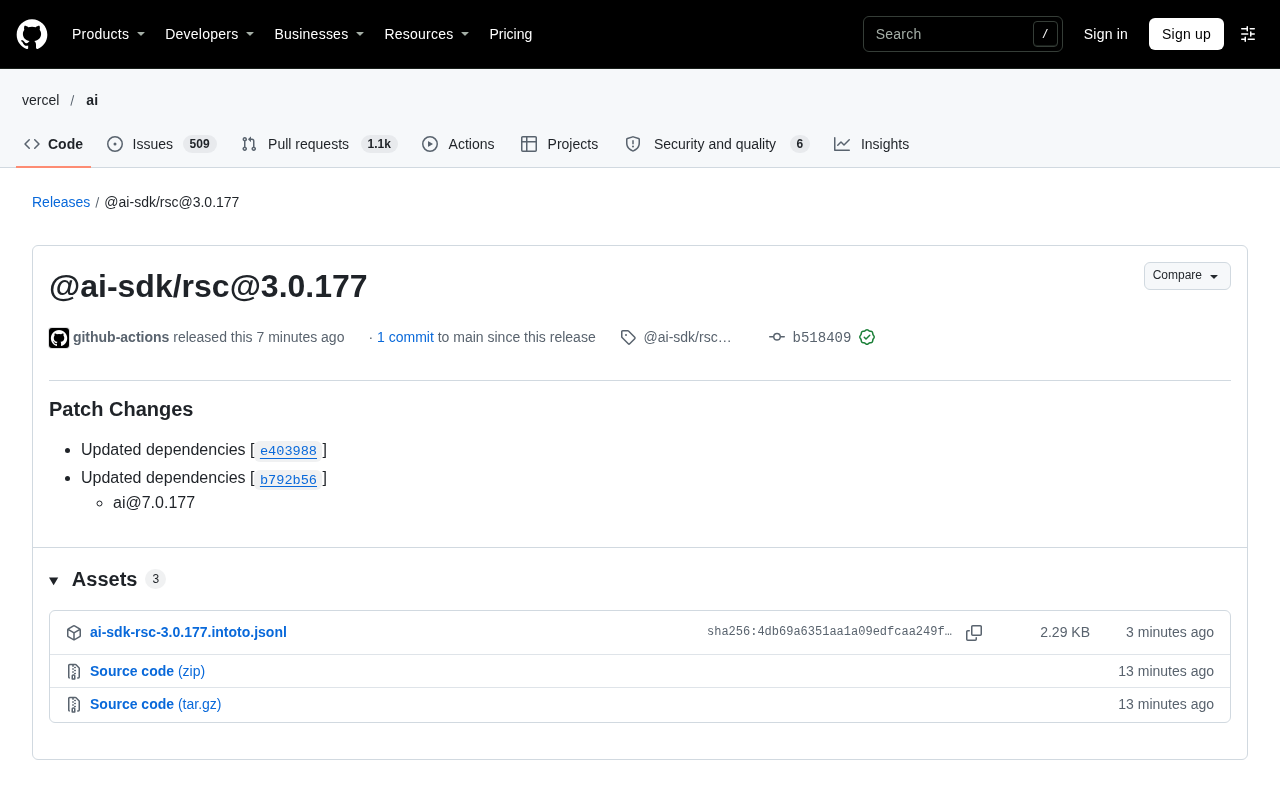
@ai-sdk/rsc releases patch 3.0.177, only syncing dependencies to ai@7.0.177, no new features.
The React Server Components package @ai-sdk/rsc in the Vercel AI SDK ecosystem has released version 3.0.177, automatically triggered by a GitHub Actions bot with only 1 commit. The change type is Patch Changes, consisting of two dependency update records, one pointing to the core package ai@7.0.177, with no new APIs or features. The main purpose is to keep the RSC package version-consistent with the core ai package to fix minor upstream issues or maintain type definition compatibility. Since patch-level updates contain no breaking changes, upgrade risk is low, and developers can simply run a routine package manager update; urgency is low unless the upstream fix is needed. The matching patch numbers of the two packages also help reduce compatibility assessment costs.
The React Server Components package in the AI SDK ecosystem, @ai-sdk/rsc, has received a 3.0.177 version update. This release was automatically completed by a CI bot, with the commit history showing a routine patch iteration whose core action is syncing upstream dependency versions.
Patch Contents: Dependency Version Alignment
According to the GitHub Releases page, the change type for @ai-sdk/rsc@3.0.177 is labeled Patch Changes, i.e., a patch-level update. The specifics are two dependency update records with commit hashes e403988 and b792b56, one of which points to ai@7.0.177.
This means the release introduces no new public APIs or features; its main purpose is to keep the RSC package version-consistent with the core ai package. For developers building streaming UIs with the Vercel AI SDK, such sync updates are typically used to fix minor issues in upstream dependencies or maintain type definition compatibility.
The release was triggered by the github-actions account at 19:02 on the 18th and contains only 1 commit, which carries a verified signature on GitHub (GPG key ID: B5690EEEBB952194). This kind of automated workflow is very common in the AI SDK's day-to-day iterations, indicating that the project maintainers have standardized the release pipeline.
React Server Components (RSC) is a component type introduced in React 18 that renders on the server and is serialized before being sent to the client, thereby placing data fetching and UI rendering in the same component tree and reducing client bundle size and waterfall requests. @ai-sdk/rsc is precisely the adapter layer that the Vercel AI SDK provides for RSC scenarios, used to directly call models within a Server Component and stream the returned UI.
Under Semantic Versioning (SemVer), an increment of the patch number (third digit) represents a backward-compatible bug fix that neither adds nor breaks public APIs; an increment of the minor version represents new features that remain compatible; only an increment of the major version permits breaking changes. Therefore, the "177" in 3.0.177 is in the patch position, indicating that this release does not change the external contract.
Vercel AI SDK is an open-source toolkit for TypeScript/JavaScript. Its core package ai provides a unified model invocation interface (such as streamText, generateText, tool calling, and structured output) and is accompanied by provider packages for various model vendors as well as UI integration packages such as @ai-sdk/rsc and @ai-sdk/react. Because these packages share type definitions and internal protocols, changes to the upstream ai package often require downstream integration packages to sync versions in order to ensure type checking passes and the streaming protocol stays consistent. This explains why the patch number of @ai-sdk/rsc aligns with that of the ai package.
Practical Impact on Developers
A patch version involves no breaking changes, so the upgrade risk is low. If your project depends on @ai-sdk/rsc, a routine package manager update is all that's needed to get this version. Since the change is only dependency alignment, the upgrade is not particularly urgent unless the upstream ai@7.0.177 contains a bug fix you need.
From a versioning strategy perspective, @ai-sdk/rsc keeps the same patch number (177) as the ai package. This lockstep versioning reduces the cognitive cost for developers to judge compatibility—when the two packages share the same patch number, it usually means they were validated in the same batch.
Lockstep versioning refers to multiple packages in the same monorepo or ecosystem sharing the same version number, as typified by Angular, Jest, and some of the AI SDK packages. Its benefit is that developers can judge compatibility simply by comparing version numbers, avoiding the need to check each package's version matrix one by one; the cost is that even a package with no substantive changes will publish a new version along with the batch, producing many "empty updates." The AI SDK's automated release pipeline is designed precisely to reduce the maintenance cost of such batch releases.
Conclusion
@ai-sdk/rsc@3.0.177 is a typical automated patch release: dependency sync, no new features, low upgrade risk. Developers following the AI SDK can treat it as a routine maintenance update and follow up as needed.
Related articles

Watching Movies in the Terminal: Building an SSH Streaming Service with Codex Multi-Agent Workflow
A creator uses Codex multi-agent workflow to build an SSH-accessible streaming service in the terminal, with planning, cloud async dev, AI-drawn scenes, and synced live channels.

AI Face Licensing: A New Micro-Drama Trend or a Hollywood Trap?
Actors are licensing their faces to micro-drama startups for AI digital doubles to perform. Popular in China, the model raises concerns in Hollywood over lost control and diluted bargaining power.

Amazon's First Digital Photo Frame Is 50% Off for Black Friday: Is the Alexa Frame Worth Buying?
Amazon's first digital photo frame, the Alexa Photo Frame, is nearly 50% off for Black Friday, with prices starting at $114. We analyze why this new product dropped in price just one month after launch, its positioning, who it's for, and buying advice.