@ai-sdk/rsc 3.0.180 Released: Patch Update Pins ai@7.0.180

@ai-sdk/rsc releases 3.0.180 patch, only aligning dependency to ai@7.0.180, no functional changes.
@ai-sdk/rsc releases patch version 3.0.180, triggered by the github-actions automation pipeline, merging 2 commits with GPG signature verification. The Patch Changes in the Release Notes list only one line: ai@7.0.180, indicating this release adds no new APIs, fixes no RSC logic defects, and makes no behavioral changes; its sole purpose is to pin the dependency on the core ai package to 7.0.180. This "core package advances, surrounding adapters follow" pattern is very common in monorepo-managed SDK projects. For users, this upgrade is a low-risk follow-up update that usually only requires updating the lockfile; when troubleshooting RSC streaming rendering or dependency conflicts, check whether the versions of the two packages match rather than guessing at code logic.
A Low-Key Patch Sync: @ai-sdk/rsc Hits 3.0.180
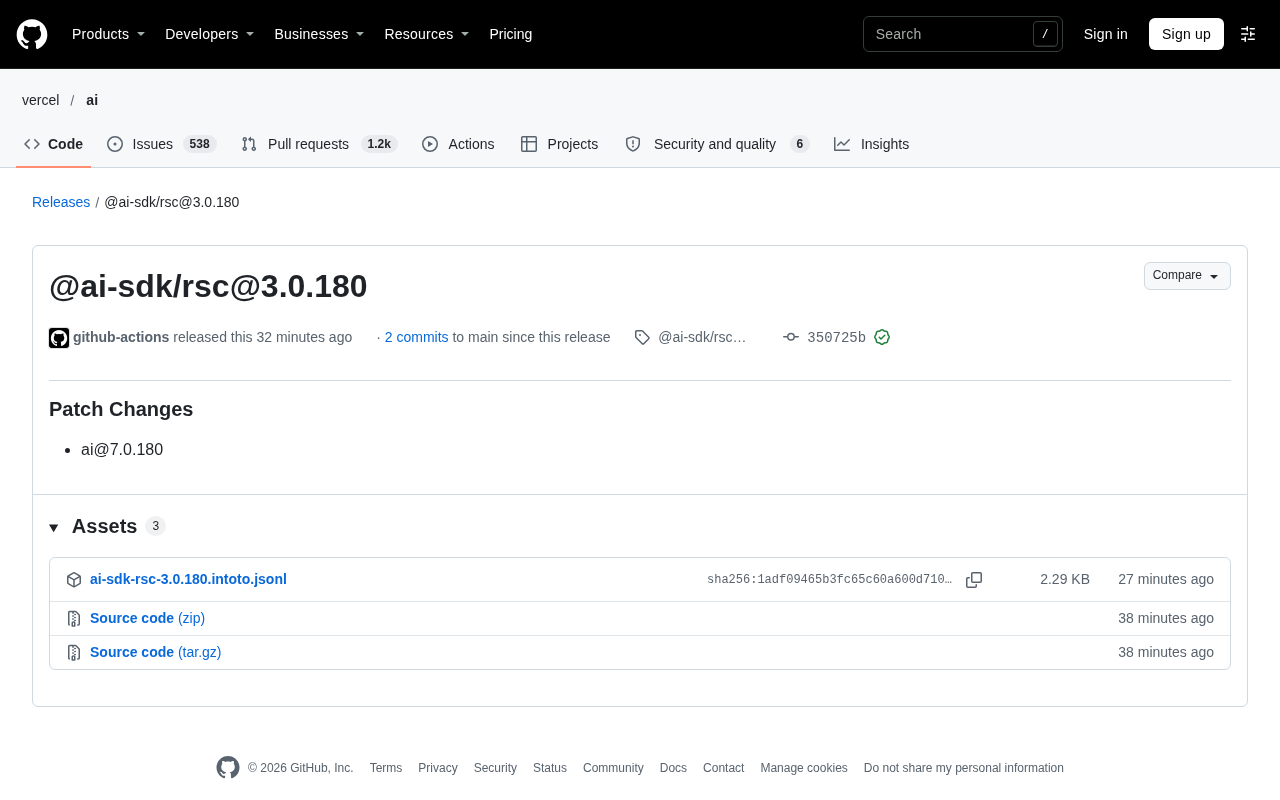
The @ai-sdk/rsc package in the AI SDK ecosystem has released version 3.0.180. Judging from the GitHub Release page, this is a typical minor patch release: automatically triggered by the github-actions bot, with 2 commits merged into the main branch, signature verification passed, and published on 23 Nov at 16:38.
For developers unfamiliar with this package, @ai-sdk/rsc is the adapter layer in the Vercel AI SDK ecosystem designed for React Server Components scenarios, bridging server components and streaming AI responses. Its version number is tightly coupled with the core ai package, and this is reflected especially directly in the release notes for this version.
Patch Contents: Just One Dependency Alignment
The "Patch Changes" section of the Release Notes lists only one line: ai@7.0.180.
This means 3.0.180 itself introduces no new APIs, fixes no specific RSC logic defects, and makes no behavioral changes. Its purpose is to pin the core ai package that @ai-sdk/rsc depends on to the specific version 7.0.180.
This release pattern is very common in monorepo-managed SDK projects: each time the core package advances, the surrounding adapter packages follow with a patch number to ensure consistency of the dependency tree. For users, upgrading to 3.0.180 is essentially equivalent to getting the contents of ai@7.0.180.
monorepo (single-repository multi-package) refers to a pattern where multiple interrelated software packages are centrally managed in the same code repository. The Vercel AI SDK adopts this structure: the core ai package and adapters such as @ai-sdk/rsc and @ai-sdk/react share the same build and release pipeline. In a monorepo, packages typically reference each other via the workspace protocol, and versions are bumped uniformly at release time by tools such as changesets. This is also why a patch to a core package triggers synchronized releases of surrounding packages—they share the same changeset and must stay version-aligned to ensure the dependency tree resolves correctly.
The Automated Release Pipeline
The release was completed by github-actions, and the commit carries a GitHub-verified signature (GPG key ID B5690EEEBB952194). This shows that the release went through a CI automation pipeline rather than manual operation, reducing the risk of missed or incorrect releases.
The "Compare" section and the tag filter component on the page failed to render properly during scraping, showing loading error messages, but this does not affect the readability of the Release Notes body content. The Assets section shows 3 attachments, consistent with a standard npm package release.
GPG signature verification is a commit-origin verification mechanism provided by Git. Developers or CI bots can sign commits with a private key, and platforms such as GitHub verify the signature with the corresponding public key and display a "Verified" badge next to the commit. In an automated release pipeline, the github-actions bot uses the key configured by the repository maintainers to sign release commits, which both proves that the version was indeed produced by the official CI process rather than manually pushed, and prevents commits from being tampered with in transit. The GPG key ID B5690EEEBB952194 mentioned in this article is the fingerprint of the key used for signature verification.
Practical Impact on Users
If your project depends on @ai-sdk/rsc, this upgrade is a follow-up update within the safe range. Since there are no breaking changes, usually you only need to update the lockfile. What to keep in mind is the strict correspondence between version numbers—when troubleshooting RSC-related streaming rendering or dependency conflicts, confirming whether the versions of @ai-sdk/rsc and ai match is often faster than guessing at code logic.
From a broader perspective, this kind of high-frequency small version release reflects that the AI SDK is still in a period of rapid iteration, with interfaces and dependency relationships in a process of continuous convergence. For production environments, pinning versions and paying attention to the specific contents of Patch Changes is more prudent than blindly following the latest version.
lockfile is a file generated by package managers such as npm, pnpm, and yarn (e.g., package-lock.json, pnpm-lock.yaml), used to record the exact version and integrity hash of each package in the dependency tree. When using range version numbers such as ^3.0.180 in package.json, the actually installed version is determined by the lockfile. "Just update the lockfile" means re-resolving and writing the newly resolved patch version without changing the version range in package.json, so that changes to the dependency tree can be precisely tracked and the same installation result can be reproduced in CI.
Related articles
Running Local AI Agents on Mac: A Full Breakdown of the MLX Four-Layer Stack
A breakdown of Apple engineer Joanna's local Mac AI agent solution: the MLX four-layer stack, a three-step setup, and how the neural network accelerator, continuous batching, and distributed inference solve local agent performance bottlenecks.
52KB Engine Runs 2B LLM in a Browser Tab
52KB Engine Runs 2B LLM in a Browser Tab
A 52KB WebAssembly engine on Hacker News claims to run Qwen3.5-2B in a browser tab. We analyze the engine-model separation, browser inference pros and cons, and the on-device AI runtime race.

MIT PhD Takes You from Scratch to Build DeepSeek: A 25-Hour Hardcore Course
MIT PhD Raj Dandekar launches a 25+ hour Bilibili course building DeepSeek from scratch—MoE, MLA, GRPO, hand-written code plus math derivations, aiming to reproduce mini R1.