AI SDK's TogetherAI Module Updated to 2.0.91

@ai-sdk/togetherai releases patch 2.0.91 syncing upstream dependencies, no breaking changes.
@ai-sdk/togetherai has released patch version 2.0.91, published automatically by GitHub Actions. This update is a dependency sync, bumping @ai-sdk/openai-compatible to 2.0.85 and @ai-sdk/provider-utils to 4.0.61, with no new features or breaking changes. Since TogetherAI's API is highly compatible with the OpenAI spec, its provider's request construction and response parsing rely mainly on openai-compatible, while provider-utils supplies shared capabilities like streaming and error wrapping. This upgrade may indirectly bring in upstream boundary fixes. Upgrade as with any npm package; low risk in production. If you've hit intermittent request-format or streaming-parsing issues, it may be worth following up.
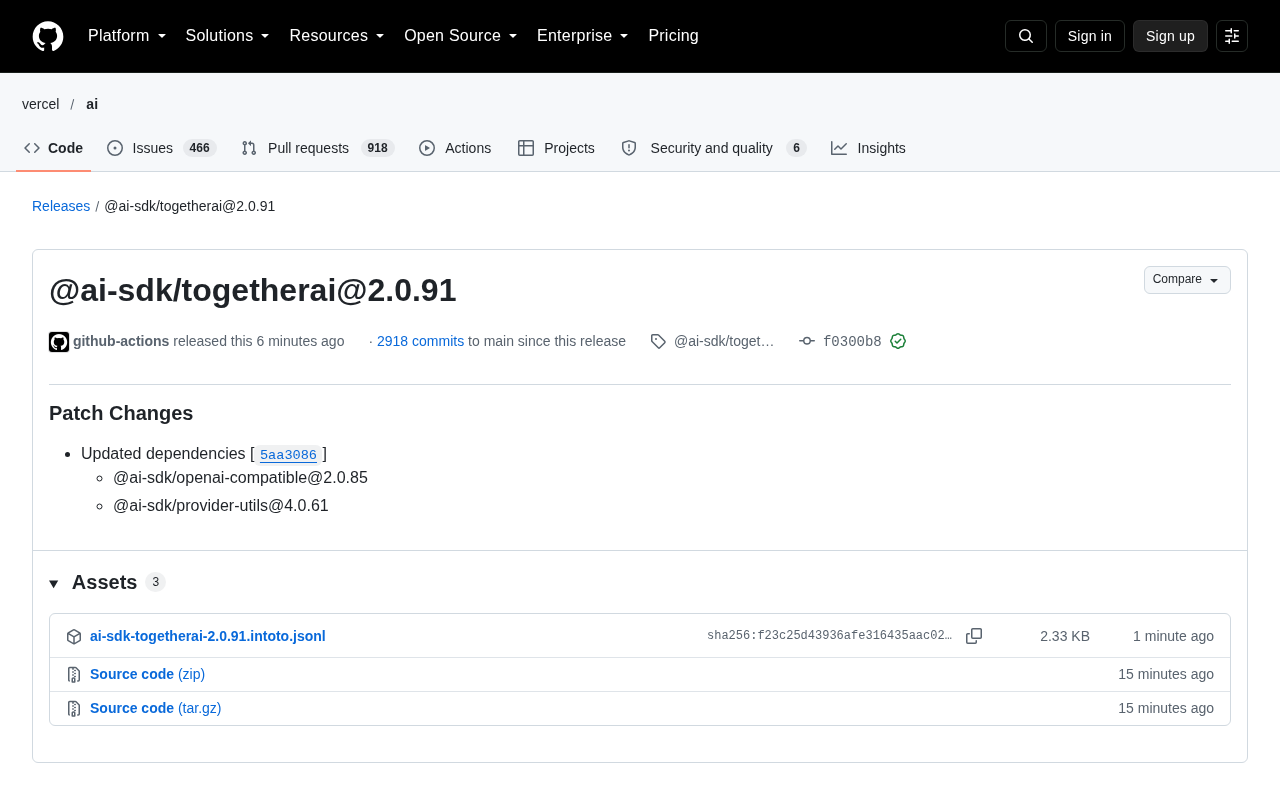
The third-party provider module @ai-sdk/togetherai in the AI SDK ecosystem has released version 2.0.91. This is a typical patch-level update, published automatically by the GitHub Actions workflow, introducing no new features or breaking changes — its main purpose is to sync upstream dependencies to their latest state.
Update Overview
According to the release changelog, version 2.0.91 falls under the Patch Changes category, with the core content being "Updated dependencies." Specifically, it bumps the following two upstream packages to the specified versions:
@ai-sdk/openai-compatibleupdated to2.0.85@ai-sdk/provider-utilsupdated to4.0.61
The changelog entry also references the corresponding commit hash 5aa3086, making it easy for developers to trace the specific code changes behind this dependency upgrade. Beyond that, this version includes no new APIs, behavioral adjustments, or migration notes.
@ai-sdk/provider-utils is the shared low-level utility library for all providers in the AI SDK, encapsulating fundamental capabilities such as streaming response parsing (e.g., SSE chunk handling), error type definitions, request retries, and timeout control. It isn't directly used in business code, but it serves as the cornerstone of provider behavioral consistency.
Patch versions (the third digit in semantic versioning) typically contain only backward-compatible bug fixes and do not change the public API. Therefore, a change like provider-utils going from 4.0.60 to 4.0.61 generally means a parsing or error-handling issue in some edge case has been fixed, without requiring downstream providers to modify how they call it.
Why Dependency Sync Matters
Many developers see "dependencies only" and skip right past it, but in a layered architecture like the AI SDK, a provider module's behavior is largely determined by its underlying shared packages.
@ai-sdk/openai-compatible carries the common logic for compatibility with the OpenAI API specification, and TogetherAI's API design happens to be highly consistent with OpenAI's style. As a result, upgrades to this module directly affect the TogetherAI provider's underlying request construction, response parsing, and related paths. @ai-sdk/provider-utils is the shared utility library for all providers, covering fundamental capabilities like streaming and error wrapping. Syncing to the latest patch version typically means boundary issues fixed in these shared logic paths are indirectly brought in.
For production users, such updates generally carry low risk — but if you've previously encountered intermittent issues related to request formatting or streaming parsing, upgrading to 2.0.91 may resolve them as a side effect.
The AI SDK is an open-source toolkit from Vercel for integrating multiple large model services uniformly in JavaScript/TypeScript applications. It uses a layered design: the core layer provides unified APIs like generateText and streamText, while individual model integrations are implemented through separate provider packages, such as @ai-sdk/openai and @ai-sdk/anthropic. This architecture lets developers switch between model providers with nearly identical code.
@ai-sdk/openai-compatible is a special case: it extracts the common logic for "compatibility with the OpenAI Chat Completions API specification," allowing any service that follows that spec (such as TogetherAI, Groq, DeepSeekAd, etc.) to quickly build its own provider on top of it — without implementing request construction and response parsing from scratch. As a result, patch upgrades to this package tend to benefit all providers that depend on it.
How to Upgrade
Since this is a standard npm package version iteration, upgrading works the same as with any regular dependency:
npm install @ai-sdk/togetherai@2.0.91
Or use your preferred package manager (pnpm, yarn, bun) to refresh the dependency. As a patch version, it typically requires no changes to your business code.
Summary
@ai-sdk/togetherai@2.0.91 is a pure dependency-sync patch release, whose value lies in keeping the TogetherAI provider aligned with the latest fixes in the upstream openai-compatible and provider-utils packages. It doesn't change the external interface, making it a minor update you can safely adopt.
Related articles

Chain of Thought Isn't Just for AI: How Humans Can Use CoT to Improve Thinking Quality
Chain of Thought isn't just a prompt trick for large models. Starting from a Hacker News discussion, this article analyzes why CoT works for human thinking too, breaks down actionable ways to transfer it, and highlights the key differences between human CoT and machine CoT.
Cloudflare Teams Up with OpenAI: Closi…
Cloudflare Teams Up with OpenAI: Closing the Loop from Vulnerability Discovery to Defense with AI
Cloudflare uses OpenAI Daybreak to investigate security vulnerabilities and generate reviewable remediation plans, while developers use Codex to boost coding efficiency and quality.

Orca Multi-Agent Orchestration in Practice: A Guide to Parallel Collaboration with Claude and Codex
Orca is Stable AI's free open-source agent workbench supporting 34 agents like Claude Code and Codex in parallel. Learn its Git worktree isolation, multi-model orchestration, and mobile management.