AI SDK's xAI Adapter Package Releases 3.0.143 Minor Version Update

@ai-sdk/xai releases patch 3.0.143, only syncing underlying dependencies, reflecting the AI SDK's multi-provider ecosystem alignment mechanism.
@ai-sdk/xai has released patch version 3.0.143, a package responsible for connecting xAI models to Vercel AI SDK's unified calling interface. This update is a typical patch-level change, with the core action being syncing upstream dependencies: @ai-sdk/openai-compatible bumped to 2.0.85 and @ai-sdk/provider-utils bumped to 4.0.61, both pointing to the same commit. This reveals that @ai-sdk/xai does not implement xAI's communication protocol from scratch, but builds on the openai-compatible layer, since xAI's API closely follows OpenAI's interface specification. Although a single patch may seem to have no new features, dependency chain changes often hint at upstream fixes—especially since provider-utils, as a common module handling request construction, streaming parsing, and error mapping, affects all provider packages simultaneously, maintaining behavioral consistency across multiple providers. For developers, the upgrade method is straightforward, but attention should be paid to transitive dependencies that may be hoisted or reused. It's recommended to regression test streaming responses and tool calls after upgrading.
Vercel's AI SDK ecosystem has seen another routine iteration. @ai-sdk/xai has released patch version 3.0.143, a package responsible for connecting xAI's model capabilities to the unified AI SDK calling interface.
What Changed in This Update
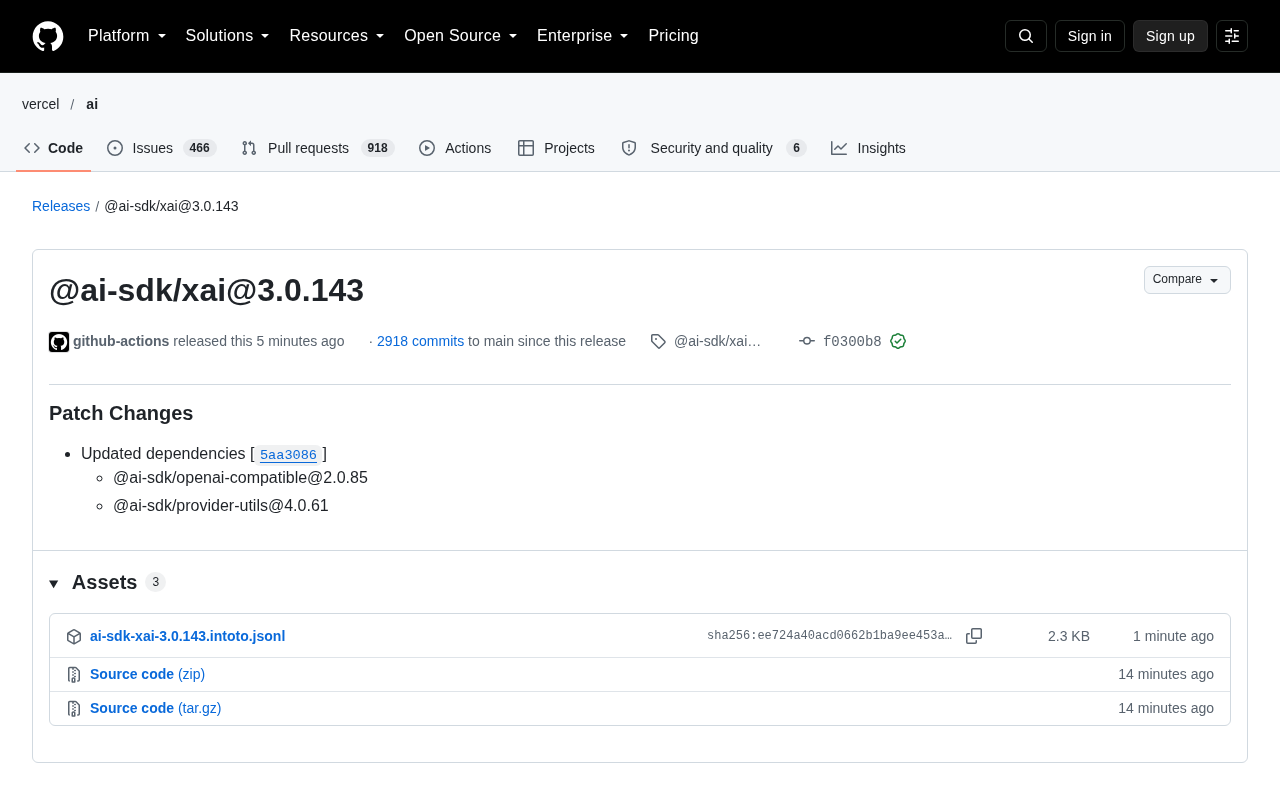
According to the release notes, 3.0.143 is a typical patch-level change, with the core action being syncing upstream dependencies: @ai-sdk/openai-compatible bumped to 2.0.85, and @ai-sdk/provider-utils bumped to 4.0.61. Both dependency updates point to the same commit 5aa3086.
This reveals a key piece of information: @ai-sdk/xai does not implement xAI's communication protocol from scratch, but rather builds on top of the openai-compatible layer. xAI's API is designed to closely follow OpenAI's interface specification, so reusing the compatibility layer can significantly reduce maintenance costs. When the compatibility layer fixes certain edge-case behaviors or tool calling details, the xai package only needs to follow along with the upgrade.
The provider abstraction layer of AI SDK: Vercel AI SDK uses a layered design. @ai-sdk/provider defines the unified interface specification (such as LanguageModelV1), @ai-sdk/provider-utils provides common utilities like request construction and streaming parsing, while each provider package (such as @ai-sdk/openai, @ai-sdk/anthropic) is only responsible for adapting each vendor's API to this interface. @ai-sdk/openai-compatible is a higher-level reuse layer, specifically serving third-party services whose interfaces resemble OpenAI's (xAI, DeepSeekAd, Groq, etc.), bridging the Chat Completions format's request/response handling. Therefore, @ai-sdk/xai itself has extremely thin code, with the real protocol logic residing in the compatibility layer.
Semantic versioning and patches: According to SemVer conventions, in the version number MAJOR.MINOR.PATCH, the patch position is only used for backward-compatible bug fixes. 3.0.143 means the API surface is unchanged, but the behavior of internal dependencies may have been fine-tuned. This is also why the author emphasizes "no new features" yet it still deserves attention—the risk is not in the interface, but in the actual execution results of transitive dependencies.
Why Patch Updates Deserve Attention
Looking at a single patch update in isolation, it seems there are no new features. But changes in the dependency chain often hint at upstream fixes. provider-utils is a common module in AI SDK that handles request construction, streaming parsing, and error mapping, and its version changes affect all provider packages simultaneously.
For teams already using xAI models in production, the significance of such updates lies in behavioral consistency: output formats, streaming events, and error types across different providers will remain aligned, reducing the cost of writing separate adapter code for each model.
Transitive dependencies and version hoisting: In the npm/pnpm ecosystem, if multiple packages that a project directly depends on share the same underlying package (such as provider-utils), the package manager will decide whether to reuse the same instance or install multiple copies based on version ranges. When @ai-sdk/xai bumps provider-utils to 4.0.61 while other packages in the project are locked at 4.0.55, there may be "two copies of provider-utils coexisting," causing cross-package logic such as instanceof checks and error type determination to fail. This is precisely the underlying reason why the author recommends regression testing streaming responses and tool calls after upgrading—it's not that the xai package itself has problems, but rather the hidden risks brought by dependency graph rearrangement.
Practical Impact on Developers
The upgrade method is straightforward: simply bump @ai-sdk/xai to 3.0.143 in your dependency declarations. Since it's a patch version, according to semantic versioning conventions it should not introduce breaking changes.
The area to watch out for is transitive dependencies: if your project also uses @ai-sdk/openai-compatible or @ai-sdk/provider-utils, the package manager may hoist or reuse a certain version. It's recommended to run your existing model calling tests after upgrading to confirm that streaming responses and tool calls are functioning normally.
Summary
3.0.143 is not a feature release, but an ecosystem alignment. It reflects how the AI SDK's multi-provider architecture operates: common layer fixes, providers follow. Paying attention to these minor versions makes it easier to control risk than waiting until a major version to upgrade.
One-line Summary
@ai-sdk/xai releases 3.0.143 patch, only syncing underlying dependencies, reflecting the alignment mechanism of the AI SDK's multi-provider ecosystem.
Paragraph Summary
@ai-sdk/xai has released patch version 3.0.143. This package is responsible for connecting xAI models to Vercel AI SDK's unified calling interface. This update is a typical patch-level change, with the core action being syncing upstream dependencies: @ai-sdk/openai-compatible bumped to 2.0.85, and @ai-sdk/provider-utils bumped to 4.0.61, both pointing to the same commit. This reveals that @ai-sdk/xai does not implement xAI's communication protocol from scratch, but builds on the openai-compatible layer, since xAI's API closely follows OpenAI's interface specification. Although a single patch may seem to have no new features, dependency chain changes often hint at upstream fixes—especially since provider-utils, as a common module handling request construction, streaming parsing, and error mapping, affects all provider packages simultaneously, thereby maintaining behavioral consistency across multiple providers. For developers, the upgrade method is straightforward, but attention should be paid to transitive dependencies that may be hoisted or reused. It's recommended to regression test streaming responses and tool calls after upgrading.
Related articles

JobRunner MCP Server: AI Agents Can Now Fix Failed Java Jobs
JobRunner launches an open-source MCP server enabling AI agents to view cluster status, diagnose failures, and recover Java jobs—incident response from any cloud coding environment or existing agent.

MLAI Digital Launches 9 Security Agents: MCP Server Safeguards the Full Lifecycle of Agentic AI
MLAI Digital launches Security MCP Server with nine built-in specialized security agents covering vulnerability discovery, attack simulation, prompt injection detection, API and infrastructure assessment, and accelerated remediation—embedding security validation across the full Agentic AI lifecycle from development to production.

Running Isaac Lab on H100 GPUs: Exploring Better Approaches
Exploring optimization methods for running Isaac Lab on NVIDIA H100 GPUs, including MIG configuration, mixed precision, TensorRT acceleration, and community experience to improve robotics simulation and reinforcement learning efficiency.