AI SDK's xAI Adapter Package Updates to 5.0.21: A Patch-Level Dependency Sync

@ai-sdk/xai releases patch version 5.0.21, syncing upstream dependencies only with no functional changes.
In the Vercel-maintained AI SDK ecosystem, the official Provider package @ai-sdk/xai for the Grok series has released version 5.0.21. This is a patch-level update with no new interfaces or behavioral changes — it only bumps @ai-sdk/provider-utils to 5.0.59 and @ai-sdk/provider to 4.0.27, corresponding to three dependency-related commits, automatically published by GitHub Actions. The article uses this to outline AI SDK's three-layer architecture: provider defines common interfaces and type contracts, provider-utils provides shared utilities, and adapter packages like xai only translate API semantics. This design keeps the adapter layer thin, but any upstream change triggers batch downstream releases. Projects directly using this package should follow along with the upgrade to avoid dependency version drift with other @ai-sdk/* packages.
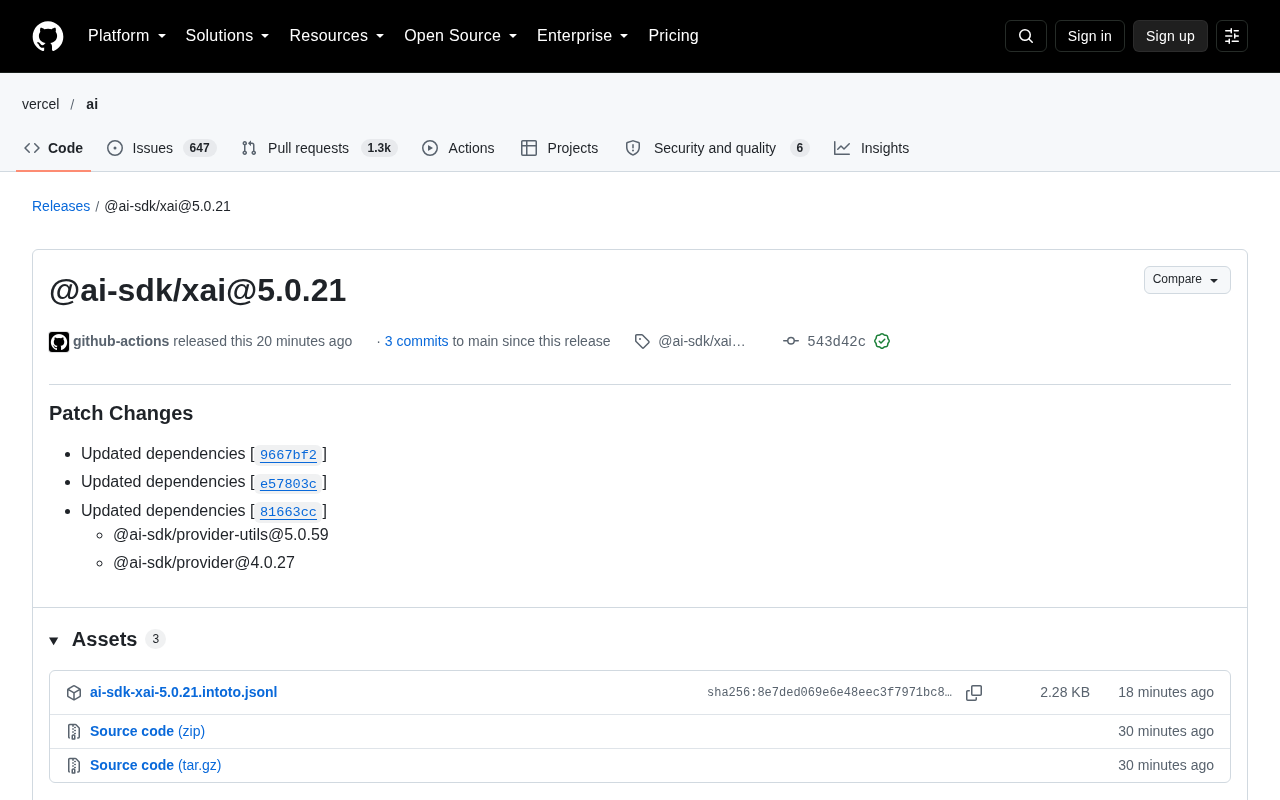
In the AI SDK ecosystem maintained by Vercel, @ai-sdk/xai is the official Provider package dedicated to interfacing with xAI (the Grok series of models). Its version 5.0.21 has been released, and based on the changes, this is a very fast-paced patch-level update.
What exactly changed in this update
The version number sits at Patch Changes, indicating there are no new interfaces, no behavioral changes — it simply brings two underlying shared dependencies up to date: @ai-sdk/provider-utils@5.0.59 and @ai-sdk/provider@4.0.27.
The three dependency update records listed in the official release note correspond to three different commit hashes (9667bf2, e57803c, 81663cc). This combination of "three dependency changes, zero functional changes" is very common in AI SDK provider sub-packages — when the upstream provider abstraction layer fixes a bug or adjusts types, all downstream adapter packages need to sync once.
For applications using @ai-sdk/xai, the most direct change after upgrading comes from the provider-utils and provider packages themselves, not from the xAI adapter layer logic.
Why AI SDK's sub-package architecture looks this way
To understand this update, you first need to understand AI SDK's dependency layering.
@ai-sdk/providerdefines the common interfaces and type contracts for Providers;@ai-sdk/provider-utilsprovides utility functions shared across Providers (request handling, streaming parsing, error wrapping, etc.);- Concrete adapter packages like
@ai-sdk/xaiare only responsible for translating xAI's API semantics into the common interface layer above.
The cost of this design is that "one upstream change triggers a cascade of downstream releases." The benefit is that the xAI adapter layer can remain extremely thin — when upstream fixes a streaming parser or type definition, all Providers benefit in sync.
From this perspective, the value of 5.0.21 isn't in what it changes itself, but in keeping @ai-sdk/xai on the same batch of dependency versions as other Providers in the ecosystem, avoiding type incompatibilities or streaming behavior differences caused by mixing in an older provider-utils.
Semantic Versioning (SemVer) is the key to understanding the magnitude of this update. SemVer specifies version numbers in the form MAJOR.MINOR.PATCH: a major version change represents incompatible, breaking API changes; a minor version represents backward-compatible feature additions; and a patch number represents only backward-compatible bug fixes. @ai-sdk/xai sitting at 5.0.21 means the major version hasn't moved, the minor version hasn't moved, and only the patch number has incremented — which is why the official release categorizes it as Patch Changes and explicitly states there are no interface or behavioral changes. This also explains why syncing dependencies itself gets recorded as a release: in the SemVer context, even if you're just bumping provider-utils from an old version to 5.0.59, as long as the downstream package's dependency declaration changes, the lockfile and installation result may differ — requiring a traceable new version number to carry this change. For projects sensitive to dependency chains, the first thing they look at when judging the risk level of an upgrade is often which segment of the version number it falls into.
Who needs to care about this update
If your project directly uses @ai-sdk/xai to call Grok models, it's advisable to follow along with the upgrade. The risk of being locked to an old version of provider-utils typically isn't in the xAI calls themselves, but in dependency version drift that occurs when coexisting with other @ai-sdk/* packages (such as the ai core package or other Providers).
If you only use the ai core package and haven't explicitly installed the xAI adapter layer, this update is irrelevant to you.
You may not have noticed that this release was completed automatically by GitHub Actions (marked with github-actions in the release), and carries a GitHub verification signature. For teams concerned about supply chain security, this means the release artifact's origin is traceable — but it doesn't mean the specific changes in the underlying dependencies have undergone manual review.
Dependency version drift refers to multiple packages in the same ecosystem each locking to different versions of the same underlying dependency, making it difficult to predict which version is actually loaded at runtime. In the AI SDK scenario, the ai core package, @ai-sdk/xai, and other @ai-sdk/* Providers often all declare @ai-sdk/provider-utils and @ai-sdk/provider as dependencies. If their version constraint ranges are inconsistent, the package manager may keep only one copy when flattening node_modules, or may install multiple copies in a nested manner. The former causes a package to unexpectedly use a version it didn't anticipate, while the latter can result in two sets of type definitions or two sets of streaming parsing logic within the same process. Both can manifest as type errors, abnormal streaming chunk boundaries, or even hard-to-reproduce runtime errors. Using a lockfile to pin versions and upgrading the same batch of @ai-sdk/* packages together is precisely how you minimize this uncertainty.
AI SDK's maintenance approach as seen from its release cadence
High-frequency rolling of Patch versions is the norm for projects like AI SDK with "multi-Provider adapter layers." Every new model added, every streaming boundary issue fixed, can trigger a round of dependency syncing.
For developers, practical approaches include:
- Using dependency lockfiles to pin specific versions, avoiding accidentally pulling incompatible combinations in CI;
- Regularly batch-upgrading the same set of
@ai-sdk/*packages, rather than sporadically upgrading individual ones; - Paying attention to semantic version changes in
providerandprovider-utils— their changes are the signals at the behavioral level.
5.0.21 itself doesn't introduce "new capabilities," but it reflects the maintenance cost that inevitably arises once AI SDK makes Providers into pluggable modules. To continuously follow xAI's model updates, you have to accept the existence of these high-frequency small versions and automate the upgrade process on the engineering side.
One-line Summary
@ai-sdk/xai releases patch version 5.0.21, syncing upstream dependencies only with no functional changes.
Paragraph Summary
In the AI SDK ecosystem maintained by Vercel, the official Provider package @ai-sdk/xai for the Grok series of models has released version 5.0.21. This is a patch-level update with no new interfaces or behavioral changes — it simply bumps @ai-sdk/provider-utils to 5.0.59 and @ai-sdk/provider to 4.0.27, corresponding to three dependency-related commits, and was automatically published by GitHub Actions. The article uses this as an opportunity to outline AI SDK's three-layer architecture: provider defines common interfaces and type contracts, provider-utils provides shared utility functions, and adapter packages like xai only handle API semantic translation. This design keeps the adapter layer extremely thin, but any upstream change triggers batch downstream releases. Projects directly using this package are advised to follow along with the upgrade to avoid dependency version drift with other @ai-sdk/* packages.
Related articles

Chain of Thought Isn't Just for AI: How Humans Can Use CoT to Improve Thinking Quality
Chain of Thought isn't just a prompt trick for large models. Starting from a Hacker News discussion, this article analyzes why CoT works for human thinking too, breaks down actionable ways to transfer it, and highlights the key differences between human CoT and machine CoT.
Cloudflare Teams Up with OpenAI: Closi…
Cloudflare Teams Up with OpenAI: Closing the Loop from Vulnerability Discovery to Defense with AI
Cloudflare uses OpenAI Daybreak to investigate security vulnerabilities and generate reviewable remediation plans, while developers use Codex to boost coding efficiency and quality.

Orca Multi-Agent Orchestration in Practice: A Guide to Parallel Collaboration with Claude and Codex
Orca is Stable AI's free open-source agent workbench supporting 34 agents like Claude Code and Codex in parallel. Learn its Git worktree isolation, multi-model orchestration, and mobile management.