AI SDK's ZAI Adapter Releases Patch Update with Synchronized Dependency Chain Upgrades

@ai-sdk/zai releases patch 2.0.18, focused on dependency synchronization with no breaking changes.
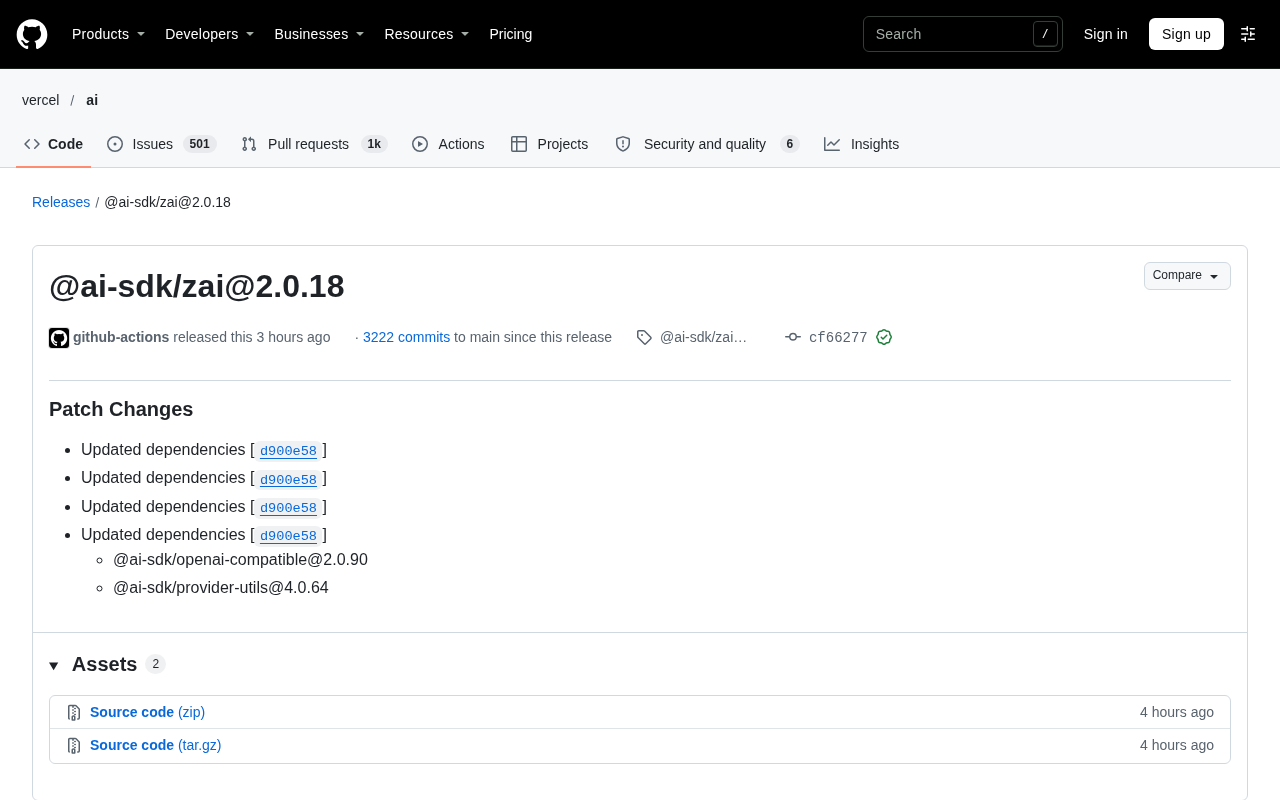
@ai-sdk/zai 2.0.18 is a patch-level release produced automatically by github-actions, based on 3222 commits accumulated on the main branch. The core changes upgrade @ai-sdk/openai-compatible to 2.0.90 and @ai-sdk/provider-utils to 4.0.64, all pointing to the same commit d900e58. The article notes that this "parent package patch + underlying dependency patch" linked pattern is common in multi-provider adapter projects, allowing the ZAI adapter to indirectly inherit upstream fixes in request wrapping, error handling, and stream parsing, and reducing cross-provider behavioral differences. Automated releases and commit signing reflect standardized CI/CD and supply chain security practices. For users, this upgrade keeps the API unchanged with a smooth path; following patches within the lockfile's allowed range is recommended, and if dependencies are strictly locked, related versions can be manually aligned after tests pass. Resource loading errors on the release page are GitHub rendering issues and do not affect installation.
The @ai-sdk/zai package in the AI SDK ecosystem has released version 2.0.18, a typical patch-level update. According to the GitHub release record, this version was published by the automated workflow github-actions at 03 Nov 01:21, based on 3222 commits accumulated on the main branch.
Reaching version number 2.0.18 means the project is now on a stable 2.x iteration track. Patch updates typically focus on bug fixes, dependency alignment, and compatibility maintenance rather than introducing breaking changes.
Patch Content: Primarily Dependency Updates
The changelog for this release is quite restrained. The core entries are multiple "Updated dependencies" items, all pointing to the same commit d900e58. The dependencies updated include:
@ai-sdk/openai-compatible@2.0.90@ai-sdk/provider-utils@4.0.64
The version number changes show that the underlying toolchain is advancing in sync: openai-compatible has reached 2.0.90, and provider-utils has reached 4.0.64. This "parent package patch + underlying dependency patch" linked release pattern is quite common in multi-provider adapter projects like AI SDK.
Why Dependency Updates Matter
For developers who use @ai-sdk/zai directly, dependency updates often mean upstream fixes are inherited indirectly. provider-utils typically carries foundational capabilities such as request wrapping, error handling, and streaming response parsing, while openai-compatible handles integration with services that follow the OpenAI protocol. Synchronized upgrades of both help ensure the ZAI adapter behaves consistently with other compatibility layers, reducing hidden discrepancies when switching between providers.
@ai-sdk/provider-utils is the shared foundational utility library for all provider adapters in Vercel AI SDK. It provides common functions such as generateId, loadApiKey, postJsonToApi, and createJsonResponseHandler, as well as wrappers like StreamingTextResponse needed for streaming response parsing. It also defines standard implementations for retry strategies, error normalization, and request header handling, so that each provider package only needs to focus on protocol differences without reimplementing network-layer details. When provider-utils gets a minor version upgrade, it often comes with fixes to default timeouts, error type mappings, or stream parsing edge cases—changes that transparently propagate to all upper-layer adapters.
@ai-sdk/openai-compatible, on the other hand, is a "protocol template" package that abstracts the OpenAI Chat Completions request/response structure into a reusable factory for providers like ZAI, DeepSeekAd, and Groq that follow the compatible protocol to inherit. The ZAI adapter is essentially an instantiated configuration of this template, so a patch version bump of openai-compatible often means enhanced compatibility with protocol details (such as tool_calls format and finish_reason values), which directly improves the ZAI adapter's stability when interacting with real services.
Engineering Signals from Automated Releases
The release record shows github-actions as the publisher, 3222 commits merged into the main branch, and commits with GitHub-verified signatures (GPG key ID identified as B5690EEEBB952194). Together these indicate that the project follows fairly standardized CI/CD and commit signing practices. Patch versions produced by automated workflows mean that mechanical work like dependency upgrades has been incorporated into the pipeline, reducing the risk of omissions from manual releases.
In monorepos like this, GitHub Actions is typically used in conjunction with changesets or release-please workflows: when a dependency-upgrade PR is merged, the bot automatically calculates the semantic version number, generates the changelog, creates the tag, and publishes to npm. GPG signatures on commits (completed with GitHub-hosted keys) allow git log --show-signature to verify commit provenance and prevent supply chain poisoning. 3222 commits merged into main indicates that the project follows trunk-based development with short-lived branches, and the patch version is just a snapshot of this continuous integration pipeline at a point in time. This model shifts from "humans deciding what to release" to "machines deciding when to release," at the cost of lower changelog information density, with the benefit of a stable release cadence and fewer omissions.
Practical Impact on Users
For the vast majority of users, this kind of patch update is imperceptible: the API is unchanged and the upgrade path is smooth. It is recommended to accept patch upgrades within the range allowed by the lockfile to obtain upstream dependency fixes. If your project strictly locks dependency versions, you can manually align the versions of @ai-sdk/openai-compatible and @ai-sdk/provider-utils after verifying tests pass.
It is worth noting that the release page itself shows several resource loading error messages (such as failures to load label filters and resource lists). These are GitHub page rendering issues unrelated to the package content and do not affect normal installation via a package manager.
Summary
@ai-sdk/zai@2.0.18 is a low-risk patch release centered on dependency synchronization. It brings no new features but reflects the ongoing maintenance of underlying consistency in the AI SDK's multi-provider adapter layer. For developers, keeping up with patch-level releases is the lowest-cost maintenance strategy.
Related articles

AI Tools Quietly Altering Settings: Postman Silently Installs Plugin, Codex Sharing Option Auto-Resets
AI Daily reports: Postman silently installs a Mac plugin and self-approves startup hooks, logged as auto-existing upgrade; Hacker News developers say Codex data-sharing opt-out flips back. Plus Simon Willison's raw float weight experiment with QEN 3.8-27B.

AI Learns to Rewrite AI: MIT's "Weightspace Programming" Redraws the Path to Recursive Self-Improvement
MIT team proposes weightspace programming: GPT-6 Astra reads and edits AI model weights directly. Math scores jump several-fold, hand-written networks beat trained models. Eight experiments analyzed, plus Anthropic's same-day warning and the real boundaries of recursive self-improvement.

Running Qwen 3.8 on a Laptop to Read Raw Weights: 46 Minutes Per Answer
Simon Willison reproduced weight space programming with Qwen 3.8 27B on a laptop: a 17GB model file, 46 minutes per answer, 43,506 reasoning tokens, Pong over an hour, Freeway failed. Suited for interpretability researchers.