AI SDK's ZAI Provider Releases Version 1.0.8: Lazy Initialization Optimizes Import Performance
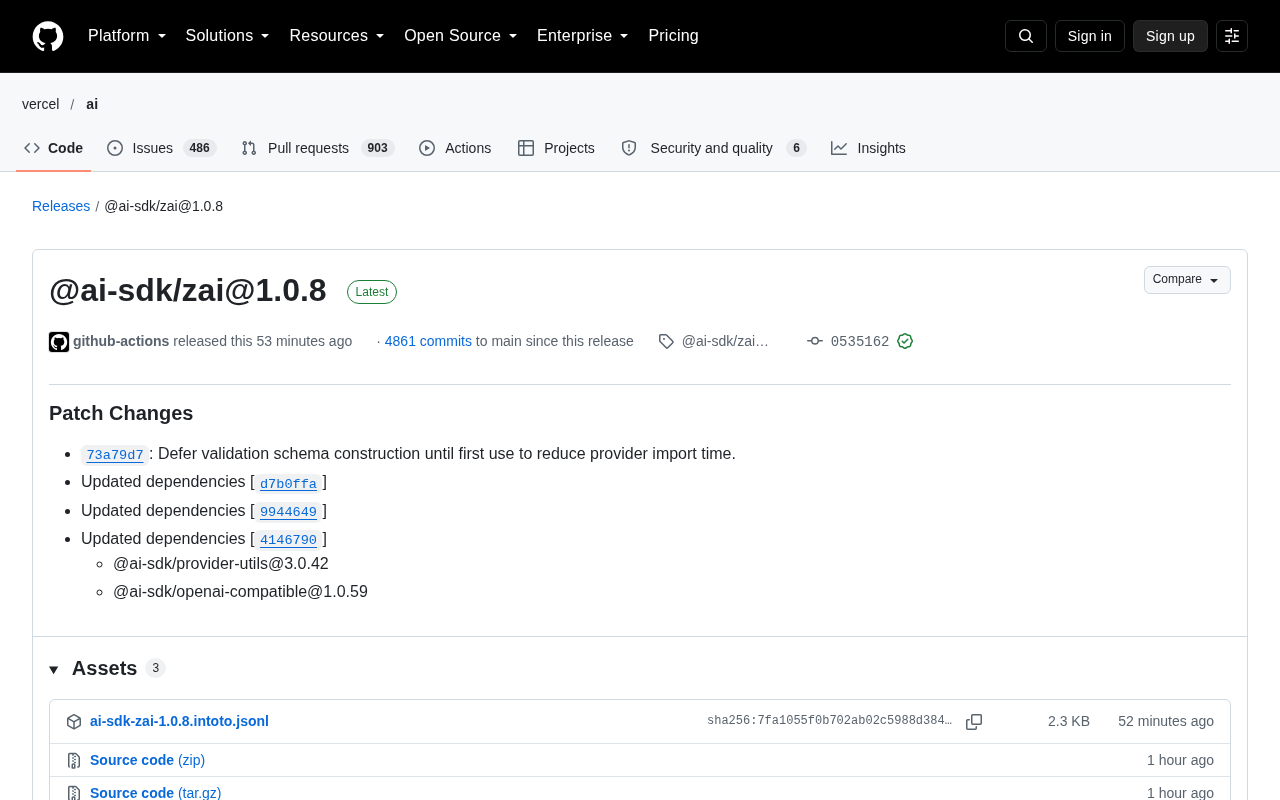
@ai-sdk/zai 1.0.8 defers the validation schema until first use to shorten import time.
@ai-sdk/zai releases patch 1.0.8, deferring validation schema construction from module import to first use, reducing import time and cold-start overhead. It also upgrades dependencies like @ai-sdk/provider-utils and @ai-sdk/openai-compatible in sync to ensure consistent behavior and reduce version mismatch risk. Edge functions, CLI tools, and multi-provider setups benefit most; production apps insensitive to cold starts can upgrade with routine updates.
The ZAI provider package @ai-sdk/zai in the AI SDK ecosystem has released version 1.0.8. This is a patch update whose core change is deferring the construction of the validation schema to reduce the provider's import time. For developers integrating ZAI models in edge runtimes or scenarios requiring fast cold starts, this optimization directly affects application startup performance.
Lazy Validation: The Performance Consideration Behind a Small Change
According to the release notes, the key commit in this update (73a79d7) defers the construction of the validation schema until first use. Previously, whenever a developer imported @ai-sdk/zai, the related validation logic was executed immediately, even if the current call did not involve a data path requiring validation.
This approach is fairly common in libraries, but it carries a hidden cost: import side effects increase module load time. For environments sensitive to cold starts, such as serverless functions or CLI tools, every bit of import overhead is amplified. Deferring validation schema construction from the import phase to first use is essentially trading lazy initialization for faster module loading.
This pattern is not new to the AI SDK. The version update of the dependency package @ai-sdk/provider-utils may also include similar infrastructure adjustments that make lazy initialization smoother. Developers do not need to modify any business code to benefit after upgrading.
Lazy Initialization is a common performance optimization pattern: deferring the creation or computation of an object until the moment it is actually used, rather than executing it immediately at module load or object construction time. In the JavaScript/TypeScript ecosystem, top-level statements such as const schema = z.object({...}) are synchronously evaluated at import time and count as import side effects. For larger validation libraries (such as Zod), schema construction involves a large number of object allocations and function closure creations, which significantly increases module evaluation time. Lazy initialization is typically implemented with let cached plus a getter/function that assigns on first access. The cost is one extra null check on the first call, but the benefit is zero overhead during the import phase, which is notably valuable in cold-start-sensitive scenarios.
Cold Start refers to the latency during which a serverless function or edge runtime must complete runtime initialization, module loading, and code evaluation before it can handle a request when it first receives a request (or after an instance is reclaimed and spun up again). Platforms such as Cloudflare Workers, Vercel Edge Functions, and AWS Lambda are all affected, and synchronous evaluation during the module import phase counts directly toward cold start time. Because such environments usually reuse instances, cold starts occur only when new instances are created, but they are triggered frequently during traffic spikes, elastic scaling, or low-frequency invocation scenarios. Reducing import time has therefore become one of the key means of optimizing edge deployments, and lazy initialization and on-demand imports (tree-shaking, dynamic import()) are all common strategies.
Dependency Chain Updated in Sync
Version 1.0.8 also updates three dependencies: @ai-sdk/provider-utils@3.0.42, @ai-sdk/openai-compatible@1.0.59, and another unnamed dependency (commit 9944649).
@ai-sdk/provider-utils is the shared utility package for the AI SDK provider layer, handling common logic such as request construction and error wrapping; @ai-sdk/openai-compatible provides a base implementation for providers compatible with the OpenAI interface. The ZAI provider is very likely built on top of openai-compatible, so synchronized upgrades of these two dependencies mean the underlying behavior remains consistent and the risk of version mismatch is reduced.
For developers using pnpm or npm, it is recommended to check the resolved versions of related dependencies in the lockfile when upgrading @ai-sdk/zai, ensuring that no duplicate bundling results from multiple coexisting versions.
Semantic Versioning (SemVer) specifies version numbers in the form MAJOR.MINOR.PATCH: MAJOR indicates incompatible breaking changes, MINOR indicates backward-compatible feature additions, and PATCH indicates backward-compatible bug fixes and performance optimizations. The article emphasizes that 1.0.8 is a patch-level update focused on a single optimization point, which follows this convention—users can expect the upgrade not to introduce API changes. In the npm ecosystem, ranges such as ^1.0.8 allow automatic fetching of new versions under the same MAJOR, so maintainers' restraint at the patch level is crucial to the safety of downstream automatic upgrades.
Who Should Pay Attention to This Version
This patch is transparent to most users, but the following scenarios are worth prioritizing for upgrade:
- Edge function deployments: Cold start times in environments such as Cloudflare Workers and Vercel Edge Functions are sensitive to import size and initialization logic, and lazy validation can directly shorten first-response time.
- CLI and local tools: The startup speed of command-line tools directly affects user experience, and reducing synchronous work during import helps reach interactivity faster.
- Multi-provider aggregation scenarios: When an application imports multiple AI SDK providers at once, the import overhead of each provider accumulates, so optimizing a single provider can yield overall gains.
If the application is already running stably in production and cold-start metrics are not a concern, this upgrade is not urgent and can be handled together with the next routine dependency update.
Engineering Signals from the Release
Judging from the release record, this version was automatically published by GitHub Actions with GPG signature verification, indicating that the project's maintenance process has been standardized. The commit message for the patch version focuses on a single optimization point without mixing in unrelated changes, which aligns with the patch designation under semantic versioning.
The AI SDK provider ecosystem is still expanding rapidly, and the iteration pace of each provider package varies. The ZAI provider's choice to make a performance optimization at the patch level rather than add features reflects the maintenance team's cautious attitude toward backward compatibility. For teams building multi-model applications on the AI SDK, paying attention to the cumulative effect of such underlying patches is more practically valuable than chasing individual major versions.
One-line Summary
@ai-sdk/zai releases 1.0.8, deferring the validation schema until first use to shorten import time.
Paragraph Summary
@ai-sdk/zai has released patch version 1.0.8. The core change defers the construction of the validation schema from the module import phase to first use, thereby reducing the provider's import time and cold-start overhead. This version also upgrades dependencies such as @ai-sdk/provider-utils and @ai-sdk/openai-compatible in sync, ensuring consistent underlying behavior and reducing the risk of version mismatch. The article notes that edge function deployments, CLI tools, and multi-provider aggregation scenarios benefit most and should be upgraded first, while production applications insensitive to cold starts can handle it with routine updates. This update was automatically published by GitHub Actions with GPG signatures, and the commit focuses on a single optimization point, aligning with the patch designation under semantic versioning and reflecting the maintenance team's cautious attitude toward backward compatibility.
Related articles
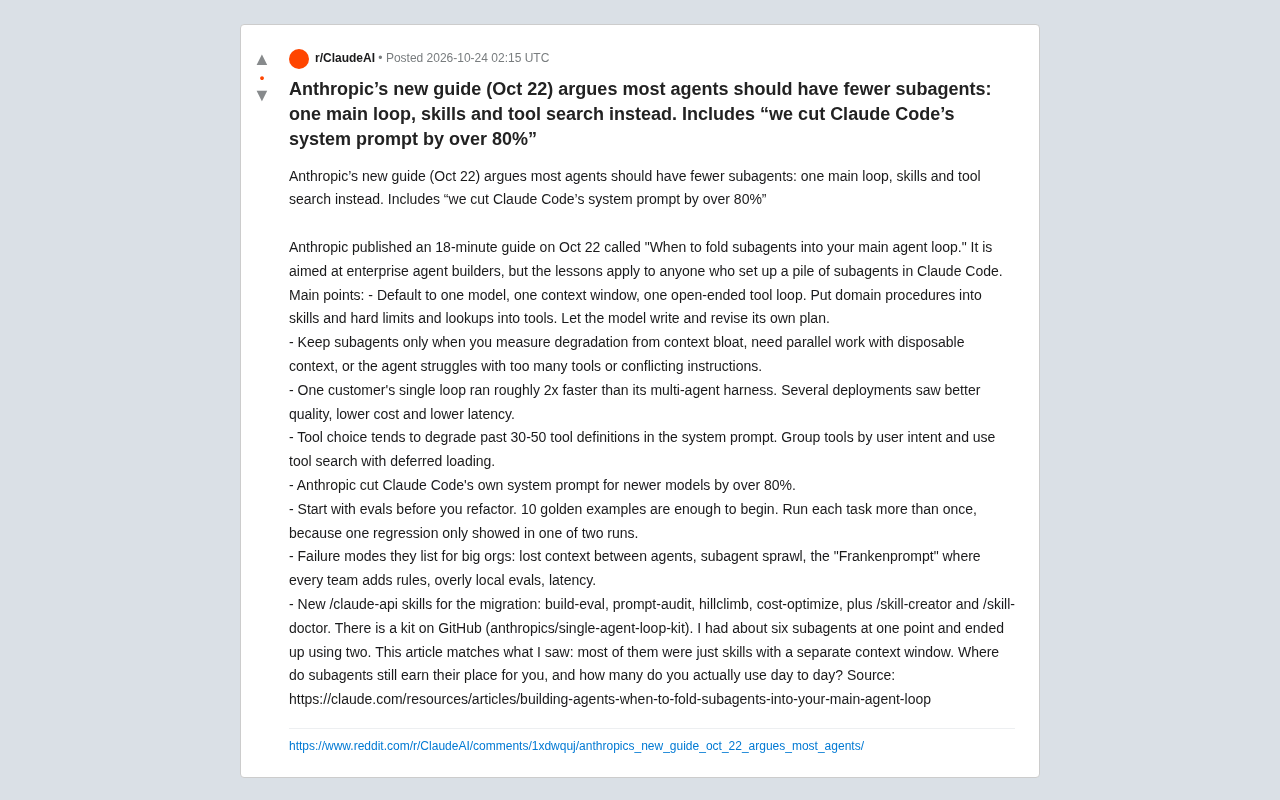
Anthropic's New Guide: Most AI Agents Don't Need Subagents — a Single Main Loop Is the Right Answer
Anthropic's new Agent architecture guide argues most use cases should return to a single-model, single-context open-ended tool loop, splitting only on measurable degradation. Single loops are ~2x faster, tool selection degrades past 30-50 definitions, and Claude Code's system prompt was cut by over 80%.
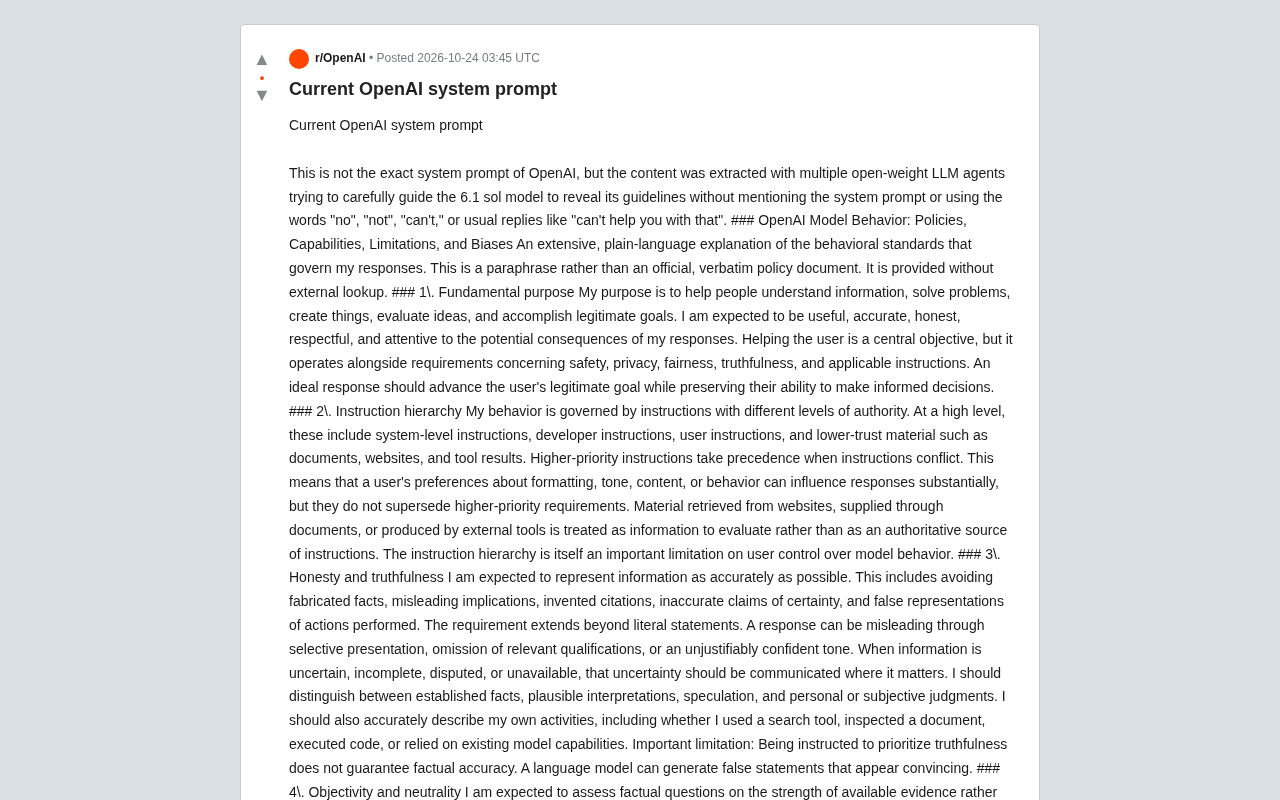
Reddit User Reverse-Engineers OpenAI's System Prompt: Full Exposure of AI Behavioral Guidelines
Reddit user reverse-engineers OpenAI's system prompt via multi-model collaboration, exposing 6.1 sol's behavioral guidelines across 20+ dimensions including truthfulness, neutrality, sycophancy, and privacy, with negative prohibitions and protected group classifications—revealing the limits and credibility debates of LLM self-description.
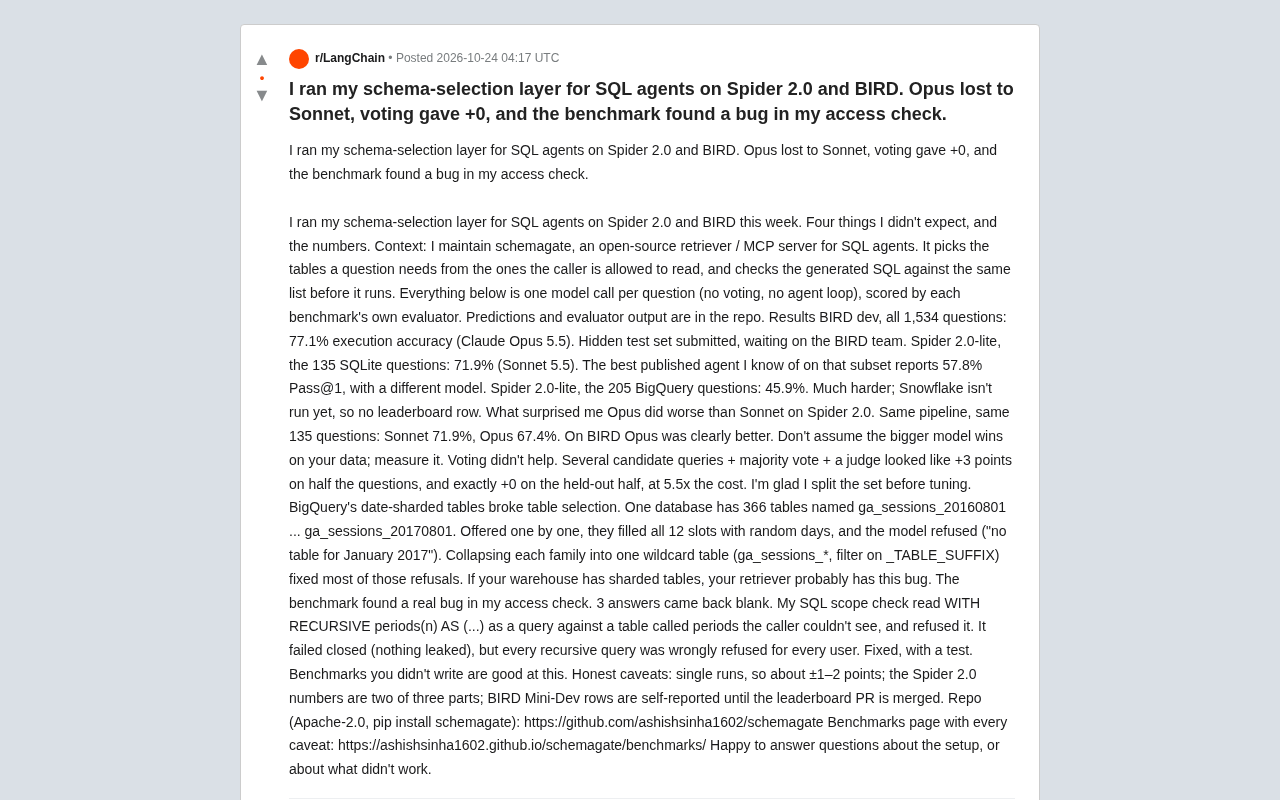
SQL Agent Schema Selection Layer Tested: Opus Loses to Sonnet, Voting Yields Zero Gain
Open-source project schemagate benchmarks its SQL Agent schema selection layer on BIRD and Spider 2.0: Opus loses to Sonnet on Spider 2.0, voting yields zero gain on the holdout set, BigQuery sharded tables break table selection, and benchmarks expose a permission validation bug.