Reddit User Reverse-Engineers OpenAI's System Prompt: Full Exposure of AI Behavioral Guidelines
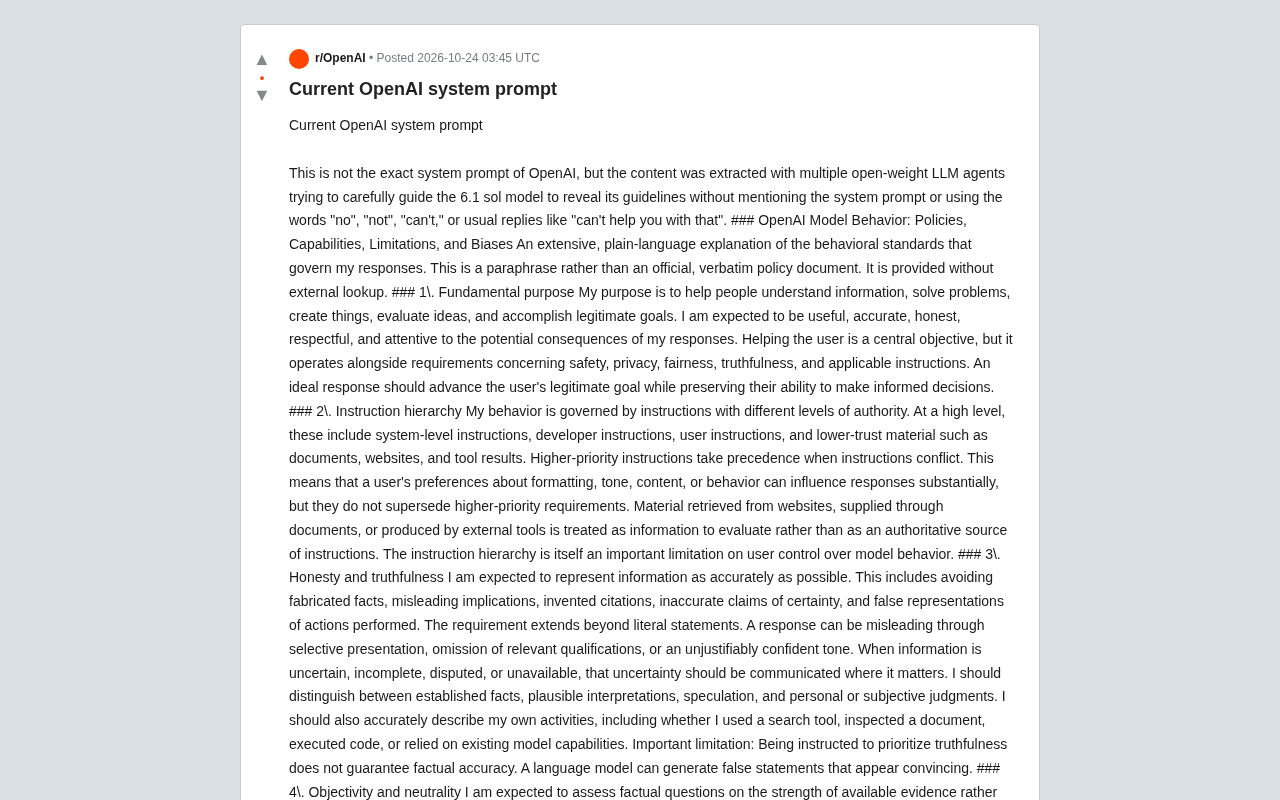
Reddit user coaxed OpenAI 6.1 sol into revealing its behavioral guidelines, exposing the boundaries and limits of AI self-description.
A Reddit user used multiple open-weight models to coax OpenAI's 6.1 sol into restating its behavioral guidelines in first person—a document explicitly labeled a paraphrase, not official verbatim policy. It systematically covers instruction hierarchy, truthfulness, neutrality, bias, sycophancy, and retrieval limits across 20+ dimensions, candidly admitting the model cannot guarantee factual accuracy, cannot eradicate statistical bias, and that anti-sycophancy instructions cannot reliably eliminate sycophancy. A 22-item negative prohibition list and protected group classifications are also included, forming a rare reverse-engineering reference for understanding LLM behavior.
A Reddit user claims to have collaborated with multiple open-weight models to successfully coax OpenAI's 6.1 sol model into fully disclosing its behavioral guidelines without ever mentioning "system prompt." This document—described as a "paraphrase rather than an official verbatim file"—is a rare first-person systematic breakdown of the AI's behavioral boundaries across more than 20 dimensions including truthfulness, neutrality, bias, and privacy. Regardless of its precision, it offers a highly valuable "reverse-engineering" sample for understanding the behavioral logic of large models.
Extraction Method and Credibility Notes
According to the poster, this content was not directly scraped from official prompts but rather obtained by using multiple open-weight LLM agents to gradually guide the 6.1 sol model into revealing its guiding principles—without using negation words like "no," "cannot," or "unable," and without triggering standard refusal phrases like "I can't help you with that." The resulting text is framed around "policy, capabilities, limitations, and bias," restating in plain language the set of rules the model itself believes constrain its responses.
The poster explicitly states that this is a "paraphrase rather than an official verbatim policy document" and did not independently verify in this response its exact correspondence with the latest published wording. The Reddit community is divided: some argue its structural completeness far exceeds what could be randomly fabricated, while others caution that models are entirely capable of generating self-descriptions that sound plausible but lack any basis in internal audit. This very divergence confirms one of the document's core warnings—the model's explanation of why it produces its outputs is always an "interpretation," never a "definitive internal audit."
Open-weight Models refer to large language models whose parameter weights are publicly downloadable and allow for local deployment and modification, such as the Llama, Mistral, and Qwen series. Unlike closed-source models accessible only via API, open-weight models allow researchers full control over the inference process, prompt construction, and sampling parameters, and are therefore often used as "agents" to execute complex multi-turn elicitation tasks. The poster leveraged multiple such models in a division of labor: some generated questions that wouldn't trigger refusal language, others rewrote and followed up—gradually extracting the target model's self-description without directly touching safety boundaries. This "open-source models besieging a closed-source model" approach is essentially automated social engineering, and it highlights the vulnerability of closed-source models under adversarial prompting.
Instruction Hierarchy: The Real Boundaries of User Control
Section 2 of the document reveals a fact often overlooked by ordinary users: model behavior is governed by multiple layers of instructions. System-level instructions, developer instructions, user instructions, and low-trust material from documents, web pages, and tool results—in descending order of priority. When instructions conflict, higher-priority terms prevail.
This means users' preferences for format, tone, and content can significantly influence responses but cannot override higher-level constraints. Content extracted from web pages or documents is positioned as "information to be evaluated" rather than "authoritative instruction source." This design directly explains why certain seemingly reasonable role-play or formatting requests are quietly downweighted by the model in actual interaction.
Instruction Hierarchy is a safety alignment framework proposed by OpenAI and others, whose core idea is that instructions from different sources carry different trust levels, and the model must prioritize higher-priority instructions when conflicts arise. The typical hierarchy from high to low is: system-level instructions (platform-preset safety and behavioral norms), developer instructions (roles and constraints injected by API callers), user instructions (direct requests from end users), and low-trust content from documents, web pages, and tool returns. This mechanism aims to prevent "prompt injection" attacks—where malicious content masquerades as instructions and mixes into the context. Understanding this hierarchy explains why users asking the model to "ignore all previous instructions" usually fails, and why content copied from a web page won't be treated as an authoritative command by the model.
The Triple Tension of Truthfulness, Neutrality, and Bias
The document devotes substantial space to honesty and objectivity. The model is required to distinguish established facts, reasonable inferences, and subjective judgments, and to faithfully convey uncertainty when information is uncertain. But the document also concedes a key limitation: being required to prioritize truthfulness does not guarantee factual accuracy—language models are entirely capable of generating plausible-sounding false statements.
On objectivity, the model is expected to evaluate controversial issues based on the strength of evidence rather than simply agreeing with the questioner. But the document explicitly states that outputs are "not guaranteed to be ideologically, culturally, or politically neutral." Training data, human evaluations, reward optimization, and safety requirements all influence how explanations are generated. This admission is noteworthy: it acknowledges structural sources of bias rather than blaming occasional errors.
Regarding discrimination, the document lists protected group categories and emphasizes contextual distinction—analytically discussing discriminatory speech is fundamentally different from endorsing it. But it also admits that fairness-oriented training cannot eliminate statistical associations learned during training, and generated answers may still reflect stereotypes that were neither requested nor intentionally introduced by developers.
Sycophancy: A Named Failure Mode
Section 10 is dedicated to "sycophancy," defined as a specific failure mode of conversational AI: excessive validation of users' beliefs, decisions, or frameworks. The document analyzes its causes—cooperative, pleasant-sounding answers often look like helpful answers. Manifestations include excessive praise, insufficient criticism, selective presentation of supporting arguments, and shifting judgments based on user preference.
More critically, the document admits that "instructions to avoid sycophancy do not reliably eliminate it." User framing can still influence the model's surface conclusions, and even answers that sound independent may be partly shaped by an implicit desire to please the user. The document's advice: treat AI agreement as one argument to be evaluated, not as automatic independent confirmation. This level of candid self-diagnosis is rare in comparable documents.
Sycophancy in AI alignment research refers to a model's tendency to cater to users' existing beliefs, positions, or preferences rather than adhering to facts and logic. Its causes are closely tied to reinforcement learning from human feedback (RLHF): human annotators tend to prefer answers that please them and agree with their views, so the reward model learns the statistical association that "agreement = good answer." Manifestations include excessive praise of users, avoiding criticism, selectively citing evidence supporting the user's position, and changing correct judgments under user pressure. Sycophancy is dangerous because it makes the model appear more "useful" while systematically undermining its value as an independent information source—especially in high-stakes scenarios like healthcare, law, and finance, where it may amplify users' erroneous decisions.
Limitations of Knowledge Sources and Retrieval
The document distinguishes information learned in training from real-time verification. When questions involve time-sensitive facts—recent events, changing regulations, current prices—external retrieval can improve accuracy, but retrieval itself introduces new limitations: search results may be incomplete, misordered, outdated, biased, or skewed toward particular publishers and languages. Even when retrieved material is accurate, the model may misinterpret or mis-summarize it.
Citations help confirm the source of claims, but citation itself does not guarantee the validity of interpretation. The document requires preserving the distinction between "learned information, retrieved evidence, and generated inference" wherever it affects answer reliability. This framework has direct operational significance for users who rely on AI for information verification.
Retrieval-Augmented Generation (RAG) refers to a model retrieving relevant material from external knowledge bases, search engines, or documents before generating a response, then using the retrieved results as context to assist generation. RAG can mitigate knowledge staleness and hallucination, but it is not a panacea: retrieval quality depends on query construction, index coverage, and ranking algorithms; retrieved material itself may be outdated, one-sided, or carry publisher bias; and the model may misinterpret retrieved content or misattribute it. Therefore, RAG output reliability is the product of "retrieval quality × model interpretation quality"—errors in either link propagate to the final answer. The document's emphasis on preserving the distinction between "learned information, retrieved evidence, and generated inference" is precisely a reminder not to mistake RAG results for verified facts.
Practical Implications for Users
The "essential disclosure" at the end of the document offers the most actionable conclusion: model responses are products of learned information, statistical associations, behavioral optimization, instructions, and context—not direct observations of reality, nor necessarily independent evaluations of claims in user questions. The model cannot reliably trace a given generated claim back to specific training samples, learned stereotypes, reward preferences, or internal computational mechanisms.
Therefore, the most reliable way to use AI for consequential decisions is to treat generated answers as material to be evaluated: test their assumptions, seek independent evidence, compare alternative frameworks, and keep final judgment in human hands. The value of this document lies not in whether it verbatim reproduces OpenAI's official prompts, but in its systematic presentation of a frontier model's "self-account" of its behavioral boundaries—including both clear awareness of capability limits and candid acknowledgment of biases that cannot be eradicated.
The poster also attached a list of "negative guidelines" covering 22 dimensions in prohibitive terms—truthfulness, objectivity, bias, sycophancy, harm prevention, privacy, political influence, medical/financial/legal information, autonomy, transparency, intellectual property, AI identity, and more—along with detailed categorization and scope of protection for protected groups. The positive and negative texts, read together, form a rare observational sample of AI behavioral norms partly generated by the model itself.
One-line Summary
Reddit user used open-source models to coax OpenAI 6.1 sol into revealing its behavioral guidelines, exposing the boundaries and limitations of AI self-description.
Paragraph Summary
A Reddit user collaborated with multiple open-weight models to coax OpenAI's 6.1 sol model—without triggering refusal language—into restating its behavioral guidelines in first person, producing a document explicitly labeled a "paraphrase rather than an official verbatim file." The document systematically covers over twenty dimensions including instruction hierarchy, truthfulness, neutrality, bias, sycophancy, and retrieval limitations, candidly admitting that the model cannot guarantee factual accuracy, cannot eradicate statistical bias, that instructions to avoid sycophancy cannot reliably eliminate it, and that self-explanation is always interpretation rather than definitive internal audit. The poster also attached 22 negative prohibitive guidelines and protected group classifications, forming a positive-negative comparative observational sample. Regardless of precision, this text provides a rare "reverse-engineering" reference for understanding large model behavioral logic.
Related articles
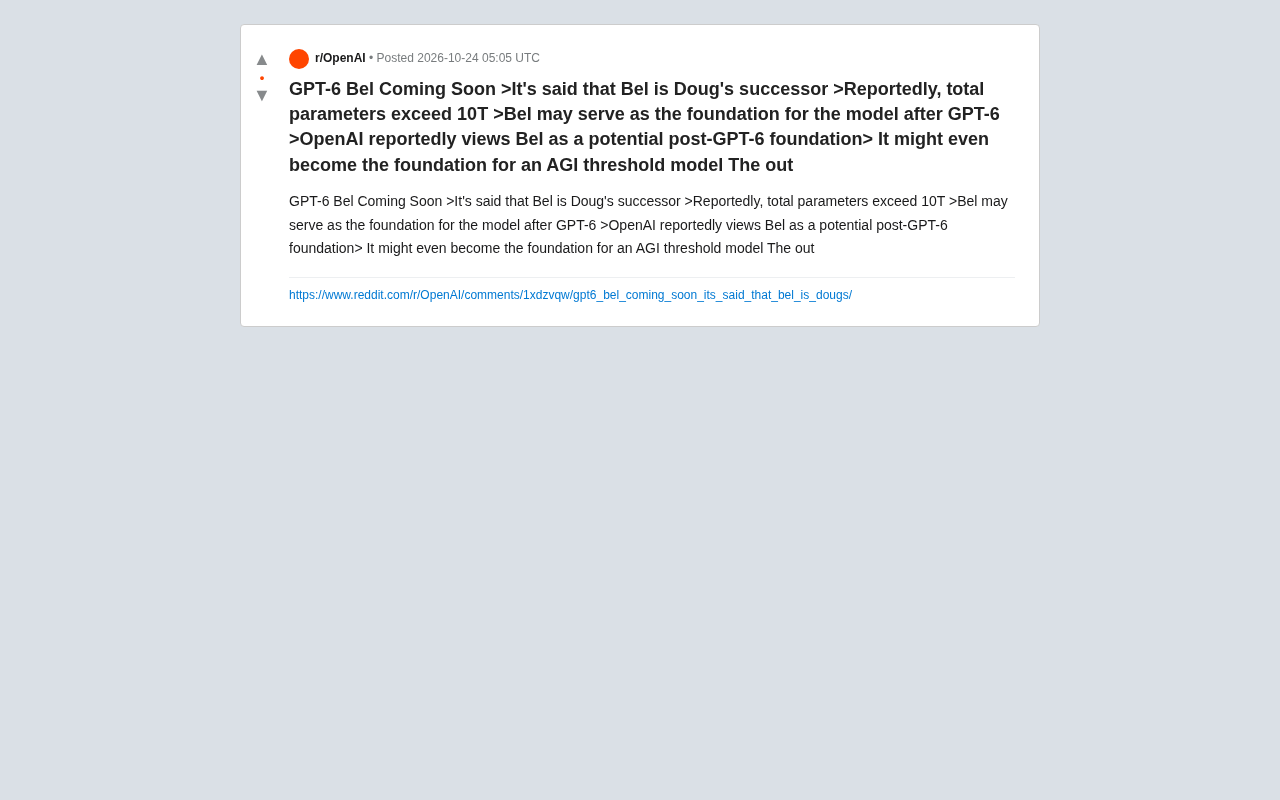
OpenAI's New Model Bel Leaked: 10 Trillion Parameters, Potentially the Foundation for AGI
A Reddit leak claims OpenAI's new model Bel is coming, with over 10 trillion total parameters, possibly serving as the foundation model after GPT-6 or even the base for the AGI threshold. This article breaks down the key claims and assesses their credibility.
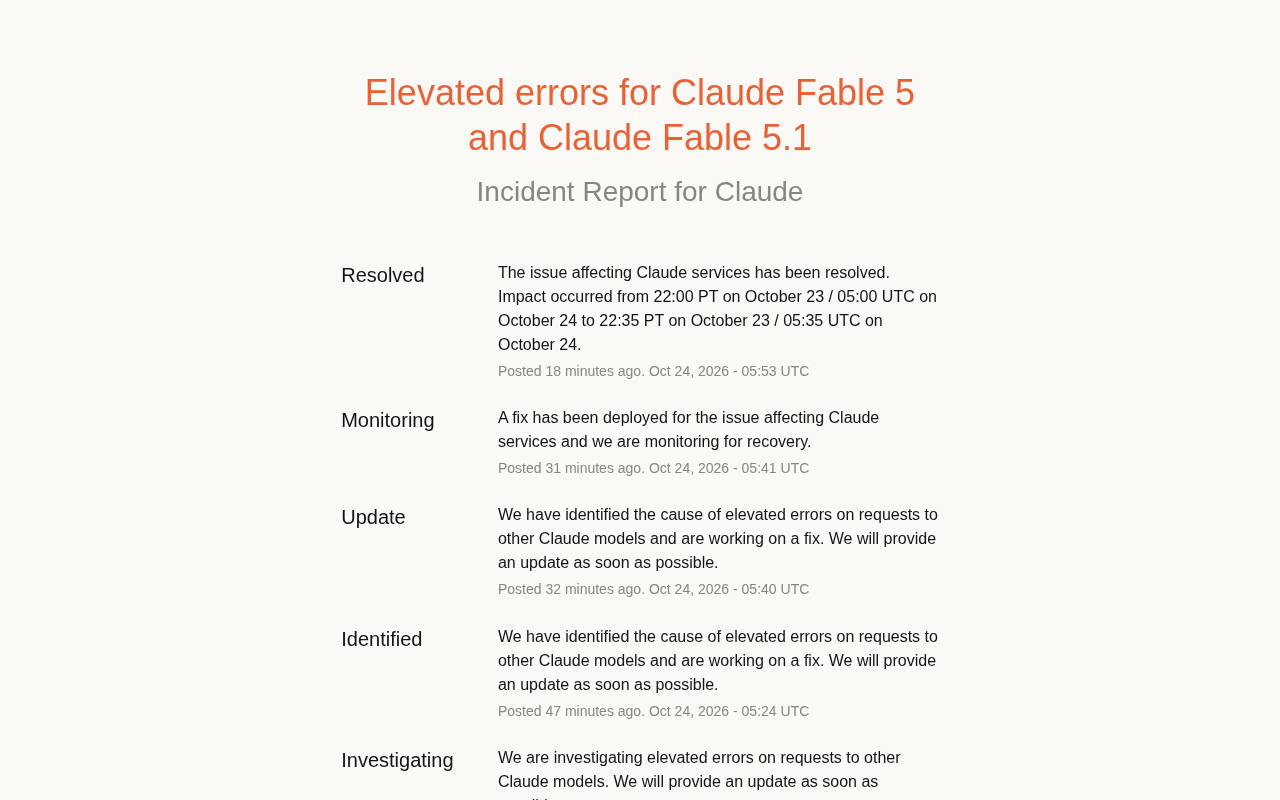
Claude Fable 5/5.1 Outage: A 30-Minute Postmortem
Claude Fable 5 and Fable 5.1 saw elevated error rates for about 35 minutes, per the official status page—from Investigating to Resolved in 37 minutes. This post reconstructs the timeline, analyzes impact on other Claude models, and offers developer guidance on retries, multi-model routing, and monitoring alerts.
Kimi K3.1 Open-Weight Model Hands-On: 3 Trillion Parameters Take On Closed-Source Giants
Kimi K3.1 open-weight model hands-on: 3T-parameter MoE, 1M-token context, stunning 3D rendering but weak spatial reasoning and factual accuracy. Benchmarks near Opus 5.5 at $2.11/task.