@ai-sdk/sandbox-just-bash 1.0.188 Patch Release: Dependency Updates and Security Practices

@ai-sdk/sandbox-just-bash releases patch 1.0.188, synchronizing dependencies and demonstrating automated releases and signature verification.
The sandbox package @ai-sdk/sandbox-just-bash in the AI SDK ecosystem has released patch version 1.0.188, with the core change being synchronization of the dependency @ai-sdk/harness@1.0.188, reflecting the ecosystem's synchronized versioning strategy. The release was automatically triggered by github-actions, contains only one commit, and carries a GitHub verified signature and GPG key ID, providing an auditable basis for supply chain security. For developers using sandbox capabilities, the article recommends watching upstream dependency change notes, confirming version alignment in the lock file, and verifying the dependency chain in a test environment before production. Overall, such small patches reflect the maturity of the AI toolchain's engineering standards, and developers should establish a systematic version upgrade strategy rather than tracing every patch individually.
The AI SDK ecosystem has always moved at a brisk pace, and this time it's the turn of the sandbox-related package @ai-sdk/sandbox-just-bash to ship a 1.0.188 patch release. Judging from the release record, this is a minor version update focused on dependency synchronization, driven by an automated pipeline and accompanied by GitHub signature verification. For developers who rely on this package to build sandbox environments for AI agents, understanding what these patches mean is more valuable than simply bumping the version number.
Patch Contents: A Chain Reaction Triggered by a Dependency Update
According to the release notes, 1.0.188 is a Patch Change, and the core action is updating the dependency @ai-sdk/harness@1.0.188. Note the version alignment here—sandbox-just-bash and harness are both at 1.0.188, which shows that multiple packages under the AI SDK umbrella follow a synchronized versioning strategy, where a single patch often pulls related packages up together.
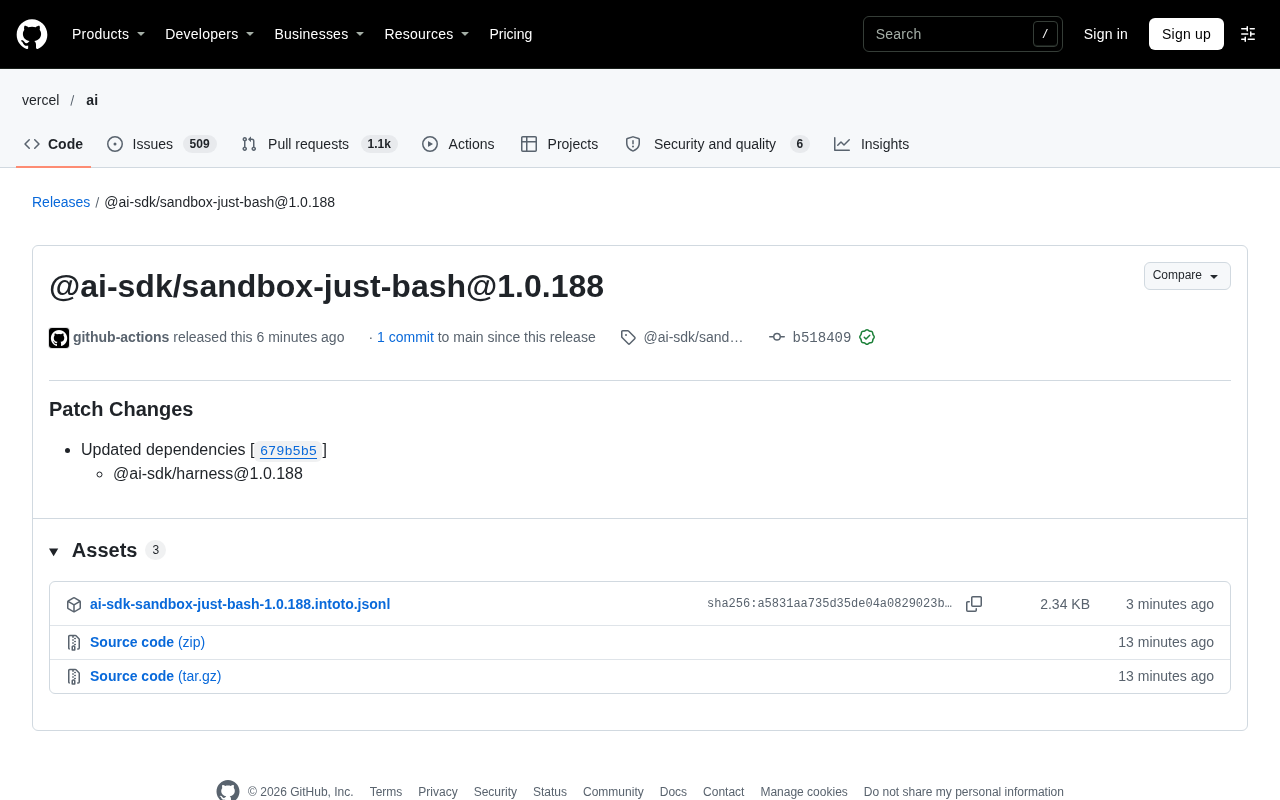
The benefit of this synchronization mechanism is high version consistency across the ecosystem, reducing compatibility issues caused by cross-package version mismatches; the cost is that the release notes for any single package carry limited information, and developers need to trace the dependency chain to find the actual changes. This release contains only 1 commit, triggered by the github-actions bot, making it a typical product of an automated release pipeline.
Patch versions in Semantic Versioning (SemVer): Under the SemVer specification, a version number consists of major.minor.patch (e.g., 1.0.188), where an increment to the patch number represents a backward-compatible bug fix or an internal dependency update, without introducing new features or breaking changes. Therefore, a patch release like 1.0.188 typically does not change the public API, but may include dependency synchronization, build configuration changes, or minor internal logic adjustments. Developers can use this convention to judge upgrade risk: patch upgrades are generally safe, but it is still advisable to verify in a test environment whether the dependency chain introduces unexpected behavior.
Trust Signals in the Release Process
There is a detail in the release record that is easy to overlook but worth noting: the commit was created by GitHub with a verified signature, along with a GPG key ID. For AI toolchains that are sensitive to supply chain security, this kind of signature verification is an important basis for judging the trustworthiness of a package's origin.
The combination of automated releases and signature verification means the process from code merge to package publication is auditable. When introducing or upgrading such dependencies, developers can perform basic security checks against the signature status and commit record. One detail: the release page itself showed a resource loading error message, but this is a GitHub rendering issue and does not affect the integrity of the package itself.
GPG signatures and supply chain security: GPG (GNU Privacy Guard) signatures are used to verify the authenticity and integrity of the origin of commits or released packages. On GitHub, a verified signature displays a "Verified" badge along with a key ID, indicating that the commit was signed by an entity holding the corresponding private key and that the content has not been tampered with. For open-source projects that rely on automated release pipelines, signature verification is a key part of supply chain security—it helps developers confirm that a package genuinely comes from the official repository's automated pipeline rather than a tampered counterfeit version. When introducing production dependencies, checking the signature status alongside the commit record can reduce the risk of dependency confusion attacks.
What This Means for Developers Using AI SDK Sandbox Capabilities
Judging from its name, @ai-sdk/sandbox-just-bash relates to bash execution capabilities within a sandbox environment, commonly used in scenarios where AI agents need to run commands in a controlled environment. Patch updates to foundational packages like this usually do not introduce breaking changes, but synchronized upgrades of the dependency chain should still be verified in a test environment first.
Practical recommendations: pay attention to the corresponding version change notes for @ai-sdk/harness, since the actual changes in sandbox-just-bash are determined by its upstream dependency; confirm version alignment in the lock file; and for production environments, prefer release versions that have passed signature verification. Patch versions may be small, but version discipline is precisely the part of AI engineering deployment that is most easily underestimated.
AI agent sandbox environments: A sandbox is an isolated runtime environment used to safely execute untrusted code or commands. In AI agent scenarios, agents often need to execute shell commands, access the file system, or call external tools; the sandbox prevents malicious or erroneous operations from affecting the host machine by restricting resource access, network permissions, and file system scope. @ai-sdk/sandbox-just-bash, judging from its name, provides the ability to run bash commands inside a sandbox and is a foundational component of the agent execution layer. Patch updates to such packages usually focus on dependency synchronization or internal stability, but when upgrading, you should still confirm whether the sandbox's isolation policy has changed.
Version Management Thinking in the Era of Automated Releases
This release record offers a glimpse into the engineering approach of the AI SDK project: a bot-driven release process, synchronized version numbers, signature verification, and GPG validation together form a relatively complete automated release chain. For application developers building on top of the AI SDK, rather than tracing the specific changes of every patch one by one, it is better to establish a version upgrade strategy—regularly synchronize patch versions, watch for major version changes, and add dependency integrity checks to CI.
Such small patch releases carry limited information in themselves, but they reflect the maturity of the entire AI toolchain in terms of engineering standards. As AI capabilities gradually settle into reusable SDK components, the rigor of the release process often determines whether upper-layer applications can depend on them with confidence.
One-line Summary
@ai-sdk/sandbox-just-bash releases patch 1.0.188, synchronizing dependencies and demonstrating automated releases and signature verification.
Paragraph Summary
The sandbox package @ai-sdk/sandbox-just-bash in the AI SDK ecosystem has released patch version 1.0.188. The core change is synchronizing the dependency @ai-sdk/harness@1.0.188, reflecting the ecosystem's synchronized versioning strategy. This release was automatically triggered by github-actions and contains only one commit, with a GitHub verified signature and GPG key ID, providing an auditable basis for supply chain security. For developers using sandbox capabilities, the article recommends paying attention to upstream dependency change notes, confirming version alignment in the lock file, and verifying the dependency chain in a test environment before going to production. Overall, such small patches reflect the maturity of the AI toolchain in terms of engineering standards, and developers should establish a systematic version upgrade strategy rather than tracing every patch one by one.
Related articles

Abnormal Error Rate Spike in Claude Mythos 5.2 and Fable 5.2
Claude Mythos 5.2 and Claude Fable 5.2 show an abnormal spike in request error rates, marked as investigating on the official status page. This article covers the incident overview, practical impact on developers, and recommended responses.

ReAct Runtime Context Trimming: Why Claude Code Acts at 70%
A deep dive into ReAct runtime context trimming: why Claude Code compresses at ~70% usage, why tool calls dominate, why messages must be dropped in pairs, and why codebases don't need RAG.

AI Agent vs LLM: How Cursor and Claude Code Actually Work
An in-depth analysis of the essential difference between AI Agents and LLMs: LLMs generate code suggestions, while Agents modify files and run tests via tool calls. Using a Spring Boot bug fix as an example, it breaks down the workflows, permission control, and verification mechanisms of Cursor and Claude Code.