@ai-sdk/svelte 3.0.276 Patch Release: The AI SDK Ecosystem Keeps Iterating

@ai-sdk/svelte ships patch 3.0.276, syncing the ai@5.0.276 dependency—a routine maintenance update.
@ai-sdk/svelte releases patch version 3.0.276, syncing its underlying ai dependency to 5.0.276. It's a standard Patch Changes release with no breaking changes or new features. This kind of "follow-along" release stems from the AI SDK's monorepo architecture: after the core package updates, each framework adapter generates a corresponding patch version via automated workflows, ensuring a consistent dependency tree. The article notes that the Svelte adapter's value lies in wrapping streaming responses, tool calls, and multi-turn conversations into Svelte-friendly APIs, letting SvelteKit teams integrate large models without pulling in the React ecosystem. Because the AI SDK uses a high-frequency, small-step release strategy, patch numbers grow fast, so pinning versions and checking changelogs before upgrading is recommended.
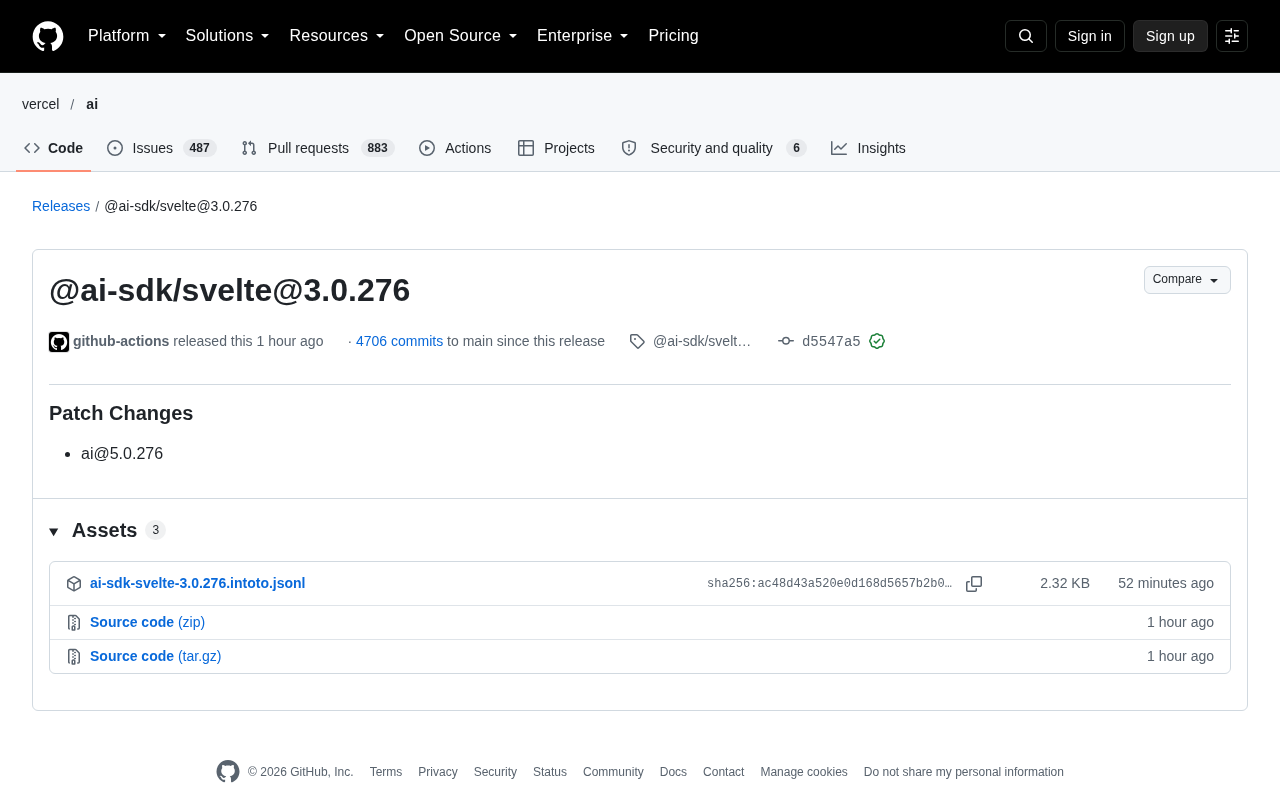
The AI SDK ecosystem has another routine update. The @ai-sdk/svelte@3.0.276 patch version, auto-published on GitHub by github-actions, ships alongside a synchronized dependency bump to ai@5.0.276. For developers building AI applications with Svelte, this is a minor iteration worth noting.
What Exactly Changed in This Update
Based on the release information, this is a standard Patch Changes release. Patch versions typically don't introduce breaking changes and mainly focus on dependency version alignment, internal bug fixes, or minor documentation tweaks. This time, @ai-sdk/svelte moves to 3.0.276, with the core action being syncing its ai package dependency to version 5.0.276.
This kind of "follow-along" release is very common in monorepo-based SDK projects. The AI SDK family maintained by Vercel includes the ai core package along with multiple framework adapters such as @ai-sdk/svelte, @ai-sdk/react, and @ai-sdk/vue. When the core package ships a new version, each framework adapter package generates a corresponding patch version through automated workflows, ensuring developers pull a consistent dependency tree.
This release was completed by the github-actions bot, with the commit carrying a GitHub-verified signature (GPG key ID: B5690EEEBB952194). Looking at the commit history, this branch is 4706 commits ahead of main, indicating the project is in a highly active development rhythm.
Patch Changes and Semantic Versioning
The Patch Changes mentioned here come from the Semantic Versioning (SemVer) spec: in the version number MAJOR.MINOR.PATCH, the third segment is the patch number, representing backward-compatible bug fixes that add no new features and break no existing APIs. By contrast, minor versions add backward-compatible new features, while major versions are the only place where breaking changes are allowed. So the 276 in 3.0.276 is merely an iteration counter and doesn't reflect the scale of changes—because the AI SDK uses automated, high-frequency releases, the patch number gets pushed up rapidly. Understanding this helps gauge upgrade risk: patch upgrades can usually be adopted directly, but you should still watch for adapter-layer behavior changes that may follow shifts in the underlying core package.
Dependency Synchronization in a Monorepo Architecture
A monorepo refers to managing multiple related packages within a single code repository, with typical tooling including pnpm workspaces, Turborepo, and others. Vercel's AI SDK uses exactly this structure: ai serves as the core package carrying the low-level logic such as streaming protocols and tool calling, while @ai-sdk/svelte, @ai-sdk/react, and others are thin framework adapters that depend on and forward core capabilities. When the core package ships a new version, the CI pipeline generates a corresponding patch version for each adapter package, ensuring a one-to-one version match between ai and each framework package. This explains why an apparently small core update triggers releases across multiple adapter packages at once.
Why the Svelte Adapter Layer Is Worth Watching
Svelte has shown clear growth momentum in the frontend community in recent years, especially after Svelte 5 introduced the runes reactivity system, which led many developers to re-evaluate its suitability for small and medium-sized AI interaction interfaces. The value @ai-sdk/svelte provides is encapsulating streaming responses, tool calls, and multi-turn conversations into APIs that follow Svelte conventions, so developers don't have to handle low-level SSE parsing and state synchronization themselves.
For teams already building products with SvelteKit, this package can significantly lower the barrier to integrating large models. You don't need to bring in the React ecosystem just to use AI capabilities—the entire tech stack can stay unified.
Svelte 5 Runes and Streaming State Management
Runes are the new reactivity primitives introduced in Svelte 5, replacing the old let plus $: syntax with compile-time markers like $state, $derived, and $effect, making reactive logic more explicit and easier to reuse across components. This is especially critical for AI interaction interfaces: streaming responses continuously append text at very high frequency, and tool calls introduce asynchronous state branches. If you maintain these manually with plain variables, it's easy to make mistakes in update ordering. The value of @ai-sdk/svelte is precisely in organizing these state transitions into a runes-friendly form, letting developers declare states like "message list" and "is loading" declaratively, while the SDK handles low-level SSE parsing and incremental merging.
The Rhythm Behind the Version Number
The patch number 276 itself reveals something. The AI SDK adopts a high-frequency, small-step release strategy, where almost every change to the core package triggers synchronized updates across all framework adapter packages. The benefit of this model is that bug fixes reach users on all frameworks quickly; the cost is that version numbers grow fast, and developers need to get used to frequent dependency updates.
In practice, it's advisable to pin specific version numbers rather than use ^ or ~ range specifiers, to avoid unexpected behavior changes from automatic upgrades. For production environments, checking the corresponding changelog before each upgrade remains a necessary step.
How to Upgrade
Developers using npm, pnpm, or yarn can pull this version by running the usual package manager update commands. If you're integrating for the first time, installing @ai-sdk/svelte will automatically bring in the matching ai core package dependency.
Note that aside from "Patch Changes" and the dependency version, this release information doesn't list more granular change entries. If you run into issues after upgrading, it's worth checking the release notes for ai@5.0.276, since actual behavior changes in the adapter layer often originate from the core package.
SSE and the Underlying Mechanics of Streaming
SSE (Server-Sent Events) is a one-way streaming protocol based on HTTP. The server can continuously push chunked data to the client via text/event-stream until the connection closes. The experience of a large model outputting text token by token is built on exactly this: the server writes each generated token into the response body immediately, and the client renders as it receives. Compared with WebSocket, SSE requires no additional handshake protocol and natively supports automatic reconnection, making it better suited to this kind of "question-and-answer" push scenario. However, the browser's native EventSource only supports GET and can't customize request headers, so the AI SDK typically switches to fetch combined with ReadableStream to manually parse the data stream and handle reassembling truncated JSON fragments—these details are all encapsulated by the adapter layer, so developers only need to handle already-assembled text increments.
Summary
@ai-sdk/svelte@3.0.276 is a typical maintenance patch release—no new features, but it keeps version consistency across the entire AI SDK ecosystem. For Svelte developers, keeping up with updates like this ensures you're using the latest underlying fixes while avoiding compatibility issues caused by lagging versions.
One-line Summary
@ai-sdk/svelte releases patch 3.0.276, syncing the ai@5.0.276 dependency—a routine maintenance update.
Paragraph Summary
@ai-sdk/svelte releases patch version 3.0.276, syncing its underlying ai dependency to 5.0.276. It's a standard Patch Changes release with no breaking changes or new features. This kind of "follow-along" release stems from the AI SDK's monorepo architecture: after the core package updates, each framework adapter generates a corresponding patch version via automated workflows, ensuring a consistent dependency tree. The article notes that the Svelte adapter's value lies in wrapping streaming responses, tool calls, and multi-turn conversations into APIs that follow Svelte conventions, letting SvelteKit teams integrate large models without pulling in the React ecosystem. Because the AI SDK adopts a high-frequency, small-step release strategy, patch numbers grow extremely fast; for production, it's recommended to pin specific versions and check the changelog before upgrading.
Related articles

Chain of Thought Isn't Just for AI: How Humans Can Use CoT to Improve Thinking Quality
Chain of Thought isn't just a prompt trick for large models. Starting from a Hacker News discussion, this article analyzes why CoT works for human thinking too, breaks down actionable ways to transfer it, and highlights the key differences between human CoT and machine CoT.
Cloudflare Teams Up with OpenAI: Closi…
Cloudflare Teams Up with OpenAI: Closing the Loop from Vulnerability Discovery to Defense with AI
Cloudflare uses OpenAI Daybreak to investigate security vulnerabilities and generate reviewable remediation plans, while developers use Codex to boost coding efficiency and quality.

Orca Multi-Agent Orchestration in Practice: A Guide to Parallel Collaboration with Claude and Codex
Orca is Stable AI's free open-source agent workbench supporting 34 agents like Claude Code and Codex in parallel. Learn its Git worktree isolation, multi-model orchestration, and mobile management.