@ai-sdk/svelte 4.0.291 Released: A Patch Update for Vercel AI SDK

Vercel releases @ai-sdk/svelte@4.0.291 patch update in sync with core package ai@6.0.291 — safe to upgrade.
@ai-sdk/svelte@4.0.291 is a routine patch release of Vercel AI SDK's official Svelte adapter, published in sync with core package ai@6.0.291. The package provides reactive bindings and component utilities for Svelte developers to integrate LLMs, handle streaming responses, and manage conversation state. This patch-level update is fully backward-compatible with no breaking changes or new features — its main purpose is version alignment between sub-packages. Developers can upgrade via npm or pnpm and are advised to run existing tests as a basic regression check.
Vercel's official AI repository recently released @ai-sdk/svelte@4.0.291, a routine patch update published in sync with the core package ai@6.0.291. For developers building AI applications with the Svelte framework, these incremental minor releases may seem unremarkable — but staying current with them is an important part of keeping your project stable and dependencies aligned.
Release Overview
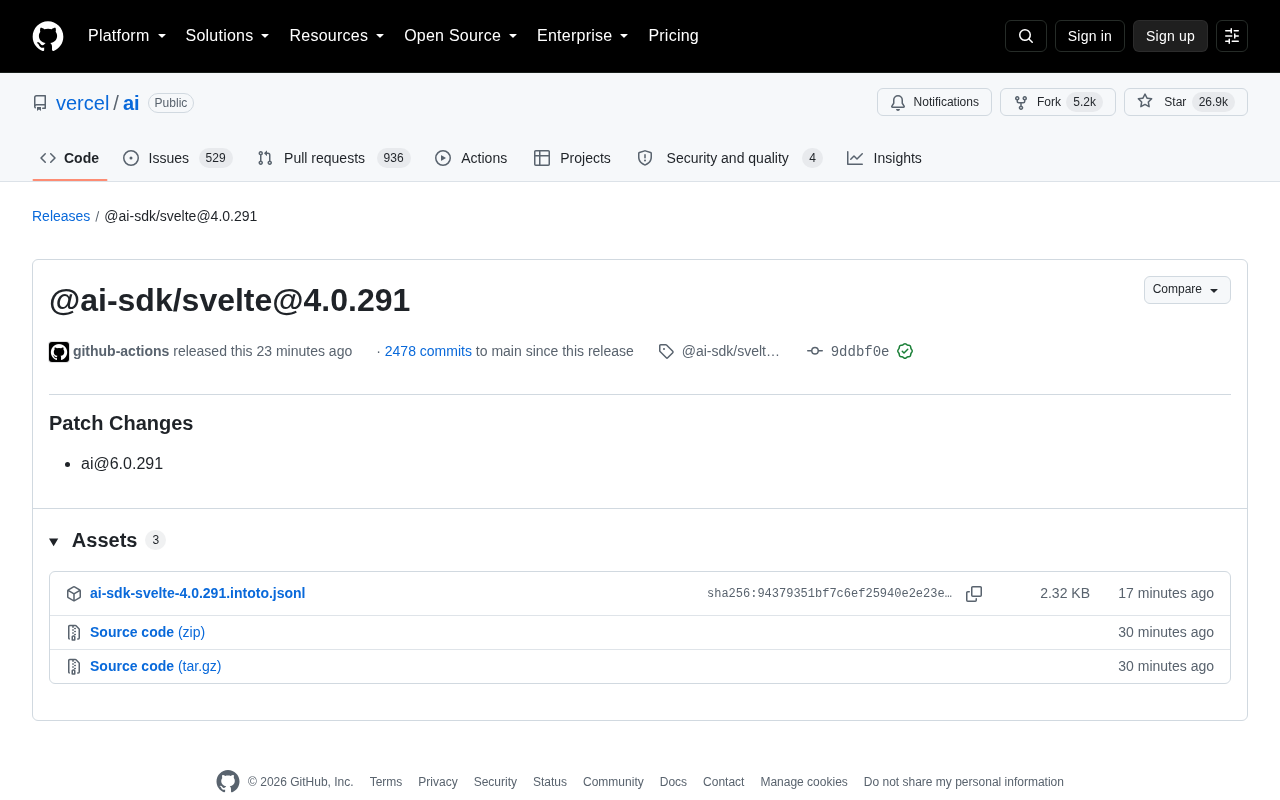
This release carries the version number 4.0.291, automatically built and published by GitHub Actions on September 24th from commit hash 9ddbf0e, with a verified GitHub signature (GPG key ID: B5690EEEBB952194). According to the release notes, this is a Patch Changes update, primarily driven by the companion update to the core package ai@6.0.291.
Also worth noting is the overall activity level of the Vercel AI repository — it has accumulated over 26.9k stars and 5.2k forks on GitHub, with 2,478 commits on the main branch since this version, reflecting the high-frequency maintenance cadence of a leading AI application development toolchain.
What Is @ai-sdk/svelte
@ai-sdk/svelte is the official Svelte adapter package for the Vercel AI SDK. The Vercel AI SDK is a TypeScript toolkit for building AI-powered applications, providing a unified abstraction layer across different frontend frameworks (such as React, Vue, and Svelte). It helps developers quickly integrate large language models, handle streaming responses, manage conversation state, and address other common use cases.
For Svelte developers specifically, this package offers reactive bindings and component utilities that align with the framework's design philosophy, making it smoother to wire up AI capabilities like chat and text generation. Its versioning closely follows the core ai package, ensuring API consistency across frameworks.
One of the core design principles of the Vercel AI SDK is unified streaming response handling. Large language model outputs are typically returned word-by-word as a stream. Handling this traditionally requires manually working with ReadableStream, parsing SSE (Server-Sent Events) data formats, and managing loading states. The AI SDK abstracts all of these low-level concerns into framework-friendly hooks or stores. In Svelte, for example, developers can subscribe to real-time streaming text updates directly through reactive stores, without writing complex async logic. This abstraction significantly lowers the barrier to integrating leading models from OpenAI, Anthropic, Google, and others into frontend applications.
Why Patch Updates Matter
A patch version (the third digit in semantic versioning) typically signals a backward-compatible fix — no breaking changes, no new features. These updates generally include bug fixes, dependency alignment, or internal optimizations. In this case, 4.0.291 syncing with ai@6.0.291 primarily serves to keep the sub-package in lockstep with the core package.
The practical advice for developers: if you're already using @ai-sdk/svelte in your project, upgrading to this version is safe and shouldn't require any changes to existing code. Keeping dependencies up to date helps you benefit from the latest stability fixes and avoids compatibility issues that can arise from version drift between different SDK sub-packages.
Semantic Versioning (SemVer) is a widely adopted versioning convention in the open-source community, following the format
MAJOR.MINOR.PATCH. A MAJOR change indicates incompatible API-breaking modifications; MINOR signals backward-compatible new features; and PATCH covers only backward-compatible bug fixes. In a monorepo architecture — where multiple sub-packages like@ai-sdk/svelteand@ai-sdk/reactcoexist alongside the coreaipackage in a single repository — projects like the Vercel AI SDK often use automated tooling (such as Changesets) to force-sync version numbers across all sub-packages at release time, ensuring dependency consistency even when a given sub-package has no substantive changes of its own.
How to Upgrade
Upgrading follows the same process as any npm package. Run the update command using your preferred package manager:
npm install @ai-sdk/svelte@4.0.291
# or
pnpm add @ai-sdk/svelte@4.0.291
Since this is a patch update, it's still good practice to run your existing test suite after upgrading to confirm there are no regressions. While patch versions are theoretically fully compatible, standard validation steps should still be followed in production environments.
Summary
@ai-sdk/svelte@4.0.291 is a typical release in the high-frequency iteration cycle of the Vercel AI SDK ecosystem. It doesn't introduce significant new functionality, but it reflects the toolchain's commitment to continuous maintenance and tight version synchronization across packages. For Svelte projects that depend on this SDK, keeping up with patch updates is a healthy engineering practice that helps maintain project stability over time.
Related articles

Chain of Thought Isn't Just for AI: How Humans Can Use CoT to Improve Thinking Quality
Chain of Thought isn't just a prompt trick for large models. Starting from a Hacker News discussion, this article analyzes why CoT works for human thinking too, breaks down actionable ways to transfer it, and highlights the key differences between human CoT and machine CoT.
Cloudflare Teams Up with OpenAI: Closi…
Cloudflare Teams Up with OpenAI: Closing the Loop from Vulnerability Discovery to Defense with AI
Cloudflare uses OpenAI Daybreak to investigate security vulnerabilities and generate reviewable remediation plans, while developers use Codex to boost coding efficiency and quality.

Orca Multi-Agent Orchestration in Practice: A Guide to Parallel Collaboration with Claude and Codex
Orca is Stable AI's free open-source agent workbench supporting 34 agents like Claude Code and Codex in parallel. Learn its Git worktree isolation, multi-model orchestration, and mobile management.