@ai-sdk/svelte 4.0.321 Patch Released: The AI SDK Ecosystem Keeps Iterating

@ai-sdk/svelte releases 4.0.321 patch version, maintained in sync with the core package.
The article introduces version 4.0.321 of @ai-sdk/svelte, the official Svelte adapter in the AI SDK ecosystem. This patch update is generated in sync with the core package ai@6.0.321, typically for bug fixes, syncing upstream changes, or dependency updates, with no breaking changes. It explains how the adapter lets the Svelte community integrate large model streaming output in a way that fits the framework's reactive conventions. For existing users, it recommends confirming core package version alignment and verifying critical flows in a test environment before upgrading; for teams not yet using it, the continuous patch iterations signal active official support. It concludes that this regular, "boring" release cadence reflects a stabilizing abstraction layer and responsive maintenance in the frontend AI toolchain.
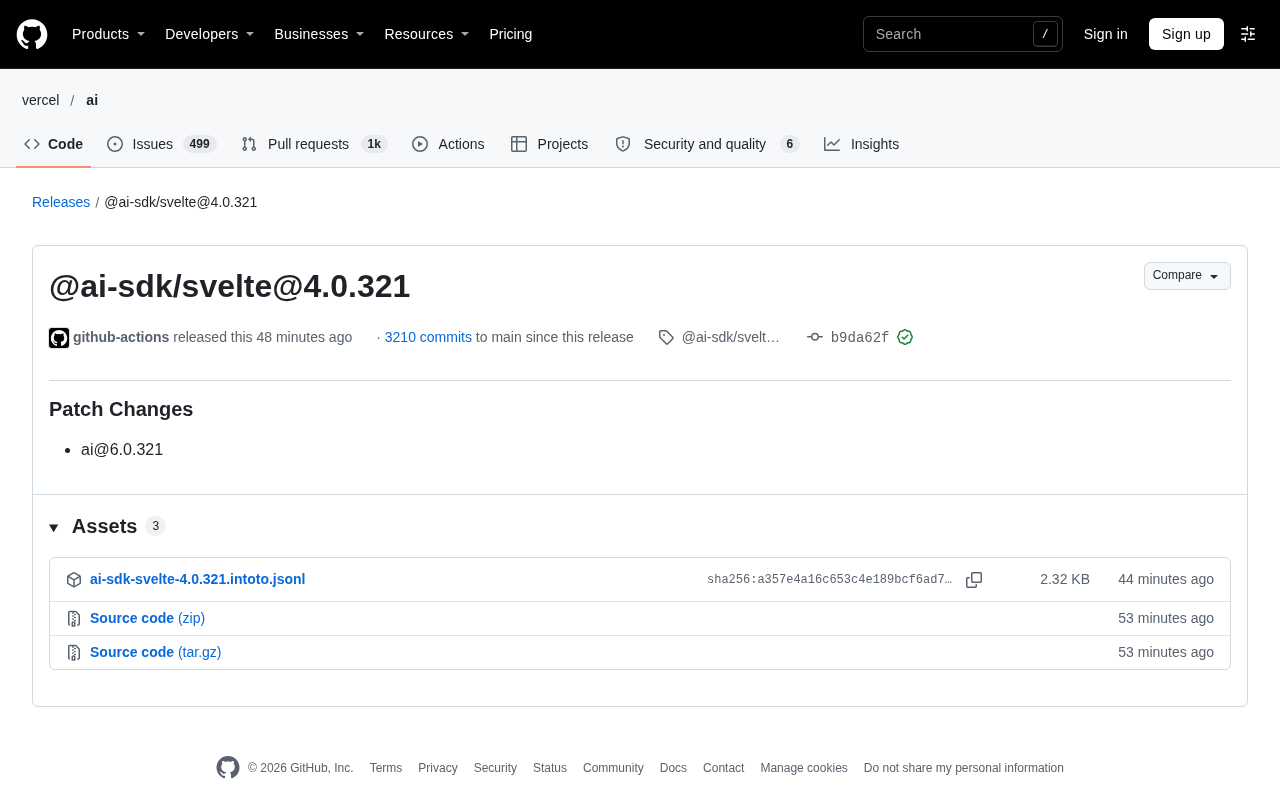
The Svelte adapter package in the AI SDK ecosystem, @ai-sdk/svelte, has released version 4.0.321. This is a typical patch update, and based on the release record, it was generated alongside a version change to the core package ai@6.0.321. For frontend developers building AI applications with Svelte, these small version iterations—though unremarkable—are a direct reflection of the entire toolchain staying alive.
Technical Background of the Version Update
@ai-sdk/svelte is the official wrapper for the Svelte framework within the AI SDK project led by Vercel. The AI SDK itself provides a unified set of interfaces that let developers call large model capabilities across different frontend frameworks and runtimes. Svelte, a compiled framework that has grown rapidly in recent years, has a natural advantage in combining its reactive model with AI streaming output, so the significance of this adapter package is not just "one more option," but rather enabling the Svelte community to integrate AI features in a way that fits the framework's conventions.
Judging from the release information, 4.0.321 is a patch version number, which typically means bug fixes, syncing with core package changes, or dependency updates—rather than introducing breaking changes. The commit record shows this version is associated with the main branch's evolution of 3,209 commits, indicating the project remains under high-frequency maintenance.
AI SDK's Cross-Framework Abstraction Layer: The core design philosophy of Vercel AI SDK is to abstract the act of "interacting with large models" into framework-agnostic underlying capabilities, including streaming text generation, tool calling, structured output, and multi-turn conversation state management. The core package ai is responsible for defining unified interfaces and protocols, while framework adapter packages (such as @ai-sdk/react, @ai-sdk/svelte, @ai-sdk/vue) are only responsible for bridging core capabilities into the corresponding framework's state and rendering model. The benefit of this layering is that model provider integrations (OpenAI, Anthropic, etc.) only need to be implemented once at the core layer, and framework adapter layers don't need to reinvent the wheel; the cost is that adapter packages must stay version-aligned with the core package, otherwise type definitions and actual runtime behavior will diverge. This is also the fundamental reason the article emphasizes "confirming whether the ai core package version is aligned."
Where Svelte's Reactive Model Meets Streaming Output: Svelte generates reactive code at compile time, tracking dependencies through runes like $state and $derived (introduced in Svelte 5) or traditional $: reactive declarations, rather than relying on immutable state and re-render scheduling like React. For scenarios where large models return streaming output token by token, this fine-grained dependency tracking can achieve "updating the corresponding DOM node as soon as a new token arrives," eliminating the overhead of virtual DOM diffing. The value of the adapter package lies precisely in wrapping incremental fragments of streaming responses into Svelte-recognizable reactive state, letting developers consume AI output using conventions that fit the framework, without manually managing event listeners and state synchronization.
The Significance of Patch Updates and Usage Recommendations
For projects already using @ai-sdk/svelte, patch versions can generally be upgraded safely. Developers are advised to pay attention to two things: first, confirm whether the ai core package version the project depends on is aligned with 6.0.321, to avoid type or runtime behavior inconsistencies caused by version mismatch; second, check whether the changelog involves edge cases of APIs you use. Since this release does not list specific feature changes, verifying critical flows in a test environment before upgrading is a prudent approach.
For Svelte teams that have not yet adopted this package, this kind of continuous small version release sends a signal: AI SDK's support for Svelte is active and keeping pace. If your project has needs such as streaming conversations or structured output, evaluating the adoption of @ai-sdk/svelte and practicing with the official documentation is more maintenance-efficient than building your own request layer.
What Semantic Versioning and Patch Numbers Mean: According to the Semantic Versioning specification (SemVer), in the version number MAJOR.MINOR.PATCH, an increment in the patch position represents "backward-compatible bug fixes," containing no new features, let alone breaking changes. Therefore, the article's judgment that "patch versions can generally be upgraded safely" is well-founded. However, it's worth noting that in projects where multiple packages are maintained in tandem, a patch upgrade can still have indirect effects if dependency version ranges (such as ^6.0.0) resolve to a different core package. In practice, it's advisable to lock the lockfile, run the full test suite in CI, and prioritize reading release notes or comparing commit diffs rather than just looking at the version number itself.
Ecosystem Perspective: The Big Trend Behind Small Versions
It's hard to write a dramatic story about a single patch number, but placing it back into the overall rhythm of the AI SDK reveals that the frontend AI toolchain is maturing. The synchronized releases of the core package and framework adapter packages mean the abstraction layer is gradually stabilizing; frequent patch iterations indicate that maintainers are actively responding to user feedback and upstream changes. For technology decision-makers, this "boring but regular" release cadence is often more trustworthy than a single major version announcement.
The Svelte ecosystem is still catching up with more mainstream options like React when it comes to AI integration, and the continued updates of the official adapter package are the infrastructure for narrowing that gap. Developers can stay informed, but need not devote excessive attention to every patch number—what truly deserves attention is whether there are behavior changes relevant to your own project behind the version number.
One-line Summary
@ai-sdk/svelte releases 4.0.321 patch version, maintained in sync with the core package.
Paragraph Summary
The article introduces version 4.0.321 of @ai-sdk/svelte, the official Svelte adapter package in the AI SDK ecosystem. This is a patch update generated in sync with the core package ai@6.0.321, typically used for bug fixes, syncing upstream changes, or dependency updates, and contains no breaking changes. The article notes that the significance of this adapter package lies in enabling the Svelte community to integrate capabilities like large model streaming output in a way that fits the framework's reactive conventions. For projects already using the package, it's recommended to confirm core package version alignment and verify critical flows in a test environment before upgrading; for teams that haven't adopted it yet, the continuous patch iterations signal that official support is active. The article concludes from an ecosystem perspective that this regular and "boring" release cadence precisely reflects that the frontend AI toolchain's abstraction layer is stabilizing and maintenance responsiveness is positive.
Related articles
 Tech Frontiers
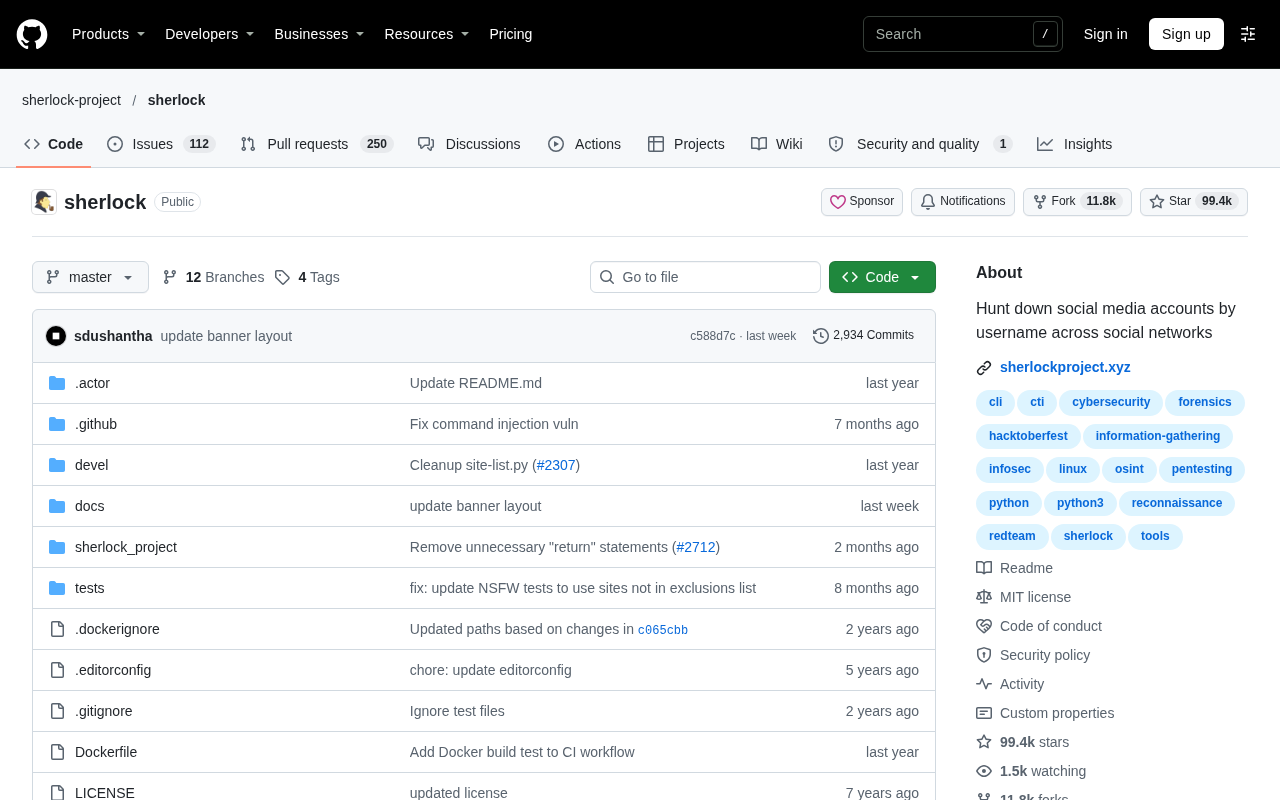
Sherlock: An Open-Source Tool for Tracking Usernames Across Social Networks
Sherlock is an open-source Python tool that tracks social accounts across networks by username. This article covers its core features, why developers love it, typical use cases, and privacy compliance considerations.
 Tech Frontiers
GitHub Daily·Nov 07: Agent-Ready and Context Compression
GitHub Trending Nov 07: meta's agent-ready design system astryx, billion-context's 5x context compression, sherlock nearing 100k stars, plus local-first localthings and bare-metal GPU orchestration nvke.
 Tech Frontiers
Buoyant Open-Sources Kinference: An Inference Control Plane for vLLM on K8s
Buoyant open-sources Kinference, an inference control plane for vLLM on Kubernetes, with declarative routing, KV-cache-aware load balancing, and per-tenant metrics—claiming 95% lower median TTFT in official benchmarks.