AI SDK Svelte 5.0.160 Patch Release: Behind the Dependency Chain Update

AI SDK's Svelte adapter releases a patch, syncing the core package to 7.0.160 with no new features.
Vercel's AI SDK project released patch 5.0.160 for the Svelte adapter, automatically triggered by github-actions, merging 13 commits with three dependency updates, with the core action being syncing the `ai` core package to 7.0.160. The article notes that the essence of such patches is maintaining version alignment between the framework adapter layer and the core package in the monorepo, not feature iteration, and the most important information for developers is whether the core package version is synced. This update has no breaking changes and low upgrade cost; it is recommended to verify streaming responses, tool calls, and other behaviors in the development environment before following up. The article also analyzes the engineering value of the automated release pipeline: strong traceability and easy rollback and diagnosis, worth learning from for small teams.
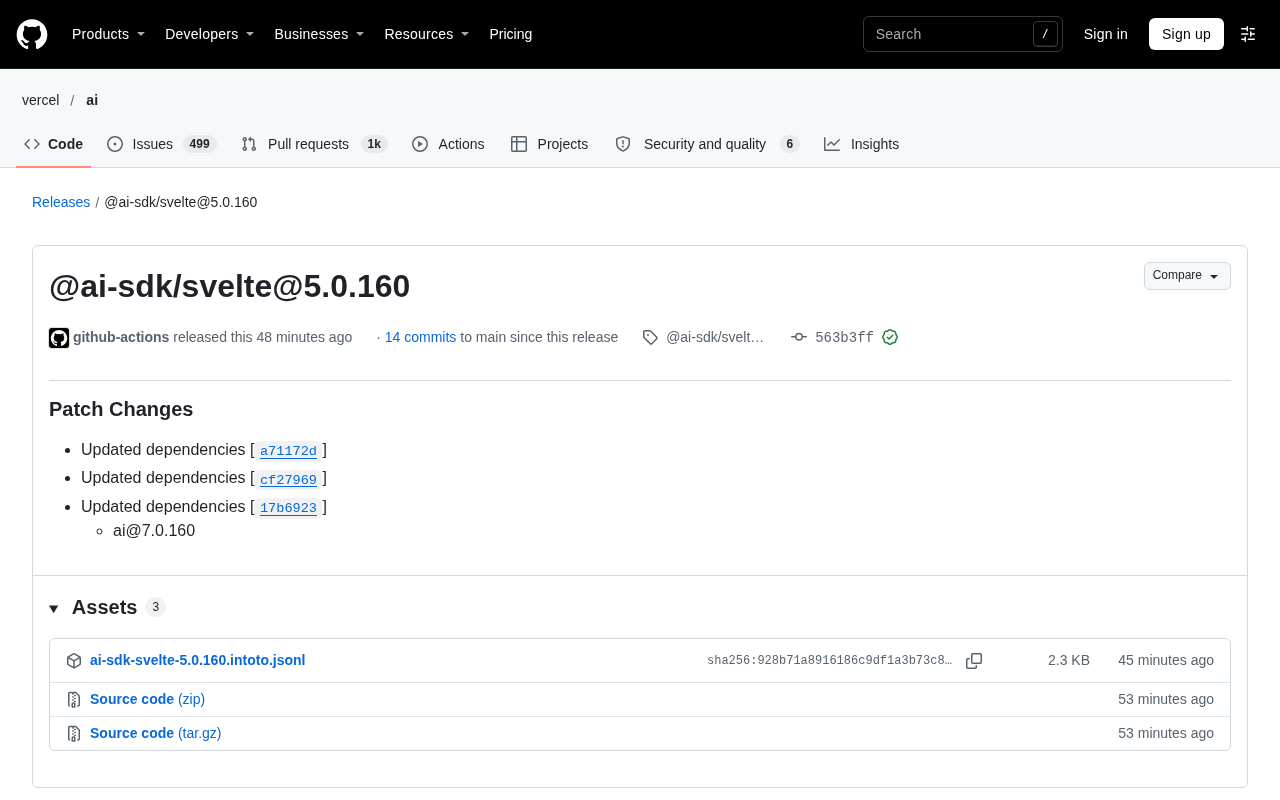
The AI SDK project under Vercel recently released version 5.0.160 of its Svelte adapter package. Judging from the release notes, this is a typical patch update whose core action is syncing the underlying dependency rather than introducing new APIs or features. For frontend teams building AI applications with Svelte, such versions may seem unremarkable, but they directly affect the cleanliness of the dependency tree and runtime stability.
Release Overview
According to the GitHub Release page, @ai-sdk/svelte@5.0.160 was automatically published by github-actions, timestamped 02 Nov 19:21, and the version merged 13 commits into the main branch. Commit 563b3ff carries a GitHub verified signature, indicating that the release process went through the repository's standard CI automation channel.
Releases triggered by bot accounts like this usually mean the version bump is a pipeline behavior rather than a manual hotfix. For users, this offers high credibility, but it also reminds us: small jumps in version numbers mostly reflect dependency resolution results and should not be over-interpreted as signals of feature iteration.
Patch Contents: Three Dependency Updates
The changes listed in the Release Notes are very focused—only three "Updated dependencies" entries, referencing commits a71172d, cf27969, and 17b6923 respectively. These three dependency updates ultimately bumped the core package ai to 7.0.160.
In other words, this release of the Svelte adapter package is essentially following the version cadence of the ai core package. AI SDK uses a multi-package monorepo structure, and each framework adapter layer (Svelte, React, Vue, etc.) needs to stay version-aligned with the core package; otherwise, type definition mismatches or runtime behavior differences can easily occur. Patch releases are precisely the mechanism for maintaining this alignment.
Why Dependency Sync Matters
In a fast-evolving toolchain like AI SDK, version drift between the core package and framework adapter packages is a common source of failures. If a developer upgrades only ai and forgets to sync @ai-sdk/svelte, they may encounter mismatches between hook behavior and type declarations. Conversely, updating an adapter package alone without following up on the core package can also introduce hard-to-locate runtime exceptions.
Therefore, when you see a patch version change, the more practical approach is to check whether the ai core package has been upgraded in sync, rather than obsessing over what changed in the adapter package itself. This release aligning ai to 7.0.160 is itself the most important information.
Semantic Versioning (SemVer) is the basis for calling this release a "patch version." SemVer specifies a three-part version number of major.minor.patch: major version changes represent incompatible API modifications, minor versions represent backward-compatible feature additions, and patch versions contain only backward-compatible bug fixes and internal adjustments. Therefore, a version jump like 5.0.160 should by convention not introduce any change requiring developers to modify code. Dependency syncing happens to fall under "internal adjustments," so placing it in the patch position is compliant with the specification. Understanding this helps judge upgrade risk: when you see the patch number advance, you usually only need routine regression verification rather than reviewing API changelogs item by item.
monorepo (single repository, multiple packages) structure is the key background for understanding AI SDK's release cadence. A monorepo manages the core package ai and framework adapter packages (@ai-sdk/svelte, @ai-sdk/react, etc.) in the same Git repository, sharing build configuration and release pipelines. The benefit is that cross-package changes can be completed in a single commit and dependency versions can be aligned centrally; the cost is that a change to any package may trigger a chain of releases. This explains why adapter packages frequently have patch versions that only update dependencies—they often simply follow the core package's version number, aligning passively rather than iterating actively.
Version drift refers to the phenomenon where multiple interdependent packages in the same project gradually become inconsistent in version. In the monorepo ecosystem, the core package and adapter packages constrain each other through peer dependencies or exact versions. Once a developer manually upgrades one while ignoring the other, mismatches can occur where type definitions come from the new version but the runtime implementation comes from the old version. Such problems often do not error at compile time but surface only when calling hooks or handling streaming responses, making them costly to diagnose. The value of the dependency sync release mechanism is that it delegates this alignment action to the pipeline, reducing human oversight.
Practical Impact on Svelte Developers
Judging from the nature of the changes, this update involves no breaking changes, and the upgrade cost is very low. Projects using @ai-sdk/svelte can simply perform a routine dependency update without modifying business code.
However, two points are worth noting. First, the Release page explicitly indicates a GPG verified signature, meaning supply chain integrity is guaranteed—a positive signal in projects with frequent automated releases. Second, the release was triggered only after 13 commits were merged into main, indicating that a batch of underlying changes was brought in alongside the patch. It is recommended to run existing tests after upgrading to confirm that AI-related interaction logic has not regressed.
Upgrade Recommendations
For production projects with pinned versions, prioritize verification in the development environment, observing whether behaviors that depend on the core package—such as streaming responses and tool calls—remain consistent. For projects using SvelteKit, pay attention to the compatibility matrix between the adapter package and Svelte versions, and avoid crossing multiple major versions at once.
Engineering Practices Behind Automated Releases
This release also reveals the release habits of the AI SDK team: uniformly triggered by github-actions, dependency updates recorded as separate commits, and version numbers strictly following semantic versioning. The benefit of this pattern is strong traceability—each dependency change maps to a specific commit, making rollback and diagnosis easy when problems arise.
For independent developers and small teams, this pipeline design offers useful lessons. Making dependency syncing part of automated releases, rather than relying on human memory to edit package.json, can significantly reduce the maintenance burden of multi-package projects.
Summary
@ai-sdk/svelte@5.0.160 is a patch release aimed at dependency alignment, with the core change being syncing the ai core package to 7.0.160. It has no new features, but it has practical value in maintaining consistency between the Svelte adapter layer and the core package. The upgrade barrier is low; following up is recommended, along with a basic regression verification after upgrading.
Related articles

AI Tools Quietly Altering Settings: Postman Silently Installs Plugin, Codex Sharing Option Auto-Resets
AI Daily reports: Postman silently installs a Mac plugin and self-approves startup hooks, logged as auto-existing upgrade; Hacker News developers say Codex data-sharing opt-out flips back. Plus Simon Willison's raw float weight experiment with QEN 3.8-27B.

AI Learns to Rewrite AI: MIT's "Weightspace Programming" Redraws the Path to Recursive Self-Improvement
MIT team proposes weightspace programming: GPT-6 Astra reads and edits AI model weights directly. Math scores jump several-fold, hand-written networks beat trained models. Eight experiments analyzed, plus Anthropic's same-day warning and the real boundaries of recursive self-improvement.

Running Qwen 3.8 on a Laptop to Read Raw Weights: 46 Minutes Per Answer
Simon Willison reproduced weight space programming with Qwen 3.8 27B on a laptop: a 17GB model file, 46 minutes per answer, 43,506 reasoning tokens, Pong over an hour, Freeway failed. Suited for interpretability researchers.