AI SDK Svelte Patch Update: Is Version 5.0.164 Worth Noticing?

@ai-sdk/svelte 5.0.164 patch release reflects the AI SDK's stability-first maintenance cadence.
The article covers the patch release of Vercel AI SDK's Svelte adapter package `@ai-sdk/svelte` 5.0.164. This update synchronously aligned the core package `ai@7.0.164`; the release record had no detailed notes, only two commits, and was auto-published by GitHub Actions — a typical maintenance release. The article explains the AI SDK's layered architecture: core logic is centralized in the `ai` package while framework adapter layers expose capabilities in each framework's conventions, so adapter and core packages must stay version-synced; mixing them easily causes type errors or runtime exceptions. For Svelte developers, such patches most likely involve no code changes; the right approach is to use dependency management tools and fold them into the regular upgrade process rather than manually tracking each version. The article views this high-frequency, automated synchronized publishing as reflecting a maintenance strategy that prioritizes stable delivery — a plus for technology selection.
A Routine Patch — Why It's Still Worth a Look
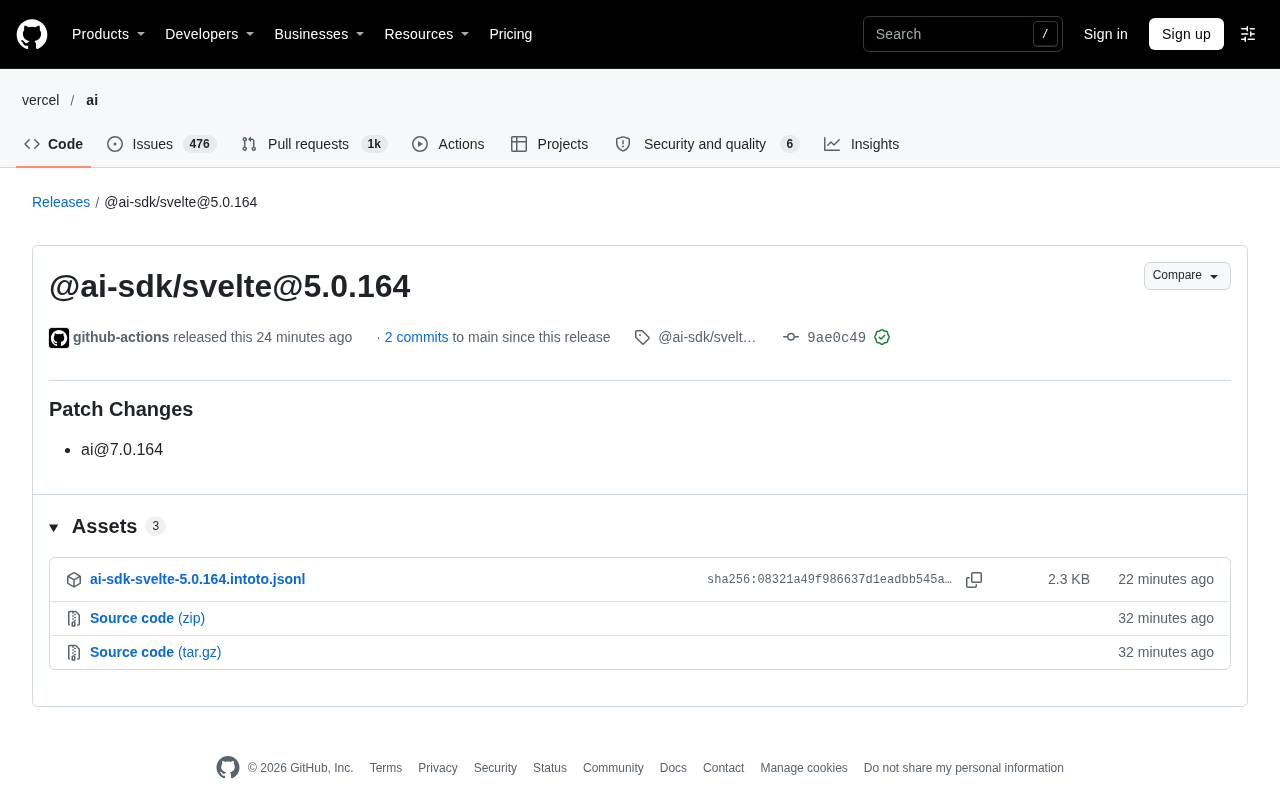
In open-source version iterations, patch updates are often the easiest to overlook. The Svelte adapter package of Vercel's AI SDK has released version 5.0.164. Judging from the release record, this is just a regular patch change that synchronously updated the core package ai@7.0.164, with no detailed changelog attached.
But it's precisely this kind of "quiet" release that reflects the current maintenance cadence and ecosystem state of the AI SDK. For front-end developers building AI applications with Svelte, understanding the significance of such patch updates is more practical than chasing major version numbers.
The Dependency Relationships Behind Version Numbers
The Role of the Svelte Adapter Package
The AI SDK uses a layered architecture: core logic is consolidated in the ai package, while framework adapter layers (React, Vue, Svelte, etc.) expose core capabilities in a way that fits each framework's conventions. Although @ai-sdk/svelte has an independently incrementing version number, its actual behavior is highly dependent on the core package's version.
This 5.0.164 patch explicitly mentions ai@7.0.164 in its changelog, indicating that both were released synchronously at the same point in time. This version linkage is standard practice for the AI SDK maintenance team: after the core package is fixed, framework adapter packages follow suit and align, preventing users of different frameworks from getting SDKs with inconsistent behavior.
Semantic Versioning (SemVer) and Patch Numbers: Under the SemVer specification, the three segments of MAJOR.MINOR.PATCH correspond to incompatible API changes, backward-compatible feature additions, and backward-compatible bug fixes, respectively. The 164 in 5.0.164 is in the PATCH position, meaning by convention it should not contain breaking changes or new public APIs. Note, however, that the AI SDK's adapter package version numbers don't always match the core package ai's major version (here the adapter is 5.x while the core is 7.x), so you can't directly compare version numbers across packages. Compatibility should be judged based on the official correspondence published by the project.
GitHub Actions Automated Publishing: The github-actions mentioned in the article is GitHub's CI/CD service, which can automatically execute builds, tests, and npm publishing when triggered by events such as code merges or tag creation via workflows. Publishing by a bot account typically means the version went through a standardized pipeline with minimal changes and little manual intervention.
What Patch Updates Usually Mean
Patch-level updates generally cover three types of content: dependency version alignment, bug fixes under edge-case conditions, and internal adjustments that don't change public APIs. The release record doesn't elaborate on specifics, but given that the commit history contains only two commits and was auto-published by github-actions, the scope of changes in this update is very small.
For users, the correct way to handle such updates isn't to study each change individually but to fold them into the regular dependency upgrade process — provided the project hasn't pinned exact version numbers.
Pinning Exact Versions vs. Using Version Ranges: In package.json, "@ai-sdk/svelte": "5.0.164" is an exact pin, while ^5.0.164 allows installation of higher minor and patch versions within the same major version, and ~5.0.164 only allows the patch position to float. The article's reference to "folding them into the regular dependency upgrade process" presupposes that the project uses range notation like ^ or ~, combined with lock files such as package-lock.json or pnpm-lock.yaml to guarantee reproducible installs; if exact pinning is used, the version number must be explicitly changed to get the patch fix.
Peer Dependencies: Framework adapter packages often declare the core package as a peer dependency, with the consumer responsible for installing it and ensuring version compatibility. This is the technical reason the article repeatedly emphasizes "upgrading the adapter package together with the core package" — when the two don't match, npm may issue a warning but won't auto-correct, and problems often only surface at runtime.
Practical Impact on Svelte Developers
If you're using @ai-sdk/svelte to build chat interfaces or streaming text generation features, this patch most likely won't bring behavioral changes that require code modifications. But there are two practical points worth noting.
First, keep the adapter package and core package versions in sync. There is an agreed relationship between the AI SDK's framework packages and the ai core package; mixing versions from different batches can introduce hard-to-diagnose type errors or runtime exceptions. When upgrading, it's best to upgrade both together rather than touching only one.
Second, follow the release channel but don't feel the need to track it at high frequency. AI SDK releases are driven by automated processes, and patch versions appear frequently. Teams can delegate such updates to dependency management tools for periodic merging, saving energy for major version changes that genuinely affect functionality.
What This Release Reveals About the AI SDK's Maintenance Strategy
As the middleware connecting large model capabilities with front-end frameworks, the AI SDK's maintenance approach carries strong signal value. High-frequency small releases, the synchronized cadence between core and adapter packages, and reliance on GitHub Actions for automated publishing all point to the same conclusion: this project prioritizes "stable delivery" over "version ceremony."
For technology selection, this maintenance style is a plus. The most common problem with framework adapter layers is becoming disconnected from the core package, and the automated synchronized release mechanism precisely reduces this risk.
Upgrade Recommendations
For most projects, 5.0.164 can be upgraded directly through the regular dependency update process. If your project strictly pins versions, it's advisable to confirm whether the ai core package has been synchronized to 7.0.164 before upgrading — keeping the two consistent is safer than upgrading the adapter package alone. After upgrading, run your existing tests covering streaming responses and error handling paths to complete verification.
Overall, this is a typical maintenance release: no new features, no breaking changes, and its value lies in maintaining ecosystem consistency and predictability. The takeaway for developers isn't about this version itself but about establishing a low-cost habit for tracking dependencies.
Related articles
 Tech Frontiers
Buoyant Open-Sources Kinference: An Inference Control Plane for vLLM on K8s
Buoyant open-sources Kinference, an inference control plane for vLLM on Kubernetes, with declarative routing, KV-cache-aware load balancing, and per-tenant metrics—claiming 95% lower median TTFT in official benchmarks.
 Tech Frontiers
The Truth Behind Anthropic's 2x R&D Speedup: A Deep Dive into the METR Report
METR's external evaluation shows Anthropic's AI testing progress over the past year roughly equals the prior two years, with R&D accelerating about 2x—and roughly 80% likely from AI assistance. The report also admits key evidence was redacted, the range spans 1.3x to 3x, and Anthropic says it hasn't doubled yet, diverging from METR's judgment.
 Tech Frontiers
T3 Code: Free, Open-Source, and a Unified Way to Manage All AI Coding Agents
T3 Code is a free open-source app that aggregates AI coding tools like Cloud Code and Codex into one interface, with conversation handoff, branch isolation review, automatic PR creation, and remote access.