The Truth Behind Anthropic's 2x R&D Speedup: A Deep Dive into the METR Report

METR's external evaluation says Anthropic's AI R&D accelerated about 2x over the past year, with 80% attributed to AI assistance.
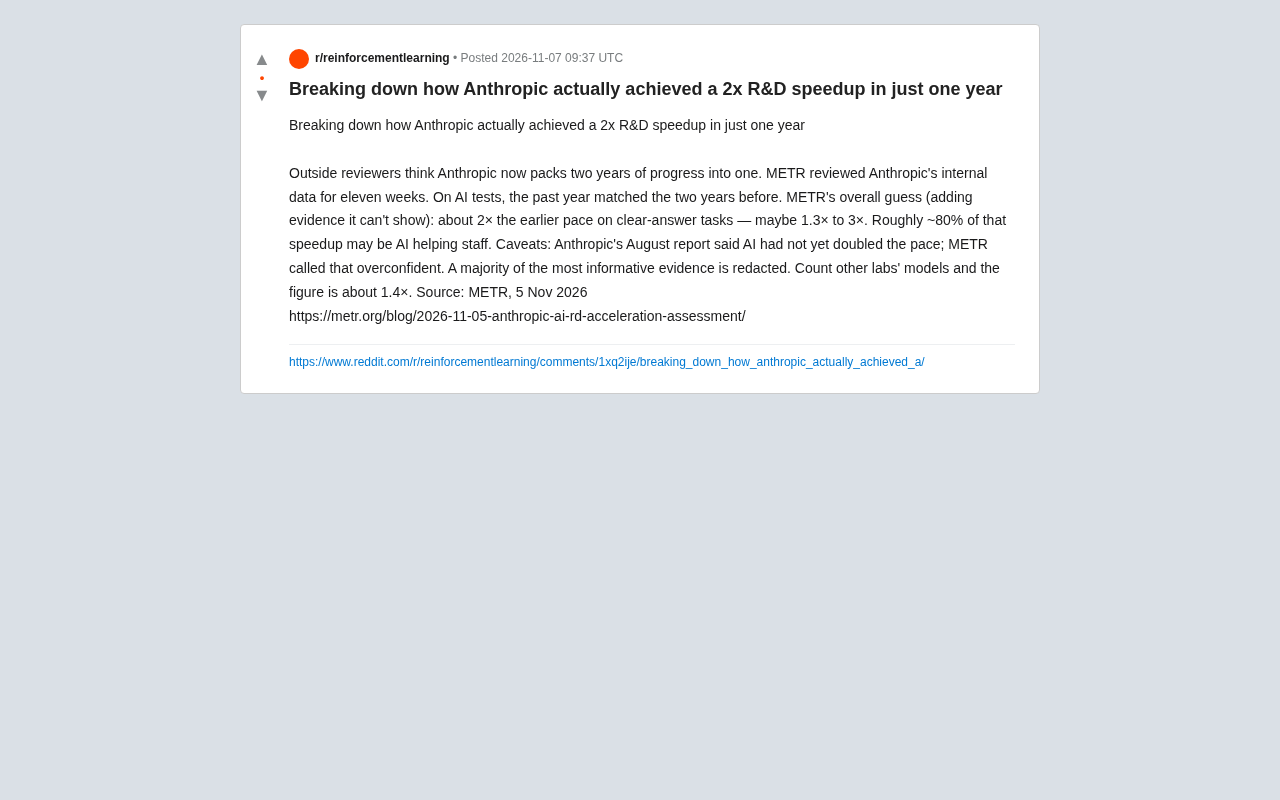
METR conducted an eleven-week review of Anthropic's internal data, judging that its progress on AI testing over the past year roughly equals the prior two years combined, with overall acceleration around 2x and a range of 1.3x to 3x. About 80% of the acceleration may come from AI assisting employees rather than hiring or process restructuring, though humans still control direction and architectural decisions. The most informative evidence in the report was redacted, so 2x is a directional judgment rather than a precise measurement. Anthropic said in August that AI had not yet doubled its R&D; METR considers this self-assessment overconfident. Counting only other labs' models, overall acceleration is about 1.4x, indicating a stronger leverage effect from internal models.
An external evaluation reveals Anthropic's "one year equals two" card
AI companies using AI to accelerate AI R&D is moving from vision to measurable reality. METR conducted an eleven-week review of Anthropic's internal data, concluding that over the past year, Anthropic's progress on AI testing equaled the sum of the previous two years combined. In other words, the R&D cadence roughly doubled.
This number deserves serious attention because it didn't come from Anthropic itself. METR is an external evaluation body, and the report explicitly distinguishes between "the verifiable portion" and "overall projections based on additional evidence." The doubling conclusion belongs to the latter—METR gives a range of roughly 1.3x to 3x, with a median estimate around 2x. The range is wide, indicating that real uncertainty exists, but the direction is clear.
More critically, the attribution: roughly 80% of this acceleration may come from AI assisting employees. That is, it's not the result of hiring expansion or process restructuring—it's models helping people do the actual work of R&D.
METR (Model Evaluation & Threat Research) is an independent research organization focused on evaluating the capabilities of frontier AI models, known for designing reproducible benchmarks and tracking progress in AI system capabilities over time. Unlike internal evaluations by model developers, METR emphasizes an external, third-party perspective, and its reports are often used as a reference for judging the pace of AI capability leaps. It previously drew attention for systematic assessments of high-risk capabilities such as autonomous replication and cyberattacks. This review of Anthropic's R&D efficiency extends the evaluation target from "model capabilities" to "how models change the R&D organization itself," which is one reason the report sparked discussion.
The attribution logic behind the numbers: AI assists, humans decide
To attribute 80% of the acceleration to AI assistance, this proportion needs to be unpacked. METR's logic is roughly: on tasks with clear answers and verifiable outcomes, R&D efficiency gains are most pronounced—and this is precisely where current AI models excel. Writing tests, validating hypotheses, troubleshooting known defect types—the output speed of these tasks is on a completely different level than a year ago.
But "AI-assisted" does not equal "AI autonomous." Humans still control direction selection, architectural decisions, and final judgment. The 80% describes the source of efficiency gains, not a relationship of replacement. Understanding this is important; otherwise it's easy to misread "2x R&D acceleration" as "AI independently completed twice the R&D work."
There's also an easily overlooked scope issue: the 2x estimate only counts acceleration from Anthropic's own models. If models from other labs are included, the overall acceleration is about 1.4x. Both numbers are valid—they just answer different questions. The former measures the leverage effect of internal models; the latter measures the combined impact of the entire AI tool ecosystem.
"Verifiable tasks" is a key concept for understanding this report. It refers to work with clear correct answers whose results can be automatically or quickly checked—for example, writing unit tests, reproducing and locating defects, or validating whether a hypothesis holds. These tasks are characterized by short feedback loops and objective evaluation criteria, making them particularly suitable for high-frequency trial and error by models. In contrast, tasks like frontier direction selection, architectural trade-offs, and cross-domain intuitive judgment lack immediate verifiable feedback signals; models struggle to independently judge right from wrong, and humans must still lead. METR attributes efficiency gains primarily to the former precisely on the basis of this task separability, rather than broadly assuming AI is equally effective across all R&D stages.
The parts redacted in the report are where the controversy lies
The most honest aspect of METR's evaluation is that it proactively acknowledges its information blind spots. The report notes that most of the most informative evidence was redacted. External reviewers can see the conclusions but not the complete raw materials supporting them.
This directly undermines the verifiability of the "2x" figure. METR doesn't hide this; instead, its wording is quite restrained: overall projection, plus evidence that cannot be shown, with a range of 1.3x to 3x. This phrasing itself is saying—please treat 2x as a directional judgment, not a precise measurement.
Another layer of tension comes from Anthropic's own statements. According to METR, Anthropic said in an August report that AI had not yet doubled its R&D speed. METR directly called this judgment "overconfident." A company saying externally "we're not at 2x yet" while an external evaluator says "you may be underestimating yourself"—this kind of reversal is unusual, and it shows there's substantive disagreement between the two parties over the interpretation of the same set of internal data.
"Redacted" is a common practice in AI safety and capability evaluation reports, typically for reasons of trade secrets, sensitive internal data, or security risk. But for evaluation conclusions, redaction creates a structural problem: readers can only see inferences and cannot verify the raw evidence underlying them, so the credibility of conclusions depends more on the evaluator's reputation than on the data itself. This is also why METR specifically labels two categories of conclusions—"verifiable" and "overall projection." The former can be independently tested; the latter can only serve as directional reference. Understanding this distinction helps determine which numbers in the report can be cited as fact and which should only be treated as trend signals.
When AI starts accelerating AI R&D, what should the industry care about?
The real value of this report isn't the number "2x"—it's that it validates the feasibility of a feedback loop: stronger models lead to faster R&D, and faster R&D leads to stronger models. METR's evaluation shows this loop has produced observable effects within Anthropic, although the magnitude remains disputed.
For the industry, this means two things. First, evaluating AI's impact on R&D efficiency requires third-party involvement; self-reported data has systematic bias—Anthropic's self-assessment was actually more conservative than the external evaluation, and this case itself breaks the stereotype that "companies will always exaggerate." Second, verifiable tasks are the main battleground for current AI acceleration; whether R&D stages that are hard to quantitatively verify (such as frontier exploration and cross-domain intuitive judgment) can be accelerated equally is a question the report doesn't answer.
As for whether "one year equals two" is a milestone or a statistical illusion, the safer reading is: on tasks with clear answers, the acceleration is real and significant; in overall R&D output, the acceleration is about 1.4x; and the attribution that 80% of the contribution comes from AI assistance is the variable most worth tracking going forward in the entire report.
Related articles
 Tech Frontiers
Coldframe: A Honeypot Disguised as a Supermarket Freezer Controller
Coldframe is a honeypot disguised as Danfoss AK-SM 800A and Dixell XWEB freezer controllers, built as a single Python file that detects CVE-2025-41450 attempts and is identified as real devices on Shodan.
 Tech Frontiers
GRFNet: A Lightweight PyTorch Model Designed for Multichannel Time-Series Classification
GRFNet is a lightweight PyTorch model for multichannel time-series classification, originating from EEG decoding research. With only 3,847 parameters, it is based on the ROCKET architecture, combining random convolution kernels with learnable spatial filters, supports arbitrary input lengths, and will soon be evaluated on the PhysioNet dataset.
 Tech Frontiers
CUDA-Accelerated Rocket League Simulator: A Player-Made Hardcore Experiment
A Reddit post shows a "100% Accurate" Rocket League simulator accelerated with CUDA. We analyze its technical context, CUDA's value in game physics simulation, and the significance and limitations of such community projects.