AI SDK Svelte Releases 4.0.309 Patch Update

@ai-sdk/svelte releases 4.0.309 patch, syncing upstream dependencies only, no feature or breaking changes.
@ai-sdk/svelte has released version 4.0.309, an automated patch-level update by GitHub Actions with no new features or breaking changes. The only change is synchronizing dependencies @ai-sdk/provider-utils@4.0.61 and core package ai@6.0.309, representing version alignment maintenance under the monorepo architecture. The article explains why dependency synchronization warrants its own release: if the three-layer structure gets out of sync, it leads to subtle issues like type mismatches and inconsistent runtime behavior. Developers can typically upgrade directly but should note compatibility with their project's ai core package version. The article also observes that the AI SDK advances core and binding package version numbers in sync, which is a positive signal of continued maintenance for the Svelte community.
AI SDK's Svelte adapter package @ai-sdk/svelte has released version 4.0.309. This is a typical patch-level update, automatically published by GitHub Actions, primarily focused on dependency version synchronization, with no new features or breaking changes introduced.
For developers building Svelte applications with the Vercel AI SDK, this type of update is worth noting but not cause for concern—it's more of a maintenance-oriented version alignment.
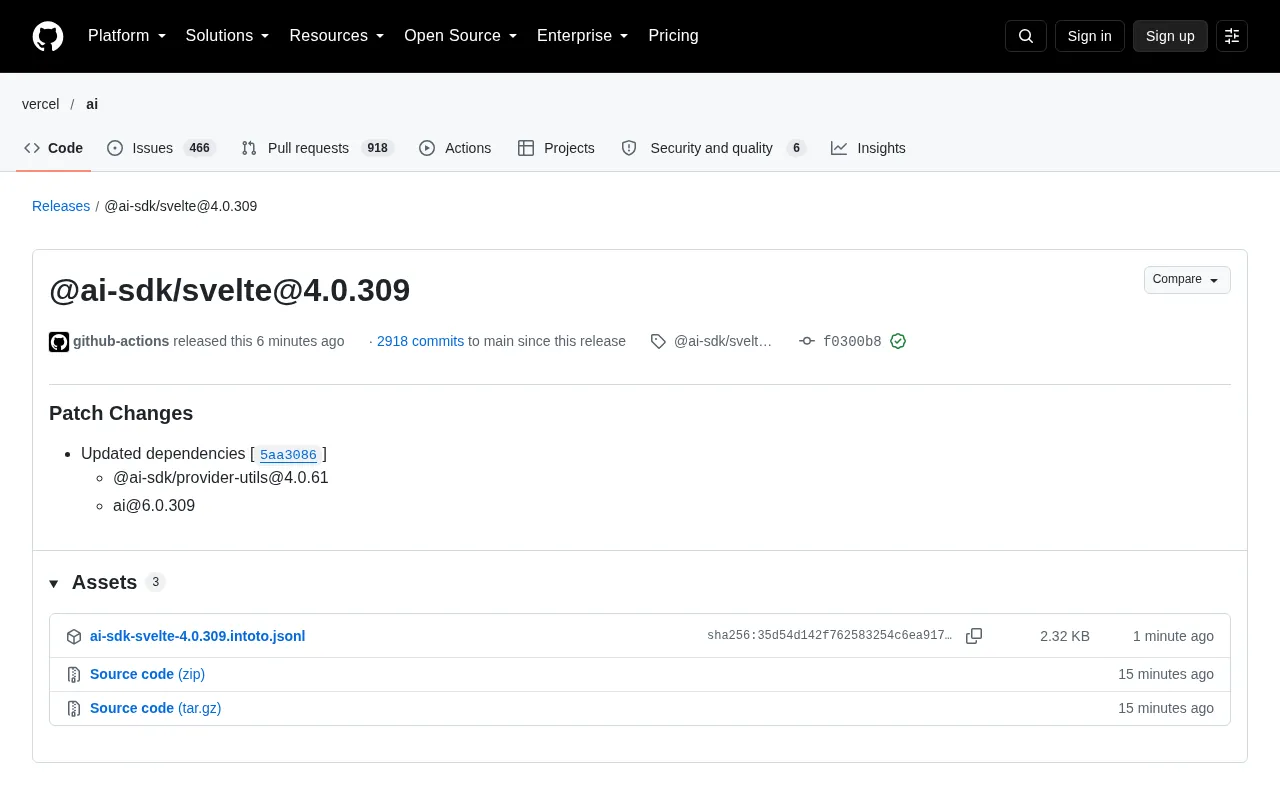
What This Update Actually Changed
According to the release notes on GitHub, 4.0.309 is explicitly marked as Patch Changes, which corresponds to a patch update in semantic versioning. Patch updates typically mean backward-compatible bug fixes, dependency synchronization, or internal adjustments—no API-level breaking changes.
Specifically, the only actual change in this release is: dependency updates. The two affected packages are:
@ai-sdk/provider-utils@4.0.61ai@6.0.309
In other words, @ai-sdk/svelte itself has no independent code changes—it's simply following the release cadence of the upstream core package ai and the utility package provider-utils, completing a synchronized dependency version alignment.
Semantic Versioning (SemVer) is the versioning convention widely adopted in the JavaScript/npm ecosystem, formatted as MAJOR.MINOR.PATCH. The major version number (MAJOR) increments when incompatible breaking changes occur, the minor version number (MINOR) increments when backward-compatible features are added, and the patch number (PATCH) is used for backward-compatible bug fixes, dependency synchronization, or internal adjustments. Therefore, when the maintainers mark a release as Patch Changes, it's equivalent to a promise to users: upgrading won't break existing call patterns. Understanding this makes it clear why jumps like 4.0.308 → 4.0.309 aren't cause for concern—it won't change your existing API call code.
A monorepo refers to an engineering pattern where multiple interrelated packages are managed together in a single code repository. The AI SDK adopts this structure: the core package ai, the utility package @ai-sdk/provider-utils, and various framework binding packages (such as @ai-sdk/svelte, @ai-sdk/react) all reside in the same repository. Monorepos facilitate unified cross-package building, testing, and releasing, but they come with a side effect: whenever any upstream package changes, downstream binding packages need to synchronize their dependency versions, frequently producing patch releases. This is exactly the update scenario described in this article.
Why Dependency Synchronization Warrants Its Own Release
In monorepo-architected SDK projects, dependency synchronization may seem simple but actually carries the responsibility of version consistency. In the AI SDK ecosystem, ai is the core package, @ai-sdk/provider-utils handles common utility logic across model providers, and @ai-sdk/svelte is the binding layer that connects core capabilities to the Svelte framework.
If the three-layer structure gets out of sync, developers may encounter subtle issues like type mismatches and inconsistent runtime behavior. By making this kind of dependency alignment a separate patch release through automated GitHub Actions publishing workflows, the benefit is that projects using fixed-version strategies can clearly track upgrade paths.
How Developers Should Respond
For most projects, this type of patch update can be upgraded directly. If you use npm install @ai-sdk/svelte@latest or rely on a range version like ^4.0.x, you'll automatically get this version.
One thing to note: before upgrading, it's advisable to confirm whether your project's ai core package version is compatible with ai@6.0.309. If your project is locked to an older ai@6.x version, directly upgrading the Svelte binding package may introduce minor type differences. This situation typically surfaces as TypeScript errors during builds, making it easy to diagnose.
Another noteworthy detail is that this release was automatically completed by the GitHub Actions bot account github-actions, with a GitHub verified signature. This indicates that the entire release pipeline is highly automated, meaning similar patch releases will continue to appear regularly and consistently.
In npm, the ^ and ~ prefixes before version numbers determine the range of automatic upgrades: ^4.0.3 allows upgrading to the latest version within 4.x.x (without changing the major version), ~4.0.3 only allows upgrading to the latest version within 4.0.x, and writing an exact version like 4.0.309 locks it completely. So if a project's dependency is written as ^4.0.x, running npm install will automatically pull in this patch. Additionally, package-lock.json records the exact version actually installed—teams should commit this file to ensure all members have consistent environments. If type errors appear after upgrading, you can first use npm ls ai to check the currently resolved core package version, then decide whether to upgrade ai as well.
Observations on the AI SDK Ecosystem
From this release, we can see the AI SDK's version management strategy: the core package, utility package, and framework binding packages advance their version numbers in sync. The last digits of ai@6.0.309 and @ai-sdk/svelte@4.0.309 match, indicating they share the same release cadence.
The advantage of this approach is that developers can easily determine version correspondence; the downside is that version numbers grow quickly, which can create an illusion of "frequent updates" for those unfamiliar with semantic versioning. In reality, most of these patch releases are internal maintenance actions that don't affect business code.
For the Svelte community, the continued maintenance of @ai-sdk/svelte is a positive signal. After Svelte 5 introduced runes, frontend state management underwent significant changes. Whether the AI SDK can keep up with framework evolution directly affects the experience of Svelte developers integrating large model capabilities. The steady output of patch releases, at the very least, shows that this maintenance pipeline is active.
Svelte 5's runes are a set of reactive primitives introduced in the fifth generation of the Svelte framework, including $state, $derived, $effect, $props, and more. They replace the reactive patterns in Svelte 4 based on let declarations and $: labels, making state definition and derivation more explicit and composable. For framework binding libraries, the changes brought by runes involve not only internal implementation but also the design of externally exposed APIs—for example, how to reactively return streamed generated tokens. Therefore, whether the AI SDK's Svelte binding package can keep up with runes evolution directly determines the development experience when integrating large models into Svelte 5 projects.
One-line Summary
@ai-sdk/svelte releases 4.0.309 patch, syncing upstream dependencies only, with no feature or breaking changes.
Paragraph Summary
@ai-sdk/svelte has released version 4.0.309, an automated patch-level update by GitHub Actions with no new features or breaking changes. The only change is synchronizing dependencies @ai-sdk/provider-utils@4.0.61 and the core package ai@6.0.309, representing version alignment maintenance under the monorepo architecture. The article explains why dependency synchronization warrants its own release: if the three-layer structure (core package, utility package, framework binding package) gets out of sync, it leads to subtle issues like type mismatches and inconsistent runtime behavior. Developers can typically upgrade directly but should note compatibility with their project's ai core package version. The article also observes that the AI SDK advances core and binding package version numbers in sync, which is a positive signal of continued maintenance for the Svelte community.
Related articles

Remote Compose: A New Document-Driven Paradigm for Cross-Platform UI on Android
Remote Compose transmits compact binary documents instead of screen pixels, enabling efficient UI rendering on remote surfaces like Wear OS and widgets. This article covers its document creation API, expression animations, size optimization techniques, and Wear OS progress.

How Crashlytics Eliminates Android Memory and Responsiveness Issues
Through the Chroma Clip case study, this article explains how Firebase Crashlytics uses Application Exit Info, Profiling Manager, GWP ASAN, and ARM MTE to pinpoint ANRs, OOMs, memory limit terminations, and native memory corruption—solving the challenge of stack traces that don't point to the real culprit.

Googlebook's First Developer Case Studies: How Notability and Logitech Built Desktop-Class Android Experiences
Notability and Logitech share first-hand experience building for Googlebook: using Jetpack Compose, Navigation 3, and Jetpack Ink for desktop-class Android, plus how the peripheral customization API bridges hardware and OS.