@ai-sdk/topaz 3.0.3 Released: A Deep Dive into This Dependency-Update Patch

@ai-sdk/topaz 3.0.3 patch release syncs two core upstream dependency packages.
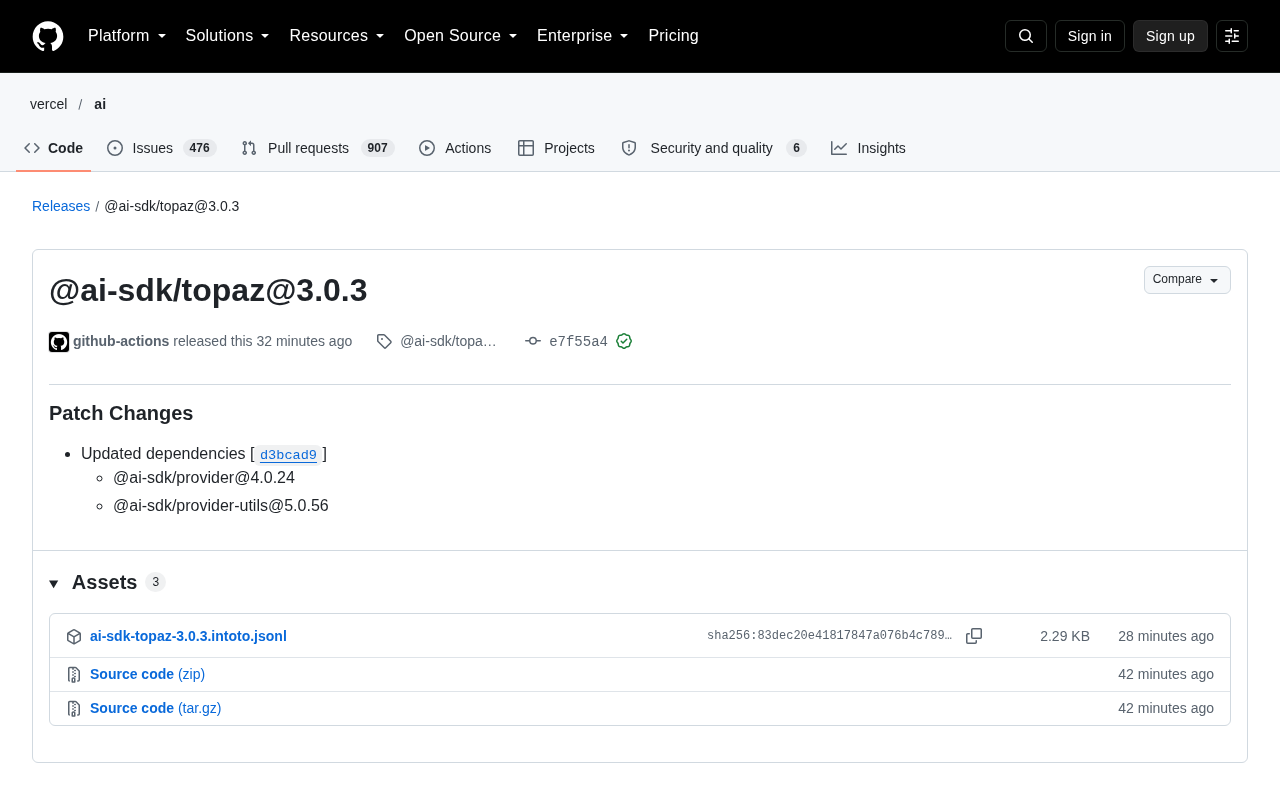
`@ai-sdk/[email protected]` is a lightweight maintenance patch released on October 7th via GitHub Actions with GPG signature verification. The substantive change is a dependency sync, bumping two foundational packages: `@ai-sdk/[email protected]`, which defines abstract model provider interfaces, and `@ai-sdk/[email protected]`, which provides shared utility functions. The release was triggered by upstream commit `d3bcad9` — a typical dependency cascade publish. Following SemVer, patch releases are backward-compatible and low-risk, though developers should still validate in a test environment and check the lockfile dependency tree before promoting to production.
Version Overview
@ai-sdk/[email protected] is a patch-level update released on October 7th via GitHub Actions. The release was verified with a GitHub GPG signature (key ID: B5690EEEBB952194), ensuring the authenticity of the published package.
The version number 3.0.3 indicates a minor patch within the 3.0.x series, following Semantic Versioning (SemVer) conventions. By definition, a patch release contains only backward-compatible bug fixes or internal dependency adjustments — no breaking changes. Existing users can therefore upgrade with confidence.
SemVer defines version numbers using a MAJOR.MINOR.PATCH structure: MAJOR signals breaking API changes, MINOR signals new backward-compatible features, and PATCH signals backward-compatible bug fixes only. In 3.0.3, the leading 3 is the major version — meaning the jump from 2.x to 3.x once introduced breaking changes — while the increment in the final digit indicates this release is a safe internal patch. Proposed by Tom Preston-Werner (GitHub co-founder), SemVer has become the de facto standard in the npm ecosystem. Package managers rely on these conventions to automatically determine whether a dependency can be upgraded without breaking existing code.
What Changed in This Release
According to the release notes, this update's core change is a dependency sync (Patch Changes), specifically bumping two foundational packages:
@ai-sdk/[email protected]@ai-sdk/[email protected]
Both packages are fundamental building blocks of the AI SDK ecosystem. provider defines the abstract interfaces for interacting with various model providers, while provider-utils supplies the common utility functions needed by provider implementations. This @ai-sdk/topaz release was triggered by an upstream commit (d3bcad9) — a classic "dependency cascade" update, where a fix or adjustment in a lower-level library prompts upper-level packages to publish new versions in order to keep the entire toolchain consistent.
Within the Vercel AI SDK architecture, @ai-sdk/provider serves as the "specification layer," defining unified TypeScript interfaces (such as LanguageModelV1 and EmbeddingModelV1) so that higher-level application code doesn't need to worry about whether the underlying implementation is OpenAI, Anthropic, Google, or any other provider. @ai-sdk/provider-utils builds on this foundation, offering cross-provider reusable utilities for parsing streaming responses, handling JSON Schema validation, and standardizing error types. As a concrete provider adapter, @ai-sdk/topaz must stay in sync with these two foundational packages — a version mismatch would cause interface signature incompatibilities that produce hard-to-trace runtime errors. This layered dependency structure is a classic pattern for managing large SDK ecosystems in a monorepo: any change to a lower-level package ripples outward, triggering cascading releases across dependent packages.
What This Means for Developers
For developers building applications with the AI SDK, patch updates like this typically have minimal impact but are still worth noting. Dependency syncs often indicate that upstream packages resolved edge-case bugs or improved internal implementations. Staying current helps you avoid potential compatibility issues caused by version mismatches.
In practice, it's a good idea to inspect the dependency tree in your lockfile before upgrading, and confirm that the versions of @ai-sdk/provider and @ai-sdk/provider-utils align correctly. Since this is a patch release, the upgrade risk is low — but in production environments, you should still follow the standard process of validating in a test environment before rolling out more broadly.
Summary
@ai-sdk/[email protected] is a lightweight maintenance release whose core value lies in syncing upstream dependencies and keeping the ecosystem healthy. It also reflects a broader characteristic of modern AI toolchains: their high degree of modularity means a single change deep in the stack propagates through the dependency graph, keeping the entire ecosystem evolving in lockstep. For teams keeping tabs on the AI SDK, staying aware of these version updates is a practical way to maintain long-term project stability.
Note: This article is based on the official release notes. For full change details, refer to the complete changelog in the GitHub repository.
Related articles

Felix Rieseberg Personal Homepage
Felix Rieseberg's personal homepage sparks attention on Hacker News. This article covers the Slack engineer's technical background, the rise and fall of nativefier, and the value of a developer homepage as a tech calling card.

@ai-sdk/vue 3.0.306 Patch Release Syncs with [email protected] Update
@ai-sdk/vue 3.0.306 released, synced with [email protected]. A routine patch release for the Vercel AI SDK ecosystem with no public API changes; the Vue adapter layer stays version-aligned with the core package.

Gemini 4 Argon API Launches: The Era of Million-Token Output Begins
Google launches Gemini 4 Argon with sparse MoE architecture, up to 1M output tokens, and a 68.90% Vals Index score, available across API, AI Studio, and the Gemini app.