@ai-sdk/tui 1.0.134 Released: Patch Update for Dependency Sync

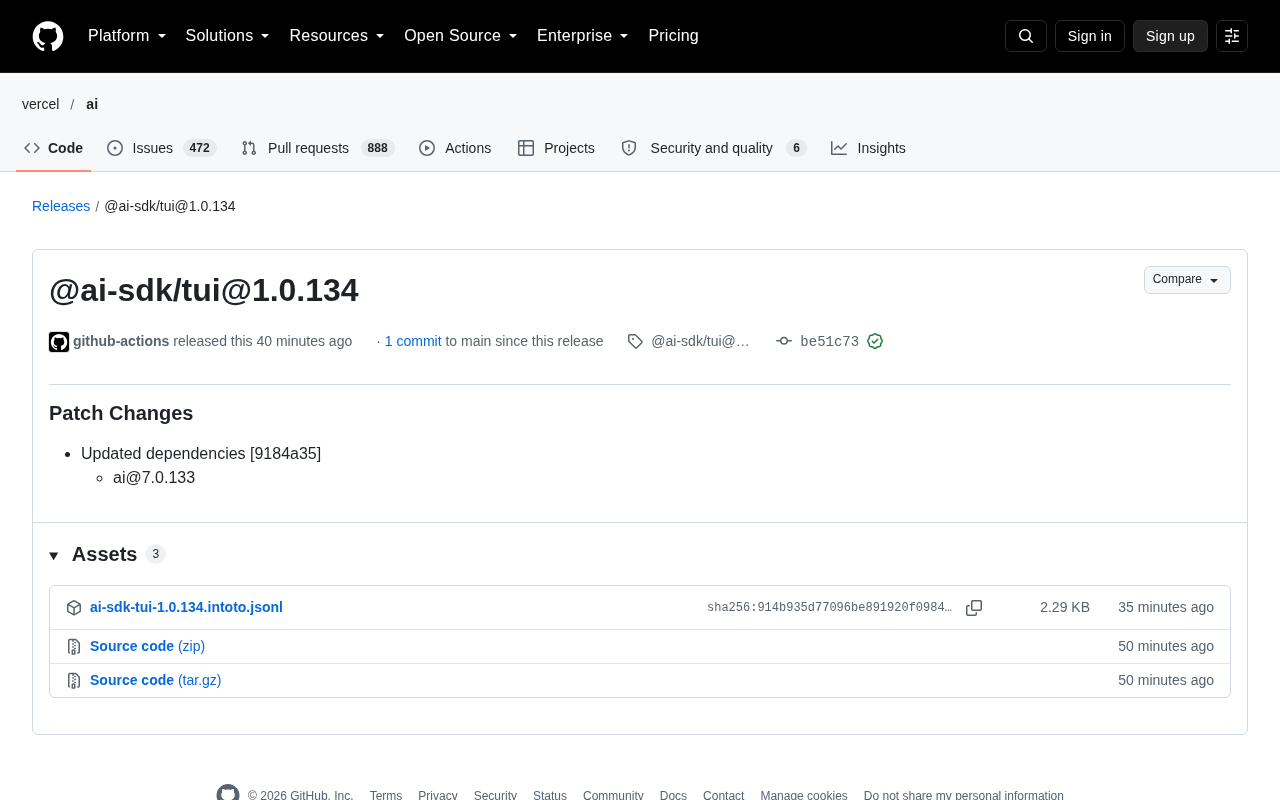
@ai-sdk/tui 1.0.134 is a patch release that syncs its dependency to ai@7.0.133 with no new features.
`@ai-sdk/tui@1.0.134` is a routine maintenance patch with no new features — its only change is syncing the underlying `ai` core package dependency to version 7.0.133. This "dependency sync" release is standard practice in monorepo-managed projects, where peripheral packages are republished in bulk whenever a core package updates to maintain toolchain consistency. `@ai-sdk/tui` focuses on providing interactive terminal UIs for AI applications, complementing the core `ai` package. The release is GPG-signed via GitHub Actions. Developers upgrading `ai@7.0.133` are advised to update this package simultaneously — the risk is minimal.
Version Overview
@ai-sdk/tui has released version 1.0.134, a typical patch-level update. According to the GitHub Releases page, this version was published via a GitHub Actions automated workflow and verified with a GitHub verifiable signature (GPG key ID: B5690EEEBB952194), ensuring the authenticity of the release artifacts.
The version number 1.0.134 reflects the continued iteration of the TUI (Terminal User Interface) package within the AI SDK ecosystem. With the major version remaining at 1.0, this update introduces no breaking changes, making it safe for developers to upgrade.
What's Changed
The core changes in this release are recorded under Patch Changes and are straightforward:
- Updated dependencies [9184a35]: Dependency versions have been synchronized
- ai@7.0.133: The underlying
aicore package has been upgraded to version 7.0.133
In other words, @ai-sdk/tui@1.0.134 does not introduce any new features. Its primary purpose is to follow the upstream ai package's version evolution and maintain dependency consistency across the SDK toolchain. This type of "dependency sync" release is very common in actively maintained npm ecosystems — especially in monorepo-managed multi-package projects. When a core package updates, related peripheral packages are published in bulk to avoid compatibility issues caused by version mismatches.
A monorepo is an engineering practice where multiple related packages are managed together in a single repository. Vercel's AI SDK follows this model. In a monorepo, version management tools (such as Changesets) track change records for each package. When a core package (in this case,
ai) publishes a new version, all sub-packages that declare a dependency on it automatically trigger a "dependency upgrade" release — even if the sub-package's own code hasn't changed. The patch version is incremented and the package is republished to ensure thatpeerDependenciesordependenciesranges across packages in the npm registry stay aligned, preventing version resolution conflicts during installation.
What Is @ai-sdk/tui
@ai-sdk/tui is part of the AI SDK toolchain, focused on building user interfaces for AI applications in terminal environments. TUI (Text-based User Interface / Terminal User Interface) allows developers to render interactive interfaces on the command line, making it particularly useful for building CLI tools, local AI assistants, or development/debugging panels.
It works in conjunction with the core ai package: the ai package provides low-level capabilities such as model invocation, streaming responses, and tool calling, while the tui package wraps these capabilities into forms suitable for terminal display and interaction. This layered design lets developers mix and match as needed — whether rendering in a web frontend or running AI applications in a pure terminal environment.
Several well-known TUI frameworks exist in the Node.js ecosystem, such as Ink (a React-based terminal UI library) and Blessed.
@ai-sdk/tuibuilds on this foundation with targeted encapsulation for AI interaction scenarios. Common capabilities include character-by-character streaming output rendering, message history display for multi-turn conversations, and progress feedback for tool call states. For use cases that require running AI workflows in CI/CD pipelines, server SSH sessions, or browser-free environments, a TUI approach is far more lightweight and easier to integrate than a Web UI.
Upgrade Recommendations
For developers currently using the AI SDK, patch updates like this are generally safe to apply:
- Version numbers follow Semantic Versioning (SemVer); changes under
1.0.xindicate only backward-compatible fixes or dependency syncs - This update primarily tracks
ai@7.0.133— if your project has already upgraded or plans to upgrade the coreaipackage, it's recommended to update@ai-sdk/tuiat the same time to keep versions aligned - Release artifacts have been verified with GPG signatures, ensuring supply chain security
Upgrading follows the same process as any standard npm package — simply run the update command with your package manager.
Summary
@ai-sdk/tui@1.0.134 is a low-risk maintenance release whose core value lies in syncing the dependency to ai@7.0.133. While there are no new feature highlights, it reflects the AI SDK ecosystem's commitment to high-frequency, standardized iteration and engineering quality. For teams focused on building terminal-based AI applications, staying current with these updates ensures timely access to improvements and fixes in the underlying capabilities.
Related articles

Chain of Thought Isn't Just for AI: How Humans Can Use CoT to Improve Thinking Quality
Chain of Thought isn't just a prompt trick for large models. Starting from a Hacker News discussion, this article analyzes why CoT works for human thinking too, breaks down actionable ways to transfer it, and highlights the key differences between human CoT and machine CoT.
Cloudflare Teams Up with OpenAI: Closi…
Cloudflare Teams Up with OpenAI: Closing the Loop from Vulnerability Discovery to Defense with AI
Cloudflare uses OpenAI Daybreak to investigate security vulnerabilities and generate reviewable remediation plans, while developers use Codex to boost coding efficiency and quality.

Orca Multi-Agent Orchestration in Practice: A Guide to Parallel Collaboration with Claude and Codex
Orca is Stable AI's free open-source agent workbench supporting 34 agents like Claude Code and Codex in parallel. Learn its Git worktree isolation, multi-model orchestration, and mobile management.