@ai-sdk/tui 1.0.179 Release: Dependency Upgrades and Signals of AI SDK Evolution
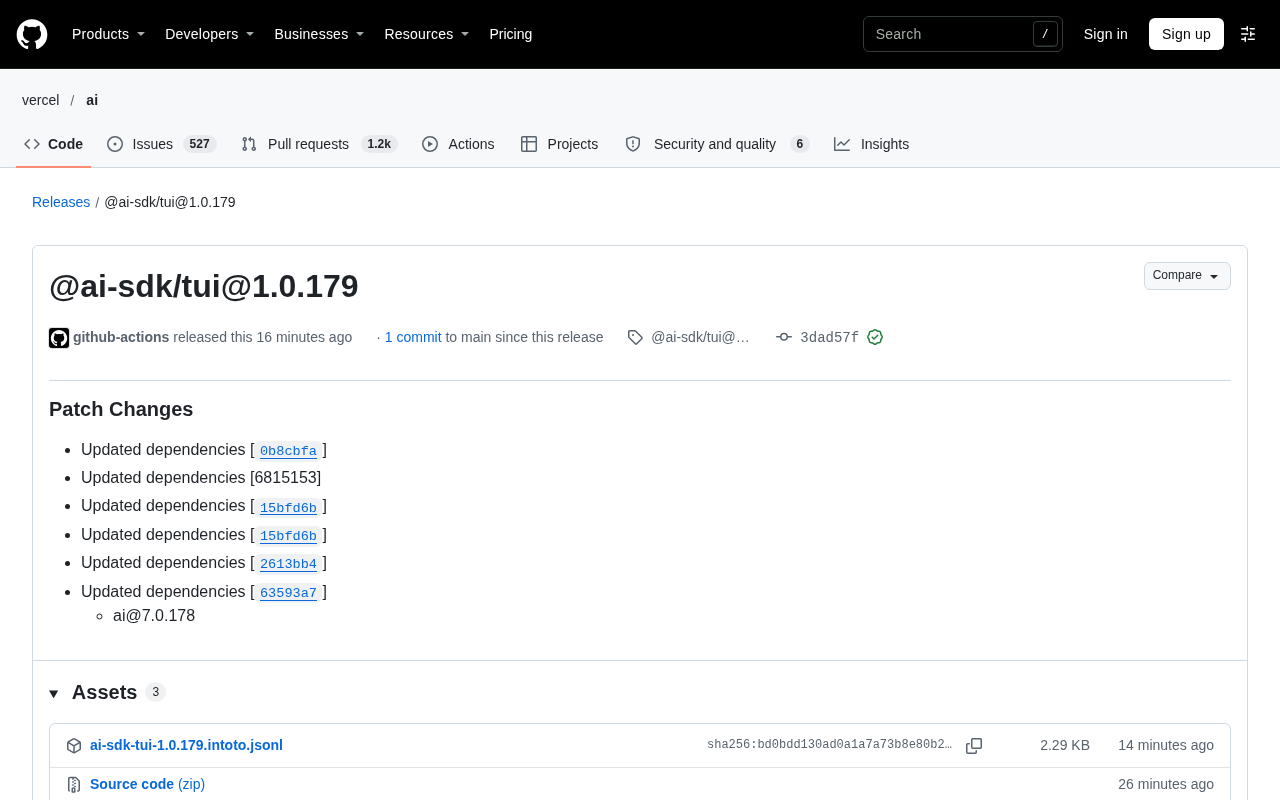
@ai-sdk/tui 1.0.179 patch update syncs dependency to ai@7.0.178, a low-risk upgrade.
@ai-sdk/tui released patch version 1.0.179, with the core action being automatic dependency sync to ai@7.0.178 via GitHub Actions. This package is the terminal user interface component in Vercel's AI SDK ecosystem, relying on the ai core package for model invocation, streaming responses, and other capabilities. This update has no breaking change declaration and is a low-risk upgrade, but developers still need to pay attention to terminal streaming rendering, error handling, and TypeScript type compatibility, and check whether the dependency tree has multi-version conflicts. The article also analyzes the high-frequency small-step release strategy adopted by the AI SDK ecosystem: automated processes ensure version synchronization, but release notes have low information density, so teams are advised to establish internal dependency change tracking mechanisms.
@ai-sdk/tui, the terminal user interface component package in Vercel's AI SDK ecosystem, has released version 1.0.179. Judging from the GitHub release records, this is a typical patch-level update, with the core action being synchronized dependency upgrades, including the key package ai@7.0.178. Although the version number is small, observing it within the overall iteration rhythm of AI SDK still reveals some technical signals worth noting.
A "quiet" patch update hiding dependency chain linkage
This release of @ai-sdk/tui was automatically completed by GitHub Actions, containing 1 commit with hash 3dad57f and a GitHub verified signature. The release notes contain no feature descriptions, only listing multiple dependency update records pointing to various commit hashes, one of which is explicitly labeled ai@7.0.178.
This means the essence of this update is upgrading the underlying AI SDK that the TUI component depends on to ai@7.0.178. For developers using @ai-sdk/tui to build terminal interaction interfaces, such patches often do not change the public API but may carry underlying fixes, type definition adjustments, or internal behavior optimizations. Since the release notes do not elaborate on each dependency change, the specific impact needs to be judged in conjunction with the ai@7.0.178 changelog.
From an engineering practice perspective, this "dependency-sync" type of release is very common in monorepo management: after an upstream package releases a new version, downstream packages quickly follow up through automated processes to keep the entire toolchain version-consistent. As the terminal UI layer, @ai-sdk/tui depends on the capabilities of the ai core package, and version linkage between the two is a design necessity.
Monorepo (single code repository) refers to an engineering pattern that places multiple interrelated packages in the same codebase for unified management. In ecosystems like AI SDK, the core package ai and peripheral packages (such as @ai-sdk/tui, model provider adapters, etc.) usually coexist in the same monorepo, sharing build configurations, testing tools, and release pipelines. The advantage of this structure is that when an upstream package releases a new version, downstream packages can batch-update dependency declarations and trigger releases through automated scripts (such as GitHub Actions), thereby avoiding version inconsistency caused by manual cross-repository synchronization. The "dependency-sync" type of release mentioned in the article is exactly a typical product of monorepo workflows—although the version number change is small, it ensures version consistency across the entire toolchain and reduces compatibility failures developers encounter due to version drift.
The role of ai@7.0.178: core package driving terminal experience
The ai package is the core abstraction layer of AI SDK, responsible for basic capabilities such as model invocation, streaming responses, and tool calls. @ai-sdk/tui encapsulates these capabilities into interactive components usable in the terminal. Therefore, any underlying change in ai@7.0.178 may indirectly affect the TUI component's performance in streaming output, error handling, or type inference.
This release does not provide the specific changes in ai@7.0.178. Judging only from the version number, it continues the patch iteration of the 7.x series. For projects currently using @ai-sdk/tui, it is recommended to focus on verifying streaming rendering and exception branches in terminal interaction scenarios after upgrading, because such dependency upgrades usually do not elaborate details in release notes, but actual behavior may have subtle differences.
Streaming Response is one of the core capabilities of AI SDK: when generating content, the model does not return the complete result all at once but gradually pushes it in the form of chunks, allowing the frontend or terminal interface to render while receiving. This mode is particularly important for terminal TUI because it can significantly reduce the user's perceived waiting time and support interactions such as real-time output and typewriter effects. The ai package is responsible for abstracting the streaming protocols of different model providers into a unified iterable data stream; @ai-sdk/tui consumes these streams and maps them to dynamic text updates in terminal components. Therefore, when the ai package is upgraded, even if it is only a patch version, it may adjust stream backpressure handling, error recovery, or chunk parsing logic, thereby affecting TUI streaming rendering performance.
Practical impact on developers and upgrade recommendations
If your project directly depends on @ai-sdk/tui, 1.0.179 is a low-risk update: patch version number, no breaking change declaration, automated release process—all these factors indicate a smooth upgrade. But low risk does not mean zero impact, especially when your project also locks other versions of the ai package, you need to check whether the dependency tree has version conflicts.
When upgrading, pay attention to three points. First, confirm the compatibility of ai@7.0.178 with other @ai-sdk series packages in the project to avoid multiple versions of the same core package coexisting. Second, run the existing interaction flow in the terminal environment to observe whether streaming output and error prompts work properly. Third, if the project is sensitive to type definitions, check whether TypeScript compilation passes, because patch updates sometimes adjust internal type exports.
Dependency tree version conflicts are a common problem in the JavaScript ecosystem: when multiple packages in a project depend on different versions of the same core package, package managers (npm, pnpm, yarn) may install multiple copies, leading to type mismatches, singleton failures, or inconsistent behavior. For the linked upgrade of @ai-sdk/tui and ai, it is recommended to use npm ls ai or pnpm why ai to check the actually resolved version, and use overrides (npm), resolutions (yarn), or pnpm.overrides to force version unification. In addition, TypeScript projects should pay attention to whether the patch version of the ai package modifies exported type definitions—even if runtime behavior is unchanged, subtle type-level adjustments may cause compilation errors, especially in strict mode or scenarios using advanced type inference.
Maintenance strategy of AI SDK seen from patch rhythm
The version number of @ai-sdk/tui has reached 1.0.179, indicating that this package adopts a high-frequency, small-step release strategy. Combined with GitHub Actions automated releases and dependency-linked updates, it can be seen that Vercel's maintenance of the AI SDK ecosystem favors continuous integration and rapid synchronization rather than accumulating large versions for centralized releases.
This strategy is friendly to users: fixes can reach downstream faster, and version drift between packages is kept within a small range. The cost is that the information density of release notes is low. In cases like this update, where only dependency changes are listed and specific impacts are not written, developers need to trace upstream commits themselves. For teams deeply dependent on this ecosystem, establishing an internal dependency change tracking mechanism will be more effective than simply reading release notes.
Overall, @ai-sdk/tui 1.0.179 itself is not a noteworthy feature release, but it is a slice for observing how the AI SDK toolchain collaborates: core packages and interface packages stay synchronized through automated processes, and terminal AI interaction capabilities are gradually improved through continuous small iterations.
Related articles

Michael Nielsen Takes Down His Classic Neural Network Textbook, Sparking Community Discussion
Michael Nielsen's classic free textbook Neural Networks and Deep Learning has been taken offline, sparking discussion on Hacker News about the reasons and impact.

Inside the AI Training Data Market: The Trade-off Between Exclusivity and Discounts
G2i founder Gabe Greenberg reveals the dual-track pricing of the AI training data market: labs pay a premium for exclusive data or accept discounts that allow others to buy it.

SessionGraph: Unifying All Coding Agent Sessions in One Interactive Graph
SessionGraph aggregates coding agent sessions into an interactive graph, helping developers review, debug, and manage AI coding workflows across sessions. This article examines its positioning, value, and open questions.