@ai-sdk/tui Patch Release: Dependency Sync Upgrade Explained

@ai-sdk/tui 1.0.131 patch release syncs the underlying ai package to 7.0.130 with minimal risk.
@ai-sdk/tui 1.0.131 is a typical dependency-sync patch update, automatically published via GitHub Actions with GPG signature verification. The release introduces no new features of its own — it simply syncs the core `ai` dependency to 7.0.130 via two associated commits, reflecting Vercel AI SDK's unified monorepo rolling release strategy. For developers building AI-powered terminal interfaces with this library, the upgrade risk is very low. It's recommended to update to the latest patch version, ensure the core `ai` package version is consistent across your project, and run basic regression tests after upgrading in case of undisclosed upstream changes.
Version Overview
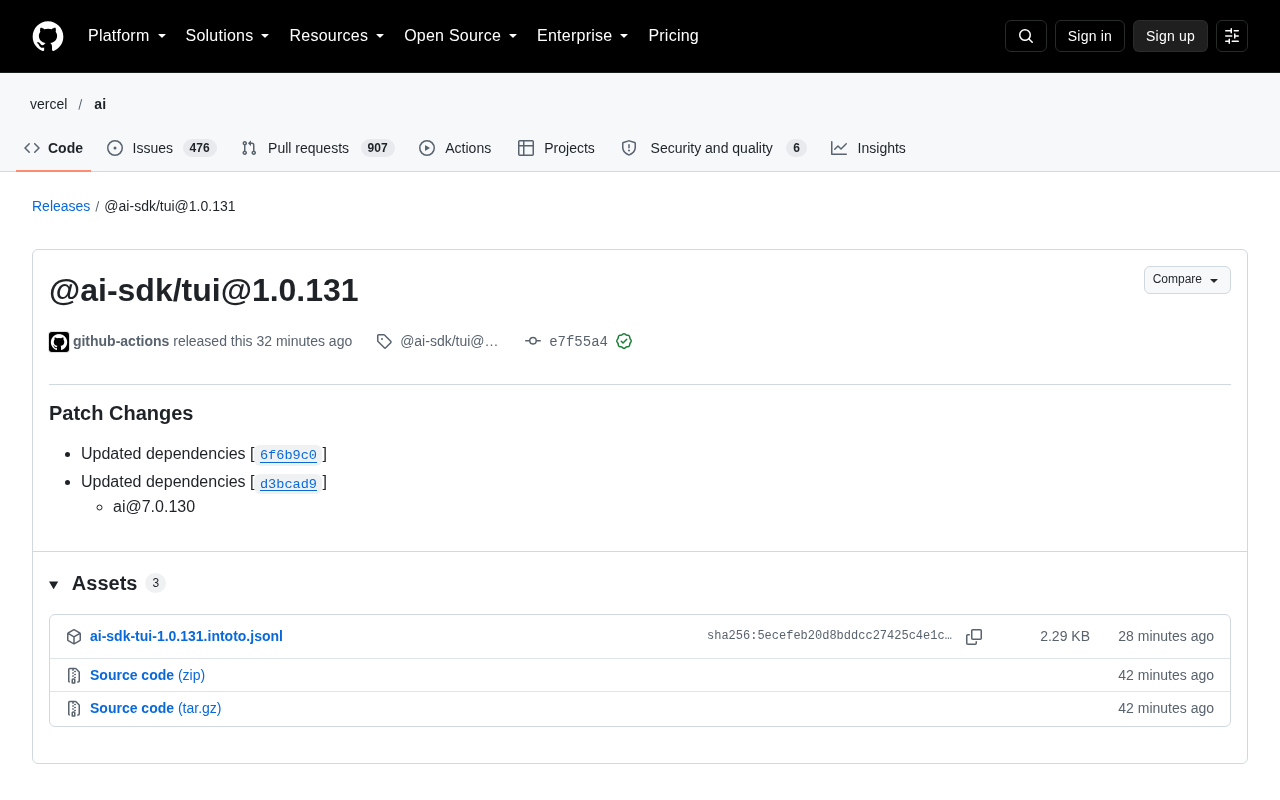
@ai-sdk/tui has released version 1.0.131, a patch-level update. According to the GitHub release record, this version was automatically published by github-actions and signed with GitHub's verified GPG key (ID: B5690EEEBB952194), ensuring the integrity and trustworthiness of the release process.
The version number 1.0.131 clearly indicates a typical patch update. Under Semantic Versioning (SemVer) conventions, patch releases only involve backward-compatible bug fixes or dependency syncs — no breaking changes are introduced — so developers can upgrade with confidence.
What is Semantic Versioning? Semantic Versioning (SemVer) is a widely adopted versioning standard in the software industry, formatted as
MAJOR.MINOR.PATCH. A MAJOR version change indicates breaking, incompatible API changes; a MINOR version change signals new backward-compatible features; and a PATCH version change contains only backward-compatible bug fixes. For a version like1.0.131, the increment in the third position means developers typically don't need to modify any business logic to upgrade. Package managers (such as npm/yarn with the^prefix constraint) will also automatically accept such updates.
What Changed: Dependency Sync
The core of this update is a dependency sync upgrade. The Patch Changes listed in the release notes include:
- Updated dependencies (associated commit
6f6b9c0) - Updated dependencies (associated commit
d3bcad9) - Underlying dependency
ai@7.0.130synced accordingly
This means @ai-sdk/tui, as a component within the ecosystem, has aligned its version with the core ai package's iteration. For developers building Terminal User Interface (TUI) applications using the Vercel AI SDK, keeping these dependencies in sync helps avoid version conflicts and allows you to benefit from upstream fixes.
The Role of @ai-sdk/tui
@ai-sdk/tui is part of the AI SDK ecosystem, designed for scenarios where developers want to build AI-powered interactive interfaces in terminal environments. Compared to graphical frontends, TUI is better suited for command-line tools, developer scripts, and lightweight server-side interactions. Its release cadence closely mirrors that of the core ai package, indicating that the ecosystem follows a unified monorepo release strategy where sub-packages roll forward alongside the core library.
The benefit of this release model is strong version coordination across all SDK components. However, it also requires developers to pay attention to dependency tree consistency when upgrading — pinning individual sub-package versions in isolation can lead to incompatibilities.
What is a Monorepo? A monorepo (single repository) is a development approach where multiple related projects or packages are managed together in one codebase. Vercel AI SDK uses this structure, typically leveraging tools like Turborepo, Lerna, or Changesets to enable cross-package version coordination and unified publishing. The close version numbers of
@ai-sdk/tui(1.0.131) and the coreaipackage (7.0.130) are a direct reflection of this unified release strategy — sub-packages are "stamped" with a new version on each core library iteration, ensuring ecosystem-wide dependency compatibility even when the sub-package itself has no substantive code changes.
Recommendations for Developers
As a purely dependency-syncing patch, upgrading to 1.0.131 carries minimal risk. Teams using this library are advised to:
- Upgrade directly to the latest patch version in your project to receive upstream fixes
- Confirm that the core dependency
aihas also been updated to 7.0.130 - Since the changelog provides limited detail, run basic regression tests after upgrading to confirm stability
It's worth noting that the official release notes are fairly sparse — they only reference dependency updates and commit hashes without elaborating on what specific issues were resolved. Developers who need more detail can review the changes in the associated commits 6f6b9c0 and d3bcad9.
Related articles

OpenAI Shopping Agent Hands-On: How Conversational AI Is Reshaping E-Commerce
Full breakdown of OpenAI's shopping agent demo: natural-language needs, budget-driven substitutions, visual generation, address changes, and upselling—how conversational AI reshapes e-commerce.

New DeepSeek Harness Plugin: Bringing the Cursor-Style Workflow into AI Coding
A Bilibili creator shares the Cursor-like Sidebar plugin, bringing a Cursor-style workspace to DeepSeek Harness: chat on the left, file editing on the right, Ctrl+L to reference code, hunk-by-hunk review of AI changes, plus installation notes.

Cursor Engineer Open-Sources Pstack: A Six-Phase AI Coding Pipeline Breakdown
Cursor's Lauren Tan open-sources Pstack, breaking AI coding into six phases. We detail its multi-agent design arena, TDD build, end-to-end verification, and PR babysitting, and compare it with other spec-driven frameworks.