AI SDK typesafe-ai 3.0.19 Released: Adds Image Input and Long-Context Support

@ai-sdk/typesafe-ai 3.0.19 adds PNG/JPEG image input and experimental 262k token long-context support for decision models.
@ai-sdk/typesafe-ai released patch version 3.0.19, introducing PNG/JPEG image input for decision models via multipart upload, plus image header and file-level typesafe.reference provider options enabling direct image references in instructions and criteria. It also adds a typesafe.longContext experimental switch extending context to 262k tokens for long documents, codebases, and conversations. New model IDs include jev-1.13.0, jev-1.14.0, and jev-preview, with provider-utils upgraded to 5.0.60.
The AI SDK ecosystem has received a noteworthy patch update. @ai-sdk/typesafe-ai has released version 3.0.19, introducing PNG/JPEG image input capabilities for decision models along with an experimental 262k token long-context switch. For developers building multimodal agents, these two changes directly expand the available input modalities and reasoning depth.
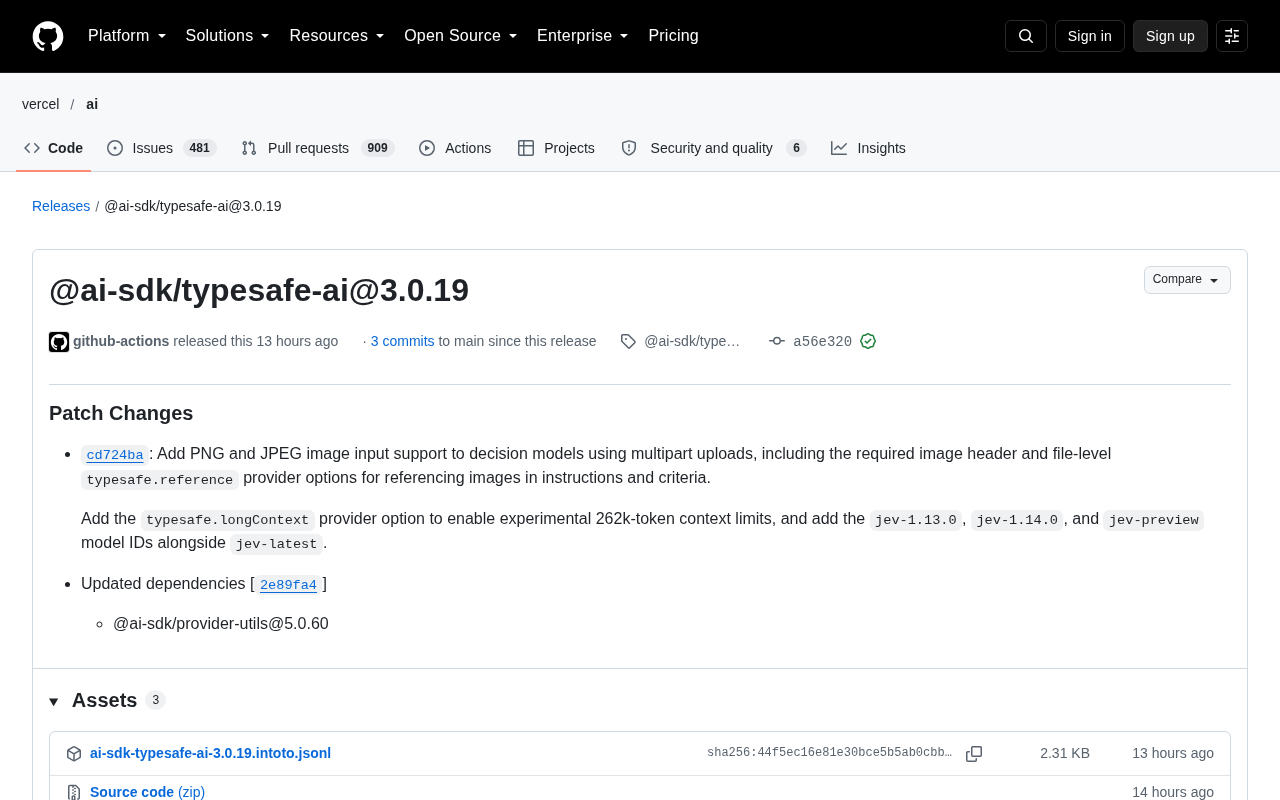
Image Input: Letting Decision Models "See"
The core change in this update is that decision models now support PNG and JPEG image input. The implementation is based on multipart upload, meaning image data is sent as a file alongside the request rather than encoded into the text prompt.
The supporting changes are equally important: a new image header and a file-level typesafe.reference provider option have been added. Developers can reference images in instructions and criteria, incorporating visual information into the model's judgment basis. Simply put, the model not only receives images but can also "point to" a specific image within its reasoning logic.
This design is particularly friendly for scenarios requiring mixed text-image judgment — for example, having the model evaluate whether a UI meets standards based on a screenshot, or executing conditional branches based on image content. Compared to stuffing base64-encoded images into text, multipart upload is more reliable for large files and aligns more closely with how mainstream multimodal APIs operate.
multipart/form-data upload mechanism: multipart is an HTTP request body encoding format that splits a single request into multiple independent "parts," each with its own Content-Type and Content-Disposition headers. Compared to base64 inlining into JSON or text prompts, multipart transmits binary data (such as PNG/JPEG) as raw byte streams, avoiding the roughly 33% size inflation and extra encoding/decoding overhead that base64 introduces, while also being more conducive to streaming and server-side chunk parsing. Mainstream multimodal APIs (such as OpenAI's and Anthropic's image interfaces) commonly adopt this approach. For developers, using multipart typically requires leveraging SDK wrappers or the FormData API to construct requests, rather than simply concatenating JSON strings.
Provider option and typesafe.reference: In the AI SDK system, a "provider option" refers to extended parameters passed to the underlying model provider through a specific namespace (here typesafe.), used to enable capabilities beyond the standard interface, typically not participating in cross-provider unified abstraction. typesafe.reference is a file-level referencing mechanism: it assigns an identifier to an uploaded image that can be referenced in the prompt. Developers can then "call out" a specific image in instructions (system-level directives) and criteria (judgment conditions), enabling the model to bind specific visual content to its reasoning logic when generating decisions, rather than treating images as indistinguishable attachments piled into the context.
Long Context: An Experimental 262k Token Switch
Another notable change is the addition of the typesafe.longContext provider option. When enabled, the context limit can be extended to 262k tokens — an experimental feature.
262k tokens roughly corresponds to hundreds of pages of text, suitable for processing long documents, large codebases, or long conversation histories. However, since it's marked as experimental, stability and practical usability may vary by model, so it's advisable to enable it cautiously in production and have fallback plans in place.
Tokens and context window: A token is the smallest unit of text a model processes. In English, one token roughly corresponds to 0.75 words, while in Chinese, one character often occupies 1 or more tokens. The context window determines the total input length the model can "see" in a single inference (including system prompts, conversation history, and the current question). 262k tokens is among the longer tiers currently available, equivalent to roughly one to two hundred thousand English words, or hundreds of pages of technical documentation. It's worth noting that a longer context does not equal equivalent comprehension — the industry widely observes the "lost in the middle" phenomenon, where models recall information in the middle of long contexts less effectively than at the beginning or end. Therefore, when processing large codebases or long documents, strategies like retrieval-augmented generation (RAG) are still commonly used alongside long context.
Model ID Updates
This release also adjusts the list of available models. Three new model IDs have been added — jev-1.13.0, jev-1.14.0, and jev-preview — alongside the existing jev-latest. Developers using fixed version numbers can lock in specific models, while jev-preview provides an entry point for trying out new capabilities.
On the dependency side, this update upgrades @ai-sdk/provider-utils to 5.0.60, a routine underlying dependency sync that typically doesn't introduce breaking changes, though running existing tests after upgrading is still recommended.
Practical Impact for Developers
From an engineering perspective, 3.0.19 is a feature-oriented patch version. The introduction of image input lowers the barrier to multimodal application integration, while the long-context option provides more room for long-text scenarios.
If your project is stuck on either "how to feed images to decision models" or "not enough context," this version is worth upgrading to validate. What still needs attention are the boundaries of experimental features — both typesafe.longContext and jev-preview are not stable commitments, and thorough testing should be done before deployment.
Overall, this update continues the rapid iteration pace of the AI SDK ecosystem, pushing both multimodal and long-context capabilities one step forward.
One-line Summary
@ai-sdk/typesafe-ai 3.0.19 adds PNG/JPEG image input and experimental 262k token long-context support for decision models.
Paragraph Summary
@ai-sdk/typesafe-ai has released patch version 3.0.19, primarily introducing PNG/JPEG image input for decision models via multipart upload, along with a new image header and file-level typesafe.reference provider option, enabling developers to directly reference images in instructions and criteria for reasoning. It also adds a typesafe.longContext experimental switch that extends the context limit to 262k tokens, suitable for long documents, large codebases, and long conversations. The model list adds jev-1.13.0, jev-1.14.0, and jev-preview, with provider-utils upgraded to 5.0.60. Overall, it's a feature-oriented patch update that lowers the barrier to multimodal integration and expands long-text processing space, though experimental features should be used cautiously in production.
Related articles

JobRunner MCP Server: AI Agents Can Now Fix Failed Java Jobs
JobRunner launches an open-source MCP server enabling AI agents to view cluster status, diagnose failures, and recover Java jobs—incident response from any cloud coding environment or existing agent.

MLAI Digital Launches 9 Security Agents: MCP Server Safeguards the Full Lifecycle of Agentic AI
MLAI Digital launches Security MCP Server with nine built-in specialized security agents covering vulnerability discovery, attack simulation, prompt injection detection, API and infrastructure assessment, and accelerated remediation—embedding security validation across the full Agentic AI lifecycle from development to production.

Running Isaac Lab on H100 GPUs: Exploring Better Approaches
Exploring optimization methods for running Isaac Lab on NVIDIA H100 GPUs, including MIG configuration, mixed precision, TensorRT acceleration, and community experience to improve robotics simulation and reinforcement learning efficiency.