@ai-sdk/typesafe-ai 3.0.29 Patch Release: Dependency Chain Update Analysis

AI SDK companion package typesafe-ai releases 3.0.29 patch, focused on dependency sync.
The type-safe wrapper package `@ai-sdk/typesafe-ai` in the AI SDK ecosystem released version 3.0.29. This is a typical patch version whose changes consist solely of two dependency updates, explicitly involving `@ai-sdk/provider-utils@5.0.70`, with no new APIs or functional changes. The version was auto-published by github-actions and passed signature verification, indicating an automated release pipeline whose cadence is tied to upstream dependency updates. Such patches maintain dependency chain consistency and avoid version drift; upgrade risk is low, but checking the lock file before upgrading is still advised. For teams evaluating the AI SDK stack, timely dependency maintenance can also serve as a window into ecosystem activity.
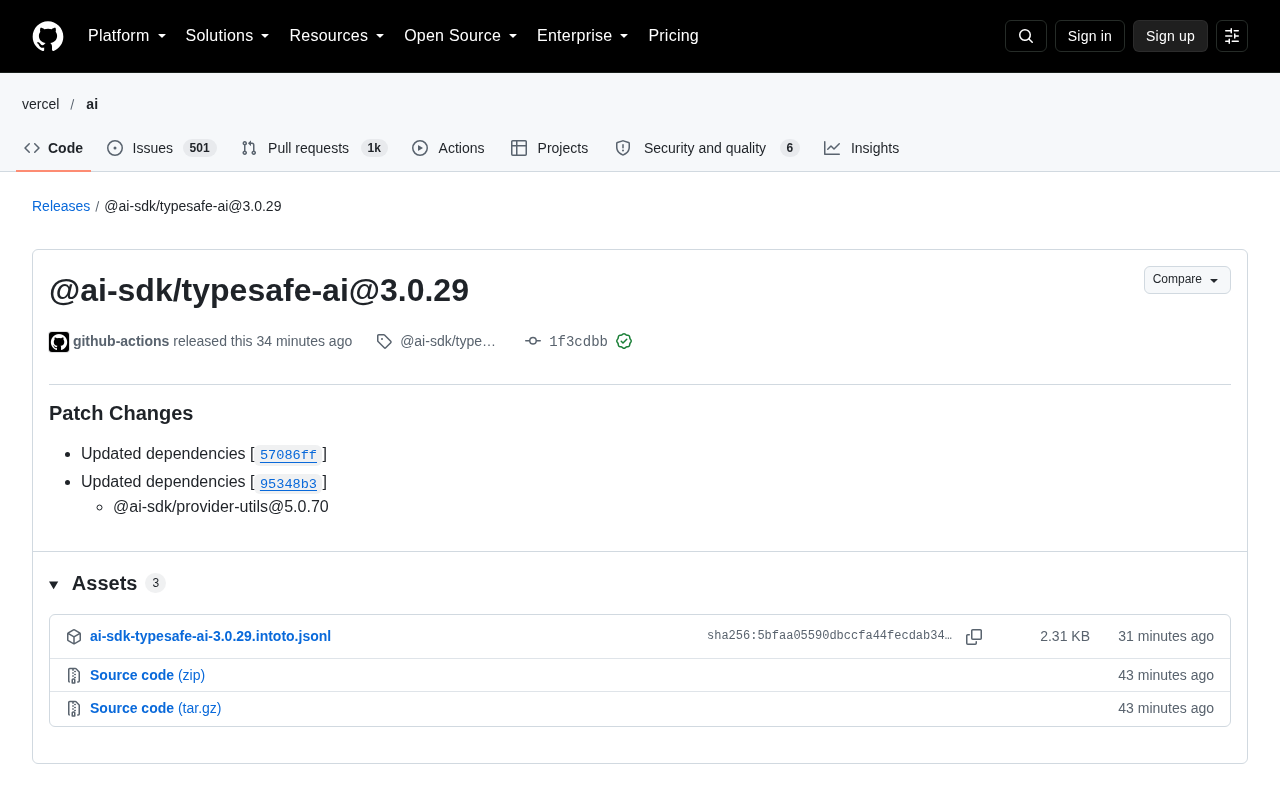
A companion package in the AI SDK ecosystem, @ai-sdk/typesafe-ai, has released version 3.0.29. Judging from the release notes, this is a typical patch version (Patch Changes), with the core content centered on dependency updates rather than major functional changes. For developers who build applications with the AI SDK day to day, understanding the significance of this kind of version iteration helps determine whether an upgrade is necessary.
Release Nature: A Converging Dependency Sync
According to the GitHub release page, 3.0.29 is a patch version with commit identifier 1f3cdbb, automatically published by github-actions and verified through GitHub's signature verification. The release notes list only two dependency updates, corresponding to commits 57086ff and 95348b3, with @ai-sdk/provider-utils@5.0.70 explicitly mentioned.
This release pattern of "updating dependencies only, adding no new APIs" is quite common in SDK ecosystems. It usually means an upstream package has fixed some internal issue or adjusted implementation details, and the downstream package syncs version numbers to keep dependencies consistent.
Why Dependency Updates Are Worth Noticing
Although patch versions may seem trivial, they reflect the health of the dependency chain. As a type-safe wrapper layer of the AI SDK, @ai-sdk/typesafe-ai depends on low-level utility packages such as @ai-sdk/provider-utils. When an underlying package releases a new version, the upper-layer package following up in a timely manner can avoid compatibility risks caused by version drift.
For project dependency management, this kind of update usually carries low risk, but it is still advisable to check the project's lock file before upgrading to confirm there are no conflicts with other dependencies.
Version Drift refers to the phenomenon in which the dependency versions actually installed in a project gradually diverge from the declared or expected versions. In a multi-layer SDK ecosystem, if upper-layer packages fail to follow updates to lower-layer packages for a long time, different sub-dependencies may each lock different versions of the same underlying package, ultimately introducing inconsistent behavior at runtime that is difficult to troubleshoot. Semantic Versioning (SemVer) stipulates that the patch position only contains backward-compatible fixes, so patch-level dependency synchronization is usually a low-risk convergence action; however, it still changes the actual resolution results in node_modules, so locking versions through a lock file and reproducing the installation in CI are standard means of judging whether a patch upgrade is safe.
The Role of typesafe-ai in the AI SDK
The AI SDK consists of multiple packages, and @ai-sdk/typesafe-ai, as the name suggests, emphasizes type safety. In TypeScript projects, type safety directly affects the development experience and runtime error rates. Such wrapper packages are typically used to provide stricter type constraints for scenarios such as model calls, tool definitions, and structured outputs.
Depending on provider-utils indicates that it sits in the middle layer of the SDK: downward, it interfaces with the adaptation logic of model providers; upward, it exposes type-friendly interfaces to application code. A patch version syncing dependencies means this layer of interfaces can still maintain consistent behavior when the underlying implementation changes.
Signals from the Automated Release Process
The release was completed by github-actions, indicating that the repository uses an automated release pipeline. Such pipelines are usually used together with tools like changesets, automatically generating version numbers and release notes when PRs are merged. For users, this means the release cadence is stable, and the speed at which patches are produced is tied to the update frequency of upstream dependencies.
The value of a type-safe wrapper layer lies in moving errors that would only be exposed at runtime forward to compile time. In LLM applications, model names, message roles, tool parameters, and schemas for structured outputs are all strings or loose JSON that are easy to get wrong. TypeScript's generics, conditional types, and features such as satisfies and as const can statically validate parameter shapes when calling models or defining tools, allowing the editor to provide autocompletion and to report errors directly when types do not match. Such wrappers usually do not change the underlying request logic; they simply put a thin shell with type constraints over the provider adaptation layer, so their own behavior is highly dependent on the implementation details of the underlying provider-utils.
Changesets is a common versioning and release management tool in the JavaScript ecosystem. Developers submit a changeset file along with a PR describing the type of change (patch/minor/major), and the release pipeline aggregates these files after merging, automatically deriving the next version number, generating release notes, and publishing to npm. Together with GitHub Actions and npm's provenance signing mechanism, it becomes possible to trace exactly which commit and which pipeline produced a given package version. This is also why the release notes for 3.0.29 show only two dependency update records—they most likely come from changesets automatically generated when upstream packages were upgraded, rather than manually written feature descriptions.
Upgrade Recommendations and Points to Watch
When facing a patch version like 3.0.29, the upgrade decision can be relatively straightforward: if the project is already locked to the 3.0.x series, following the patch usually incurs no additional cost; if the project is sensitive to dependency versions, you can first verify in the development environment.
It is worth noting that the release notes list only dependency updates and do not explain what specifically changed in @ai-sdk/provider-utils@5.0.70. Such information needs to be found in the release records of the corresponding package. In the absence of detailed change descriptions, it is sufficient to treat the patch upgrade as a routine operation to "keep dependencies fresh" without expecting behavioral changes.
For teams evaluating the AI SDK technology stack, this kind of release record also provides an observation window: whether a package maintains its dependencies in a timely manner often indirectly reflects the activity level and maintenance quality of the entire ecosystem.
One-line Summary
AI SDK companion package typesafe-ai releases 3.0.29 patch, centered on dependency synchronization.
Paragraph Summary
The type-safe wrapper package @ai-sdk/typesafe-ai in the AI SDK ecosystem has released version 3.0.29. This is a typical patch version whose changes consist solely of two dependency updates, explicitly involving @ai-sdk/provider-utils@5.0.70, with no new APIs or functional changes. The version was automatically published by github-actions and passed signature verification, indicating that the repository uses an automated release pipeline, with the release cadence tied to the update frequency of upstream dependencies. The article points out that the significance of such patches lies in maintaining dependency chain consistency and avoiding version drift; upgrade risk is low, but it is still advisable to check for lock file conflicts before upgrading. For teams evaluating the AI SDK technology stack, whether dependencies are maintained in a timely manner can also serve as a window into ecosystem activity.
Related articles

Cerebras CS-4 Stuns with Launch: The 4-Trillion-Transistor Wafer Monster That Crushes GPUs in Inference Speed
Cerebras CS-4 wafer-scale engine launched: 4 trillion transistors, 900,000 AI cores, inference an order of magnitude faster than GPUs. Modular power rack plus compute backpack design, 3D vertical stacking, and half-millimeter power delivery—online in minutes.

Apple's M6 Chip Lands in iMac: A Week in Review of Performance Upgrades and AI Controversy
Apple launches new iMac and MacBook Pro with M6 chip, N1 wireless chip brings speed gains; OpenAI claims three major discoveries but faces academic skepticism; data centers become a U.S. midterm election issue; Anduril teams up with Qualcomm for all-American laptops.

AI Cracks the Quasi-Riemann Hypothesis? A Mathematician's Account of a Stunning Moment
Number theorist Alex recounts on Lex Fridman's podcast the shocking experience of AI proving the quasi-Riemann hypothesis, plus Fermat's Last Theorem formalization and Navier-Stokes within a month, explaining the signal-processing intuition behind the Riemann hypothesis and the boundaries of AI breakthroughs in mathematics.