Cerebras CS-4 Stuns with Launch: The 4-Trillion-Transistor Wafer Monster That Crushes GPUs in Inference Speed
Cerebras unveils wafer-scale engine CS-4, challenging GPU inference dominance with modular deployment and near-memory computing.
Cerebras has launched its next-generation wafer-scale engine system, the CS-4, with a single chip integrating 4 trillion transistors and 900,000 AI-optimized cores; the company claims inference speeds an order of magnitude faster than GPU solutions. The system comprises two modular components—a power rack and a compute backpack—with power and cooling ready before compute arrives, enabling deployment in minutes. The CS-4 uses 3D vertical stacking with power converters placed directly on the wafer, shortening the power delivery path from about 50mm to half a millimeter and doubling power. Each AI core has dedicated memory adjacent to its logic circuitry, using near-memory computing to shorten data transfer distances. The modular architecture supports parallel manufacturing and future iterations, with the company claiming double the performance and half the components. However, the wafer-scale path imposes extremely high demands on manufacturing, packaging, and heat dissipation, software ecosystem maturity remains a real challenge, and its performance claims still await third-party benchmark validation.
When a Single Wafer Becomes a Data Center
As the AI compute race reaches a fever pitch, Cerebras has unveiled its latest-generation wafer-scale engine system, the CS-4. The official numbers are staggering: a single chip integrates 4 trillion transistors and 900,000 AI-optimized cores, with inference speeds an order of magnitude faster than GPU solutions—the "30x" claim in the original headline roughly stems from this "order of magnitude" description.
According to a video breakdown by a Bilibili creator, the CS-4's positioning is crystal clear: purpose-built for deploying high-speed AI inference at hyperscale data centers. Its design philosophy centers on two principles—squeezing more performance out of the wafer while making building, deploying, and scaling simpler.
This pursuit of "fast and simple" hits precisely on the pain point of today's AI infrastructure: performance gains often come with exponentially rising system complexity. Cerebras's answer is to hide that complexity inside a modular design.
Wafer-Scale Engine (WSE) is a processor architecture that designs and manufactures an entire wafer as a single complete chip, rather than dicing the wafer into hundreds of individual chips and packaging them separately as is traditionally done. The core challenge: wafers inevitably contain manufacturing defects, and under conventional dicing, any defect could scrap an entire chip. Cerebras's solution is to build in redundant cores and reconfigurable interconnects at design time, so that when some cores fail, the chip can still route around the defects through an on-chip network and keep working. Moreover, the full wafer area is far larger than a single chip, resulting in extremely high power and heat density, which necessitates special packaging and liquid cooling. This is precisely why wafer-scale engines can integrate hundreds of thousands of cores and massive on-chip memory on a single piece of silicon, fundamentally changing the physical distances involved in interconnect and memory access.
Power Rack + Compute Backpack: Turning Supercomputer Deployment into "Stacking Blocks"
The CS-4 consists of two modular components: a power rack and a compute backpack.
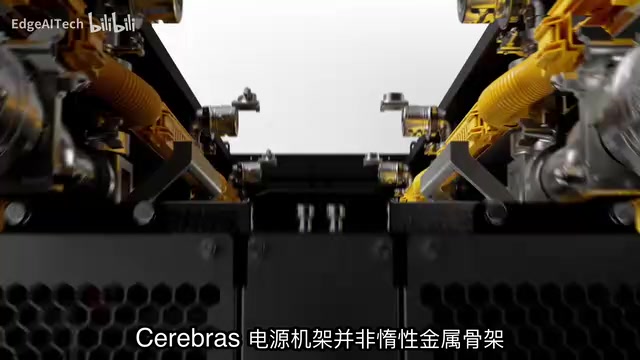
The power rack is not an inert metal skeleton in the traditional sense—it handles power delivery, cooling water distribution, and network infrastructure. Each compute backpack is powered by up to 30 power units; the rack takes AC input at up to 480 volts, and each unit converts it to 54.5 volts DC, supplying the low-voltage DC power the wafer requires.
The key to this design is decoupling: the power rack can be built, tested, and deployed in parallel with the manufacturing of compute backpacks. In other words, power and cooling are ready before the compute arrives, dramatically accelerating the entire process from installation to inference.
The compute backpack is a compact compute system, each containing one wafer-scale engine plus the power, cooling, and IO interfaces needed to run it at peak efficiency. The complexity of deploying a supercomputer is reduced to "mounting the compute backpack onto the power rack"—modularly deploying large-scale AI clusters sounds like stacking blocks in a server room.
According to the video, power, cooling water, and data connections are all made automatically, and a complete CS-4 can be brought online in minutes rather than days.

3D Vertical Stacking and Half-Millimeter Power Delivery: Squeezing Performance from Silicon
Rather than the planar layout of traditional GPU boards, the CS-4 stacks components vertically into a 3D structure. Behind the wafer is a copper cold plate that circulates cooling water through channels to carry away the heat generated by the wafer; in front of the wafer are compact power converters that deliver energy directly to the compute units.
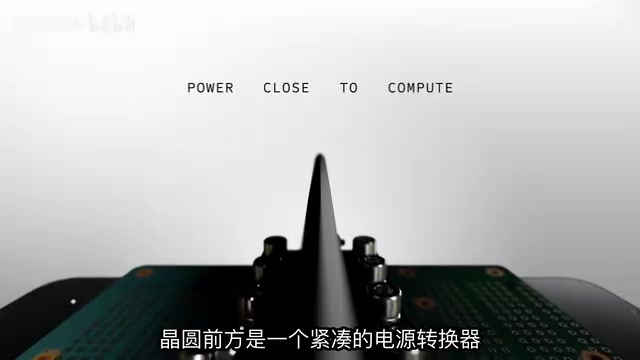
Here's an engineering detail worth noting: on traditional GPU boards, the circuit path from the power converter to the processor is about 50 millimeters, whereas the CS-4 places the power converter directly on the wafer, shortening this distance to half a millimeter—virtually eliminating power loss. The new power architecture doubles the power delivered to the wafer, enabling higher operating frequencies and faster token generation.
Focusing on heat dissipation and power delivery—the two areas that traditionally constrain chip performance—rather than simply stacking more compute units is one of the most fundamental divergences between Cerebras and the GPU approach.
Power Delivery Distance and Power Loss: On traditional GPU boards, there are typically tens of millimeters of PCB traces between the voltage regulator module (VRM) and the processor. Current flowing along this path produces resistive losses (I²R losses) and voltage drops, limiting power delivery efficiency at high currents. Cerebras integrates the power converter directly onto the wafer surface, shortening the power delivery path to the half-millimeter scale. This significantly reduces losses and allows greater current to be delivered at the same voltage, thereby supporting higher frequencies and stronger compute. This "power close to the load" approach, together with 3D stacking and liquid cooling, constitutes the physical-layer engineering innovation of the wafer-scale system.
900,000 Cores and Memory-Near-Compute: Another Answer to GPU Architecture
The world's largest computer chip sits at the heart of each compute backpack. A single piece of silicon integrates 900,000 AI-optimized cores connected by nanometer-scale wires—by contrast, GPU systems require thousands of cables for interconnection.
The memory architecture is another key difference. Each AI core has its own dedicated memory, built directly alongside the logic circuitry that uses it. Placing memory immediately adjacent to compute units dramatically shortens the distance data must travel, delivering high bandwidth and the fastest AI performance.
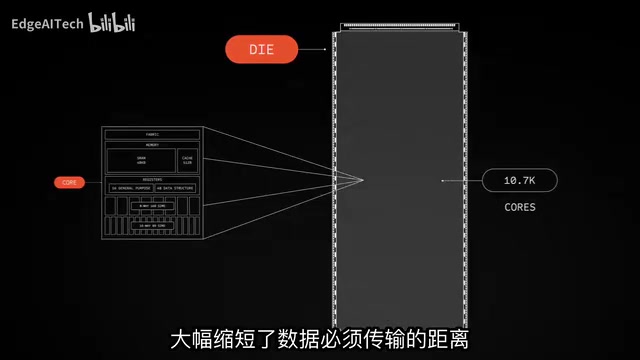
This is the ultimate expression of the "near-memory computing" approach. While GPU clusters struggle with the memory wall and interconnect bandwidth, wafer-scale integration compresses the entire memory hierarchy onto a single piece of silicon.
Near-Memory Computing refers to placing compute units as close as possible to the memory that stores data, in order to shorten data movement distances and reduce latency and energy consumption. In the traditional von Neumann architecture, data movement between processor and memory is known as the "memory wall," whose bandwidth and power consumption often become performance bottlenecks. Although GPUs alleviate some of this with high-bandwidth memory, complex interconnect hierarchies still lie between compute cores and memory. Wafer-scale engines build each AI core's dedicated memory directly alongside the logic circuitry, effectively compressing the "memory wall" to micron-scale on-chip distances—achieving advantages in bandwidth and energy efficiency. This is one of the architectural foundations behind its claimed inference speed lead.
Double the Performance, Half the Components: The Long-Term Math of Modular Architecture
Cerebras's official summary of the CS-4 is: twice the performance, half the components. By simplifying infrastructure, the CS-4 targets next-generation ultra-high-speed inference scenarios.
More noteworthy is the architecture's extensibility. The power and cooling systems are already prepared for the components, and the same modular architecture makes the CS-4 easier to maintain, easier to scale, and leaves room for future generations of wafer-scale engines. In other words, Cerebras is selling not just a machine but a deployment platform that can be continuously iterated upon.
For data centers planning large-scale inference clusters, this "infrastructure first, compute later" model may be more attractive than raw performance numbers alone.
Can the Wafer-Scale Path Challenge GPU Dominance?
Based on public information, the CS-4 offers answers fundamentally different from GPUs on inference speed, deployment simplification, and energy efficiency. But a sober view is warranted: wafer-scale engines impose extremely high demands on manufacturing, packaging, and heat dissipation, and the maturity of the ecosystem and software stack remains a real obstacle.
The video content is based primarily on official release materials and lacks cross-validation from third-party benchmarks. The conclusion that it is "an order of magnitude faster"—under which models and which workloads this holds—still awaits real-world deployment data.
What is certain is that the compute supply for AI inference is moving from a single architecture toward diversified competition. The arrival of the Cerebras CS-4 at least proves that the wafer-scale integration path has reached a stage where it can be deployed at scale—and that in itself is a signal worth watching for the entire industry.
Related articles

One Year of Dioxus Fullstack in Production: Gains and Pain Points
A developer shares a year of real-world experience running the Dioxus fullstack framework in production, covering type-safety gains in fullstack Rust, plus pain points like compile times and ecosystem maturity, as a reference for technology selection.

The Hidden Faith of AGI Leaders: Humans Are Nothing Special?
Vergecast podcast reveals the hidden belief within AGI leadership circles: humans are nothing special, consciousness is just computation. Exploring how computational functionalism shapes the worldview of tech elites and the future of AI.

GM Shifts Toward Hybrids: From an All-Electric Bet to a Pragmatic Parallel Strategy
GM once skipped hybrids to bet on pure EVs; now it plans hybrid SUV versions. This article analyzes the strategic shift, its significance for SUVs, and consumer impact.