AI SDK v0.0.92 Update: Unified Versioning and Reasoning Control Fixes

AI SDK v0.0.92 unifies versioning, fixes model-specific reasoning toggle bugs, and improves stability.
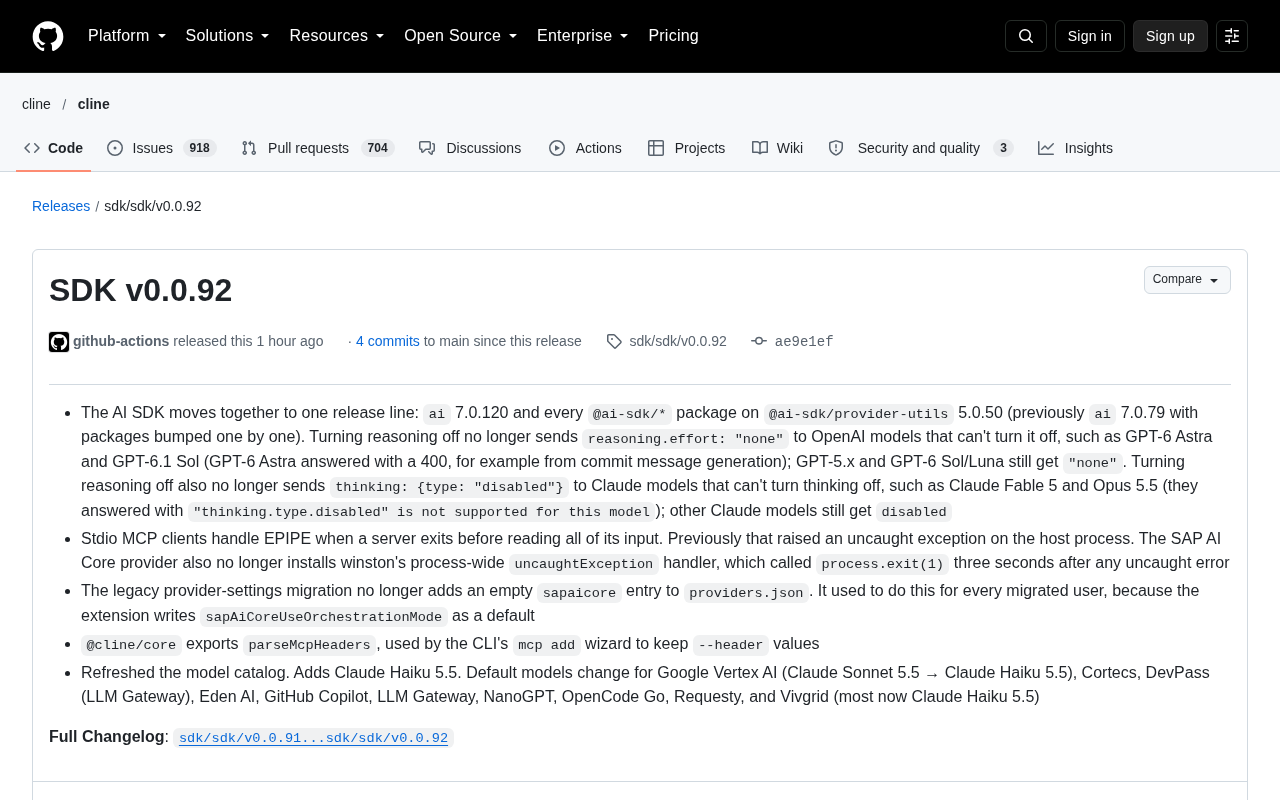
AI SDK v0.0.92 is primarily an engineering polish release. Key changes include: unifying the entire SDK ecosystem onto a single release line (core `ai` package at 7.0.120, all `@ai-sdk/*` packages on a shared `provider-utils` version); fixing reasoning-disable parameter logic so that unsupported OpenAI models (e.g., GPT-6 Astra) and Claude models (e.g., Opus 5.5) no longer receive parameters that trigger 400 errors; and resolving crash risks including EPIPE handling in the Stdio MCP client and removal of SAP AI Core's dangerous global exception handler. The model catalog also gains Claude Haiku 5.5, with multiple providers switching to it as their new default.
AI SDK has released v0.0.92, an update centered on unified version management, fixes to reasoning control logic, and a refreshed model catalog. It addresses several pain points commonly encountered during real-world integrations. Developers working within the Cline ecosystem or connecting to multiple LLM providers will find this upgrade worth noting.
Unified Versioning: No More Package-by-Package Upgrades
The most significant engineering change in this release is the shift to a unified release line across the entire AI SDK. The core ai package has been upgraded to 7.0.120, and all @ai-sdk/* packages are now unified on @ai-sdk/provider-utils 5.0.50.
Previously, ai was pinned at 7.0.79 while individual sub-packages were bumped one by one. This fragmented versioning approach made it easy to end up with mismatched dependencies and difficult-to-track compatibility issues. With everything aligned to a single release line, developers can manage dependencies more confidently and reduce integration headaches caused by version fragmentation.
This kind of seemingly mundane engineering improvement is actually a sign of SDK maturity — as the number of ecosystem packages grows, consistent version coordination reduces long-term maintenance costs far more than individual feature updates.
Reasoning Toggle Fixes: Differentiated by Model Capability
The change with the most direct developer impact is the corrected behavior when disabling the reasoning feature.
OpenAI Models
Previously, when disabling reasoning, the SDK would send reasoning.effort: "none" to all OpenAI models. However, some models don't support disabling reasoning — for example, GPT-6 Astra and GPT-6.1 Sol would respond with a 400 error (triggered in scenarios like commit message generation). After this update, the SDK no longer sends that parameter to models that cannot disable reasoning, while GPT-5.x and GPT-6 Sol/Luna still receive "none" as expected.
Claude Models
A similar issue existed with Claude models. Previously, disabling reasoning would send thinking: {type: "disabled"}, but models like Claude Fable 5 and Opus 5.5 don't support disabling thinking and would return the error "thinking.type.disabled" is not supported for this model. The SDK now omits the disabled parameter for these models while preserving the disabled behavior for other supported Claude models.
The shared logic behind both fixes is simple: send parameters based on each model's actual capabilities rather than applying a one-size-fits-all approach. As model capability matrices grow increasingly complex across providers, this kind of capability-aware adaptation at the SDK layer can significantly reduce the unexpected 400 errors developers run into.
The "reasoning" referred to here is the ability of large language models to perform internal chain-of-thought reasoning before generating a final answer — sometimes called "extended thinking." OpenAI controls the level of reasoning investment via the reasoning.effort parameter (low / medium / high / none), while Anthropic uses a thinking field to toggle the behavior. Enabling reasoning typically delivers significant accuracy improvements on complex tasks like math, code, and logic, but at the cost of higher latency and token usage. For lightweight, high-frequency scenarios like code completion and commit message generation, developers often want to disable reasoning in exchange for faster responses — which is the practical motivation behind the SDK correctly transmitting a "disable reasoning" signal.
Stability and Crash Prevention
Beyond feature logic, v0.0.92 also fixes several issues that could cause process crashes.
The Stdio MCP client now correctly handles EPIPE errors. Previously, when a server process exited before reading all its input, an uncaught exception would be thrown on the host process. This is now handled gracefully.
The SAP AI Core provider no longer installs a global uncaughtException handler from winston. That handler previously called process.exit(1) three seconds after any uncaught error — a dangerous global side effect for any host application. Removing it prevents unexpected process termination.
Additionally, the legacy provider-settings migration logic no longer writes empty sapaicore entries to providers.json. This was previously triggered because the extension defaulted to writing sapAiCoreUseOrchestrationMode, causing a redundant entry to be added for every migrated user.
MCP (Model Context Protocol) is a standardized protocol led by Anthropic for unifying communication between AI models and external tools or data sources. The Stdio transport mode is one way MCP operates — the client communicates with an MCP Server subprocess via standard input/output streams. An EPIPE error occurs when data is written to an already-closed pipe, typically when a server subprocess exits unexpectedly while the client is still trying to write to it. In this case, the operating system sends a SIGPIPE signal or returns an EPIPE error code. In Node.js, if this error isn't caught, it causes an uncaught exception in the host process, which can crash the entire application. This fix allows the SDK to handle such edge cases gracefully rather than propagating the error to the caller.
Model Catalog Refresh and Default Model Changes
v0.0.92 refreshes the model catalog with the addition of Claude Haiku 5.5. Default models for several providers have been updated accordingly, with the overall trend being a shift toward Claude Haiku 5.5.
Affected providers include Google Vertex AI (switching from Claude Sonnet 5.5 to Claude Haiku 5.5), Cortecs, DevPass (LLM Gateway), Eden AI, GitHub Copilot, LLM Gateway, NanoGPT, OpenCode Go, Requesty, and Vivgrid — most of which now default to Claude Haiku 5.5.
A collective move toward lighter, faster models like Haiku typically reflects a desire to balance cost against response speed. For high-frequency, lightweight tasks like code completion and commit message generation, faster and more economical models generally deliver a better experience.
Additionally, @cline/core now exports parseMcpHeaders, used by the CLI's mcp add wizard to preserve --header values.
Summary
This is a classic engineering polish release: no headline features, but unified versioning, capability-aware reasoning parameter handling, and several crash fixes are all improvements that directly impact stability and maintainability. For developers who heavily use the AI SDK to integrate with multiple model providers, upgrading to v0.0.92 should reduce quite a few headaches along the way.
Related articles

Chain of Thought Isn't Just for AI: How Humans Can Use CoT to Improve Thinking Quality
Chain of Thought isn't just a prompt trick for large models. Starting from a Hacker News discussion, this article analyzes why CoT works for human thinking too, breaks down actionable ways to transfer it, and highlights the key differences between human CoT and machine CoT.
Cloudflare Teams Up with OpenAI: Closi…
Cloudflare Teams Up with OpenAI: Closing the Loop from Vulnerability Discovery to Defense with AI
Cloudflare uses OpenAI Daybreak to investigate security vulnerabilities and generate reviewable remediation plans, while developers use Codex to boost coding efficiency and quality.

Orca Multi-Agent Orchestration in Practice: A Guide to Parallel Collaboration with Claude and Codex
Orca is Stable AI's free open-source agent workbench supporting 34 agents like Claude Code and Codex in parallel. Learn its Git worktree isolation, multi-model orchestration, and mobile management.