@ai-sdk/valibot 2.0.64 Patch Release: Dependency Upgrade and Ecosystem Stability Improvements

Vercel AI SDK's Valibot adapter releases 2.0.64, only syncing the upstream provider-utils dependency.
The article explains the essence of the @ai-sdk/valibot 2.0.64 patch update: the only change is upgrading the dependency @ai-sdk/provider-utils to 4.0.63, with no new APIs or breaking changes. The author notes that the Valibot adapter sits at the wrapper layer, integrating Valibot schemas into AI SDK's structured output validation flow, while actual provider compatibility and parameter validation logic lives in provider-utils. The article recommends including such updates in automated dependency update processes, confirming the resolved provider-utils version uniqueness before upgrading, and catching validation behavior regressions via CI unit tests.
Vercel AI SDK's Valibot adapter has released version 2.0.64, a patch-level maintenance update. For engineers who use this adapter in their daily AI application development, understanding the significance of such minor version updates is often more valuable than chasing major releases.
The dependency chain behind a patch update
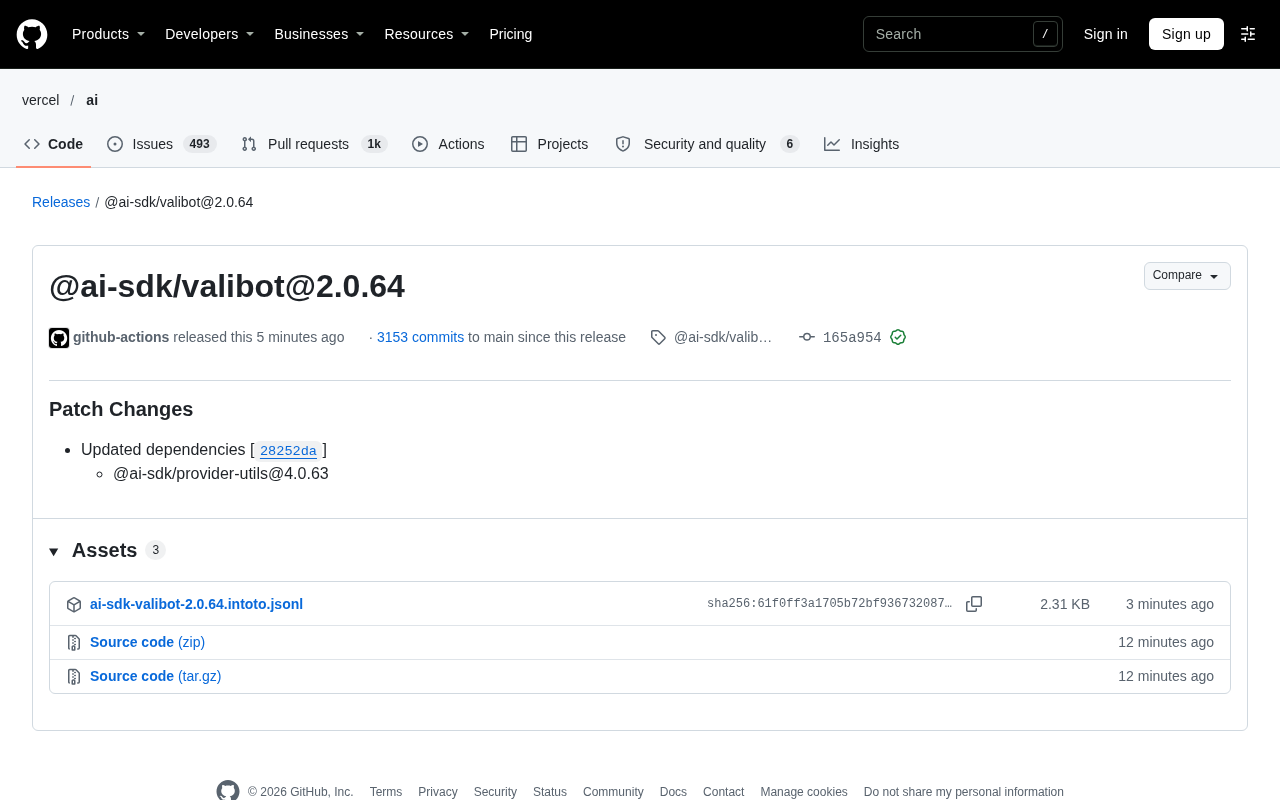
As seen on the GitHub Releases page, the changes in @ai-sdk/valibot@2.0.64 are very focused: updating the dependency @ai-sdk/provider-utils@4.0.63. This is a typical dependency-driven patch release—no new APIs and no breaking changes.
The semantics of Patch Changes are clear—it only contains changes related to fixes and dependency adjustments. For a package like the Valibot adapter that sits at the wrapper layer, its primary responsibility is to connect Valibot's schema validation capabilities with AI SDK's provider mechanism. The actual provider compatibility logic, tool-call parameter validation, structured output parsing, and other low-level capabilities mostly live in @ai-sdk/provider-utils.
Therefore, the essence of this update is to synchronize fixes from the upstream utility library, keeping the adapter consistent with the core layer in version.
Why dependency synchronization deserves attention
In the npm ecosystem, dependency drift is the source of many hard-to-reproduce bugs. When @ai-sdk/provider-utils fixes a parsing issue in some edge case, and your project has both old and new versions of the utility library installed, the behavioral difference may only surface under specific schemas or specific providers. The adapter releasing a patch version following upstream is essentially helping downstream users converge this kind of uncertainty.
Dependency drift refers to multiple incompatible or unsynchronized versions of the same package appearing in a project's dependency tree. npm uses flat installation and semantic versioning (semver) resolution; when multiple upstream packages declare different version ranges for the same dependency, the package manager may keep multiple copies. For a wrapper-layer package like @ai-sdk/valibot, it internally references the @ai-sdk/provider-utils it resolves, while business code or other libraries may reference another copy—resulting in two sets of validation logic coexisting in the same process. Such issues usually do not error during installation, but manifest at runtime as hard-to-reproduce behavioral differences. Common convergence methods include: using npm ls <package> or pnpm why <package> to check version uniqueness, confirming resolution results in the lockfile, and if necessary forcing a unified version via overrides (npm/pnpm) or resolutions (Yarn).
The role and use cases of the Valibot adapter
AI SDK's structured output capability depends on schema validation libraries. The official team maintains both Zod and Valibot adapters; teams choosing Valibot usually value its smaller bundle size and faster validation speed, especially in edge runtimes or scenarios sensitive to cold starts.
The responsibility of the @ai-sdk/valibot package is to convert Valibot schemas into descriptions that AI SDK can understand, and to perform validation after the model returns results. This means its quality directly determines the reliability of the structured output chain—parsing failures manifest as runtime errors rather than compile-time hints.
For such wrapper-layer packages, dependency updates usually mean enhancements to upstream validation logic are indirectly introduced. Users do not need to change business code; running a package manager upgrade is enough to benefit.
Valibot is a TypeScript schema validation library based on function composition. Unlike Zod's chainable API, it designs each validation rule as an independent function, composed through pipelines, and relies on tree-shaking to bundle only the rules actually used, so its size can be extremely small. Zod, on the other hand, offers a more mature chainable API and broader ecosystem integration. Both can perform type inference and runtime validation; the differences mainly lie in bundle size, validation performance, and API style. AI SDK's structured output needs to convert schemas into JSON Schema descriptions the model can understand, then perform runtime validation on model return values; the adapter is the bridge that handles this translation and validation, so swapping validation libraries does not affect upper-layer calls such as generateObject.
The practical impact of this update on developers
Based on the release record, this commit was automatically generated by GitHub Actions with a GitHub verified signature, a product of the repository's automated release process. The number of commits is consistent with the release cadence, indicating this is a routine maintenance cycle checkpoint.
For the vast majority of projects, upgrading to 2.0.64 will not require any code changes. The recommended approach is to include it in your routine dependency update process rather than scheduling a separate upgrade window for it.
Two things to confirm before upgrading
Although patch updates are theoretically non-breaking, it is still advisable to confirm the actual resolved version of @ai-sdk/provider-utils in your project before upgrading, to avoid a situation where the adapter is upgraded but the core utility library is locked to an old version by other dependencies. Second, if your project has a strict dependency version locking policy, you can check the version changes of this utility library in the lockfile to confirm uniqueness.
lockfile is a lock file that records the exact resolution results of the dependency tree, commonly in the form of package-lock.json, pnpm-lock.yaml, and yarn.lock. It ensures consistent dependency versions are installed across different machines and CI environments. Searching for the target package name in the lockfile lets you directly see its resolved version number and which packages reference it. If you find multiple version entries for the same package, the dependency tree has not converged; in that case, prioritize identifying which upstream package declares an older version range. For monorepos or projects using workspaces, also pay attention to whether dependency declarations across sub-packages are consistent, to avoid cross-package version mismatches caused by partial upgrades.
Understanding AI SDK's maintenance cadence through minor releases
The AI SDK ecosystem has many packages, with provider adapters and schema adapters evolving in parallel and dependencies forming a mesh structure. Under this architecture, high-frequency patch releases are a necessary means to maintain version consistency, and they also reflect the maintenance team's responsiveness to upstream fixes.
For users, a more meaningful approach is to establish automated dependency update mechanisms so that such patch versions are automatically verified in CI. Once the Valibot adapter's validation behavior regresses, it often surfaces directly in unit tests, with far lower remediation costs than online troubleshooting.
The release of 2.0.64 itself is not a newsworthy event, but it is a concrete sample for understanding AI SDK's dependency governance model: the core utility library fixes first, the adapter follows to synchronize, and downstream absorbs at a routine cadence.
One-line Summary
Vercel AI SDK's Valibot adapter releases 2.0.64, only synchronizing the upstream provider-utils dependency.
Paragraph Summary
The article explains the essence of the @ai-sdk/valibot 2.0.64 patch update: the only change is upgrading the dependency @ai-sdk/provider-utils to 4.0.63, with no new APIs or breaking changes. The author points out that the Valibot adapter sits at the wrapper layer, responsible for integrating Valibot schemas into AI SDK's structured output validation flow, while the actual provider compatibility and parameter validation logic lives in provider-utils. Therefore, the significance of dependency synchronization lies in converging behavioral differences caused by version drift. The article recommends that developers include such updates in automated dependency update processes, confirm the uniqueness of the resolved provider-utils version before upgrading, and catch validation behavior regressions through unit tests in CI.
Related articles

Fifty Years Studying Power: Robert Caro's Writing and Insights on Power
Robert Caro reflects on 50 years studying power: Lyndon Johnson's persuasion and leverage, Robert Moses's transformation from idealist to ruthless builder, the dilemmas of large-scale construction, and his methods of compressing themes and solitary focus in biography writing.

Can a $20,000 Robot Do Your Chores? The Test Results Are Surprising
A YouTube test video shows how a $20,000 robot responds to commands like washing dishes, turning off lights, taking out trash, and feeding the dog. This article analyzes its real capability boundaries, the state of voice interaction technology, and how far household robots are from mainstream adoption.
The Complete Guide to Running AI Models Locally: Inference Engines and Tool Stack Explained
A systematic breakdown of the complete local LLM tool stack: from PyTorch and GGML compute libraries to llama.cpp, vLLM, SGLang inference engines and Ollama, LM Studio wrapper layers, with benchmark data on performance differences and selection logic.