@ai-sdk/valibot 3.0.59 Patch Release: Dependency Sync Upgrade

@ai-sdk/valibot releases 3.0.59 patch, synchronizing @ai-sdk/provider-utils to 5.0.59 with no breaking changes.
@ai-sdk/valibot receives the 3.0.59 patch version, published by the github-actions bot on October 12 with 3 commits since the previous release, categorized as Patch Changes. No new features or breaking changes — the actual change is dependency synchronization, upgrading @ai-sdk/provider-utils to 5.0.59, keeping both packages aligned in the same release batch. Since the adapter package only bridges validation libraries and the AI SDK, its updates mostly follow core packages. Developers can upgrade directly, but should check compatibility of adjacent dependencies like @ai-sdk/provider-utils to avoid duplicate installations and type conflicts.
The validation adapter package @ai-sdk/valibot in Vercel's AI SDK ecosystem has received a 3.0.59 version update, a patch-level release centered on dependency synchronization.
A Routine Patch Iteration
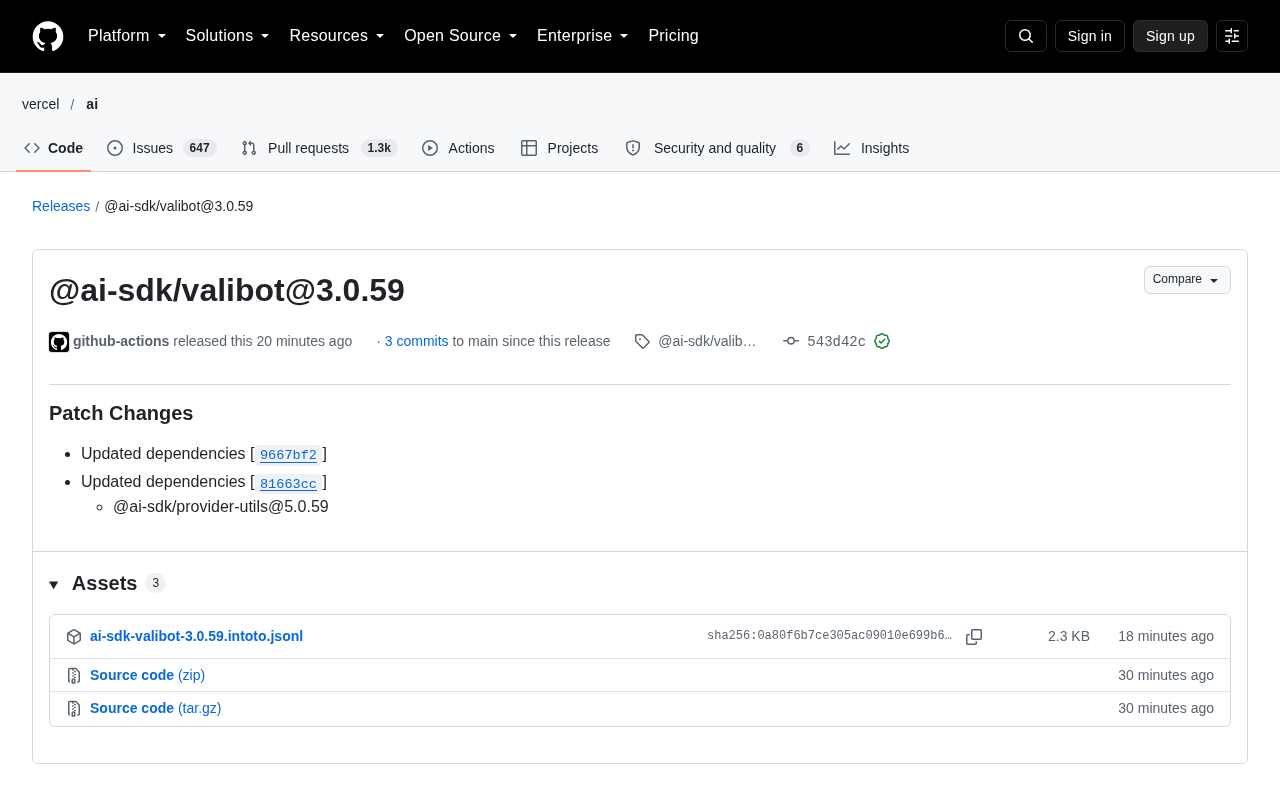
According to the release records on GitHub, @ai-sdk/valibot@3.0.59 was published by the github-actions bot on October 12 at 17:51, containing 3 commits since the previous release point and merged into the main branch. The release notes categorize it as Patch Changes, meaning this version introduces no breaking changes and does not alter the shape of the public API — it is primarily aimed at seamless upgrades for developers already using the package.
For teams building applications on the AI SDK, such patch versions can typically be upgraded directly through the package manager without modifying business code.
Under the Semantic Versioning (SemVer) system, the MAJOR.MINOR.PATCH three-segment version number corresponds respectively to breaking changes, backward-compatible new features, and backward-compatible bug fixes. An increment in the patch position (such as this 3.0.59) typically means only internal fixes or dependency synchronization were made, without changing the public API, so developers can safely let the package manager auto-resolve upgrades for version ranges like ^3.0.0. However, in real projects, even patch upgrades can introduce surprises due to behavioral changes in indirect dependencies — especially in scenarios where lockfiles are not committed or cross-package versions are not synchronized. This is also why publishers typically recommend checking adjacent dependencies together, rather than judging compatibility solely by the first segment of the version number.
What Changed: Dependency Sync Is the Focus
The actual changes listed in this release note are concentrated on dependency updates, involving two updates: one pointing to commit 9667bf2 and another pointing to commit 81663cc, with the final result being @ai-sdk/provider-utils synchronized to version 5.0.59.
@ai-sdk/provider-utils is the utility package in the AI SDK responsible for common capabilities at the provider layer, and the valibot adapter package depends on it to handle underlying validation-related collaboration. When an upstream utility package releases a new version, downstream adapter packages typically follow up by locking or loosening the corresponding version range to ensure consistent behavior across packages. This alignment of version numbers — 3.0.59 with 5.0.59 — also confirms the convention that the two packages stay synchronized within the same release batch.
Why Dependency Sync Is Worth Attention
In a modular SDK system, adapter packages (such as the bridging layers for validation libraries like valibot and zod) are not large in code themselves — they play more of a "translation layer" role, translating the data structure conventions inside the AI SDK into schemas that specific validation libraries can understand. Therefore, version updates for such packages are often not due to changes in their own logic, but rather follow the rhythm of core packages and utility packages.
Inconsistent dependency versions in the npm ecosystem can easily lead to duplicate installations, type conflicts, or even runtime behavioral differences. Keeping @ai-sdk/provider-utils close to the main package version number can reduce version mismatch issues developers encounter when using TypeScript type inference.
Version resolution in the npm ecosystem follows a flat deduplication principle: if two packages require version ranges for the same dependency that have no intersection, npm will install multiple copies at different levels. For utility packages like @ai-sdk/provider-utils that are referenced by multiple adapter packages simultaneously, having multiple copies brings two typical problems: first, bloated bundle size; second, TypeScript may deem types as incompatible when comparing across different copies, leading to seemingly inexplicable errors like "Type A is not assignable to Type B." Aligning downstream adapter packages to the same patch number is essentially an engineering measure to narrow the intersection of version ranges and converge resolution results to a single instance.
Practical Impact on Developers
If you are using @ai-sdk/valibot together with valibot for structured validation of AI outputs, this upgrade basically falls into the "just do it" category. It is worth noting that the AI SDK ecosystem has been iterating rapidly recently, with multiple packages advancing under a unified patch number, so it is recommended to also check whether adjacent dependencies such as @ai-sdk/provider-utils are at compatible versions when upgrading.
For projects that have not yet introduced a validation adapter layer, this is also a good time to re-examine the toolchain: in scenarios where LLM outputs need to be structurally parsed, introducing a lightweight validation library like valibot can catch format anomalies in model responses at runtime, rather than exposing problems deep within business logic.
Summary
@ai-sdk/valibot 3.0.59 is a standard patch release, with the core action being synchronizing @ai-sdk/provider-utils to 5.0.59. There are no new features and no breaking changes — it is suitable for direct upgrade. For teams concerned with the stability of the AI SDK ecosystem, continuously following up on such minor versions is a low-cost way to keep the dependency chain healthy and avoid accumulating technical debt.
One-line Summary
@ai-sdk/valibot releases 3.0.59 patch, with the core action being synchronizing @ai-sdk/provider-utils to 5.0.59 — no breaking changes.
Paragraph Summary
@ai-sdk/valibot has received the 3.0.59 patch version, published by the github-actions bot on October 12, containing 3 commits since the previous release point and categorized as Patch Changes. This release has no new features and no breaking changes — the actual changes are concentrated on dependency synchronization, upgrading @ai-sdk/provider-utils to 5.0.59, with the two packages keeping version numbers aligned within the same release batch. Since the adapter package itself only serves as a bridge between validation libraries and the AI SDK, its updates mostly follow the rhythm of core packages. For developers, this is a minor version that can be upgraded directly, but it is recommended to also check compatibility of adjacent dependencies such as @ai-sdk/provider-utils to reduce duplicate installations and type conflicts.
Related articles

A 93-Move Optimal Solution: An Exact Proof for a Nonlocal Crystal-Exchange Puzzle
Researchers present a 93-move optimal solution to the crystal-exchange puzzle in *Order of the Sinking Star*, using exact BFS and an admissible heuristic to rule out all shorter solutions while retaining over 1.8 billion states, with reproducible code and proof.

A New Breakthrough in Parallel Thinking: How DPT Makes LLM Reasoning Paths More Diverse
Parallel thinking in LLMs often fails due to mode collapse. Researchers propose DPT, which penalizes path prefix similarity to encourage reasoning path diversity, surpassing existing parallel thinking methods on multiple reasoning benchmarks and achieving state-of-the-art performance.

Fragment-Level Graph Encoding: A New Approach to Interpretability in Molecular Property Prediction
Fragment-level graph encoding represents molecules as BRICS fragment nodes, grounding GNN explanations at the functional group level, shrinking graph size fivefold without accuracy loss, and recovering pharmacophores on BACE and PTR1 targets.