@ai-sdk/valibot 3.0.80 Released: Patch Update and Dependency Adjustment

@ai-sdk/valibot 3.0.80 is a patch release that only syncs its underlying dependency, a low-risk maintenance update.
@ai-sdk/valibot in the Vercel AI SDK ecosystem released patch version 3.0.80, whose core change is upgrading the internal dependency @ai-sdk/provider-utils to 5.0.80, with no new APIs or feature changes. This dependency handles request construction, stream processing, and error mapping, so the upgrade is a maintenance sync to keep the Valibot adapter aligned with the latest utility functions. The release was automated by a GitHub Actions bot with GPG signature verification. The upgrade is low-risk, but running existing tests is still recommended.
A Minor Version Update — Why It's Worth Noticing
@ai-sdk/valibot in Vercel's AI SDK ecosystem has released version 3.0.80. This is a patch-level update whose main change is upgrading the internal dependency @ai-sdk/provider-utils to version 5.0.80. For AI application developers using Valibot for schema validation, updates like this typically mean synchronization and bug fixes in the underlying toolchain. Though the changes are small, keeping dependencies consistent is fundamental to stability.
Update Details
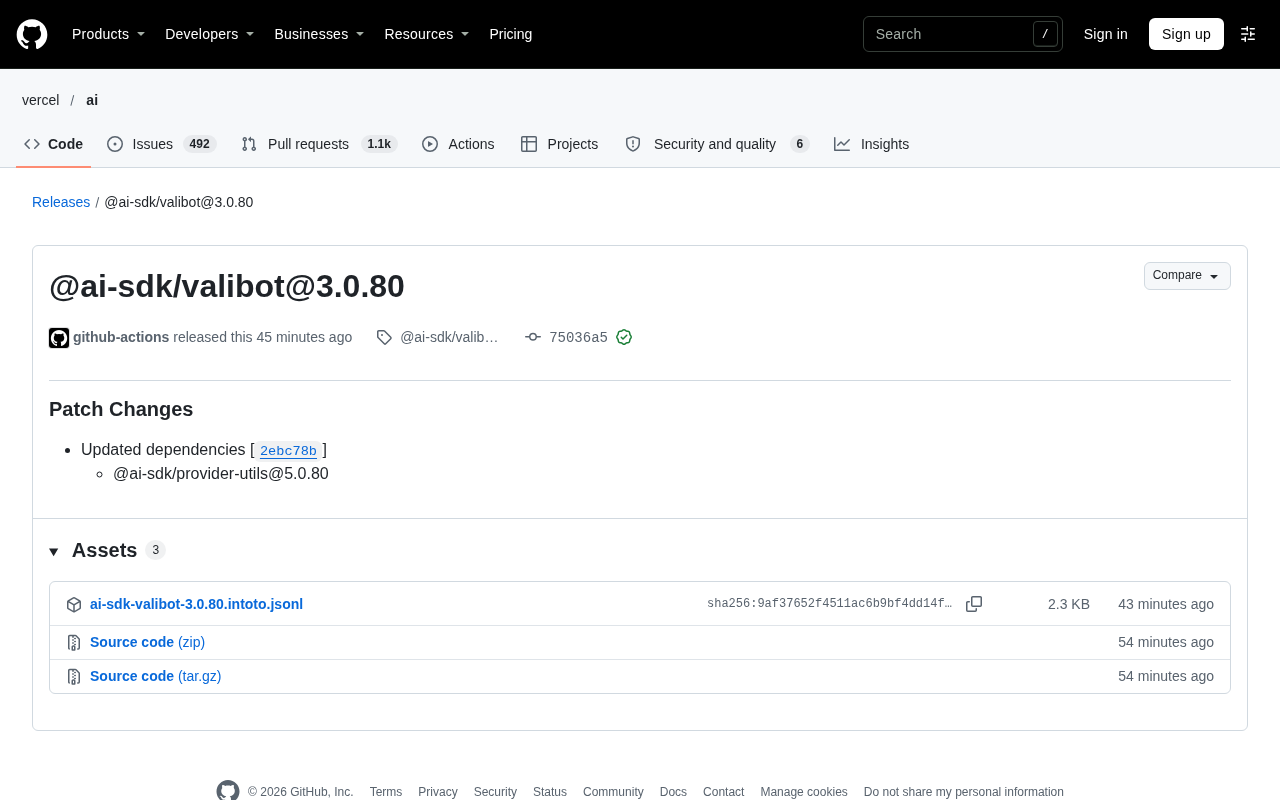
According to the GitHub release page, this update falls under Patch Changes, with the specific entry: Updated dependencies [2ebc78b] @ai-sdk/provider-utils@5.0.80. In other words, @ai-sdk/valibot itself introduces no new APIs or feature changes; it simply follows the version advance of its dependency @ai-sdk/provider-utils. That dependency has been upgraded to 5.0.80 with commit hash 2ebc78b.
@ai-sdk/provider-utils is the shared package in the AI SDK for provider-related utility functions, covering request construction, stream processing, error mapping, and other low-level logic. @ai-sdk/valibot depends on it to ensure compatibility with the AI SDK core. This update can therefore be seen as a maintenance sync, intended to keep the Valibot adapter layer aligned with the latest utility functions.
The release was automatically completed by the github-actions bot on November 12 at 20:23, with the commit verified by GitHub signature (GPG key ID: B5690EEEBB952194). This reflects the project's emphasis on supply chain security, and the automated release process also reduces human error.
@ai-sdk/provider-utils is a low-level shared package in the Vercel AI SDK ecosystem, providing unified utility functions for the adapter layers of various model providers (such as OpenAI, Anthropic, Google, etc.). It primarily handles three responsibilities: first, request construction — converting the AI SDK's unified call parameters into the request format required by each provider API; second, streaming response handling — parsing SSE and other streaming data and converting it into a unified streaming output interface; third, error mapping — normalizing heterogeneous error codes returned by different providers into the AI SDK's standard error types. Because it sits at the bottom of the call chain, every provider adapter package (including @ai-sdk/valibot, @ai-sdk/zod, etc.) depends on it to ensure behavioral consistency, so its patch upgrades propagate to all upper-layer adapter packages.
Impact on Developers
For developers already using @ai-sdk/valibot in their projects, upgrading to 3.0.80 is a low-risk operation. As a patch version, it is not expected to break existing functionality. However, dependency upgrades can sometimes indirectly affect behavior, especially when @ai-sdk/provider-utils includes bug fixes or subtle adjustments. Developers are advised to run existing tests after upgrading to ensure schema validation and AI request flows work correctly.
If you haven't yet used Valibot but are looking for a schema validation solution to pair with the AI SDK, Valibot is a lightweight and type-friendly choice. @ai-sdk/valibot provides an adapter layer that converts Valibot schemas into a format the AI SDK can recognize, making it convenient to define parameter structures in scenarios such as tool calling.
Valibot is a schema validation library for modern JavaScript/TypeScript, emphasizing lightweight design and tree-shaking. Compared with Zod, Valibot splits each validation capability into independent small functions, so only the parts actually used are bundled — giving it an advantage in size-sensitive scenarios such as edge runtimes and browsers. Its API follows a functional composition style, for example using object({ name: string() }) to describe a structure, with equally robust type inference. In the AI SDK, the role of a schema validation library is to describe the parameter structure for tool calling: JSON parameters returned by the model must first pass schema validation before they can be safely passed to business functions. @ai-sdk/valibot precisely converts Valibot schemas into the JSON Schema representation recognized internally by the AI SDK, allowing developers to define tool parameters using familiar Valibot syntax.
The Maintenance Philosophy Behind the Version Number
The version number of @ai-sdk/valibot remains in the 3.0.x series, with the patch number already at 80. This high-frequency patch release cadence typically reflects the project actively tracking upstream dependency changes rather than frequently introducing breaking changes. For enterprise applications, this means continuous fixes and improvements can be obtained without changing the major version.
From a broader perspective, the AI SDK ecosystem is iterating rapidly, and each adapter package (such as valibot, zod, etc.) needs to stay in sync with the core package. Each dependency upgrade release is part of ecosystem coordination. Developers can follow such releases to understand the evolution direction of the underlying toolchain.
Under Semantic Versioning (SemVer), the version number MAJOR.MINOR.PATCH corresponds to breaking changes, backward-compatible new features, and backward-compatible bug fixes, respectively. 3.0.80 means major version 3, minor version 0, patch number 80 — that is, the project has released 80 consecutive patches on the 3.0 API stability line without ever introducing breaking changes or new features. A rapidly climbing patch number usually has two causes: first, upstream dependencies release frequently and adapter packages need to align; second, the release process is fully automated, with every merge triggering a version increment. The github-actions bot auto-release described in this article belongs to the latter, making a "small steps, fast pace" maintenance rhythm possible and rendering the patch number itself less informative — developers should focus more on the specific entries in the changelog than on the version number digits.
How to Upgrade
The upgrade command is simple — use your preferred package manager:
npm install @ai-sdk/valibot@3.0.80
# or
pnpm add @ai-sdk/valibot@3.0.80
# or
yarn add @ai-sdk/valibot@3.0.80
After upgrading, check whether the version of @ai-sdk/provider-utils in package.json has also been updated in sync (if it is a direct dependency). If it is not a direct dependency, no additional action is needed.
Summary
@ai-sdk/valibot@3.0.80 is a typical maintenance patch, with dependency alignment at its core. It reminds us that in the rapidly evolving AI toolchain, keeping dependency versions consistent is an important habit for avoiding potential compatibility issues. For teams pursuing stability, regularly reviewing such releases and evaluating upgrades is a routine part of the development process.
Related articles

Gemini 4 Neon Leak: A Potential Strong Contender Against Opus 5.5
A Hacker News thread suggests Gemini 4 Neon looks like an Opus 5.5 competitor. This article unpacks the product positioning behind this community signal, shifts in the top-model competitive landscape, and what it means for developers' model selection strategy.

Claude Fable 5.2's Self-Authored Short Film 'Fable' Sparks Discussion
A short film 'Fable,' credited to Claude Fable 5.2 for script, visuals, and directing, appears on Hacker News. This article analyzes the significance of full-pipeline AI creation, community reactions, and what it means for content creators.

Anthropic IPO Pricing: A Signal of AI Giants Going Public
Anthropic's IPO pricing draws attention. This article analyzes its potential impact on AI industry valuation, commercialization paths, and the competitive landscape, and highlights public-market expectations and challenges for AI companies.