@ai-sdk/valibot 3.0.83 Patch Release: Dependency Update Explained
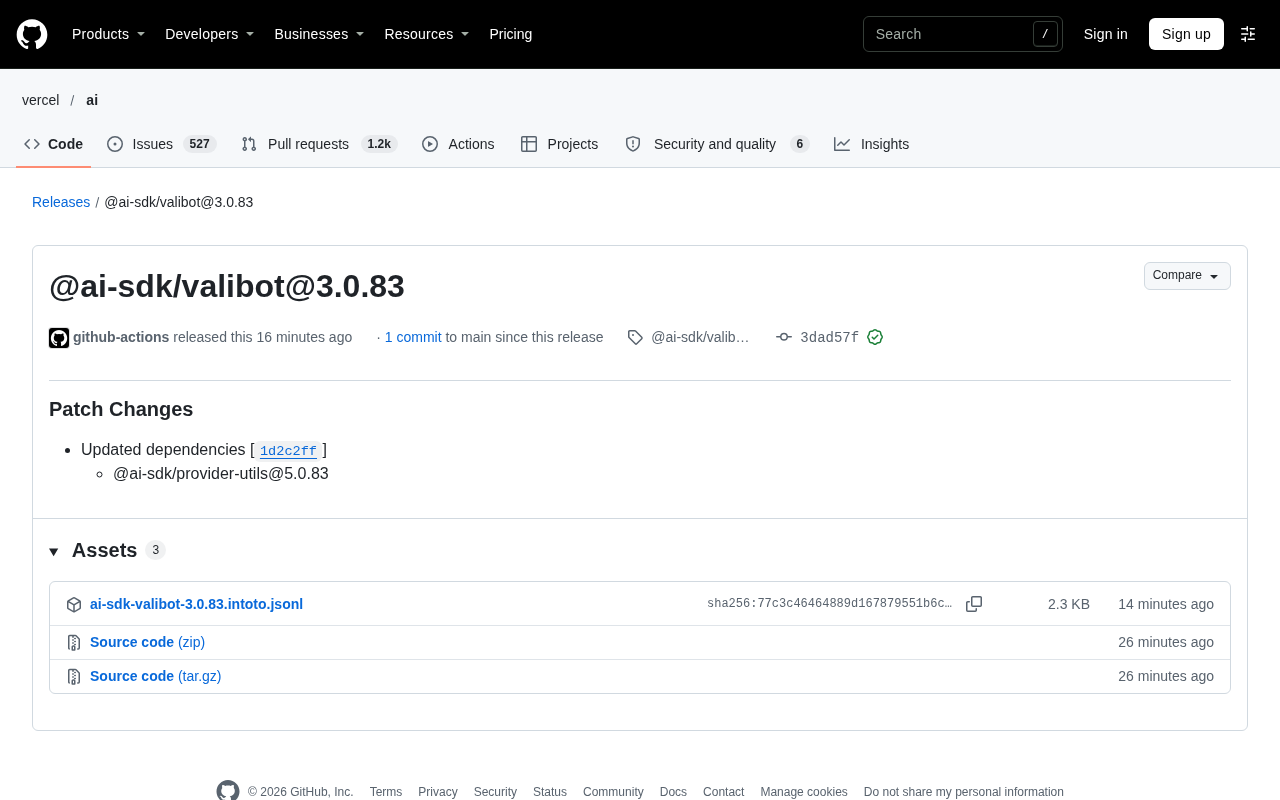
@ai-sdk/valibot 3.0.83 is a linked dependency patch that syncs provider-utils to 5.0.83.
@ai-sdk/valibot released patch version 3.0.83, with the only change being bumping the dependency @ai-sdk/provider-utils to 5.0.83, automatically built and released by github-actions with signature verification. The article notes this reflects the AI SDK's linked versioning strategy: sub-package patch numbers are forced into alignment, so upstream fixes reach downstream users without API changes. The Valibot adapter is used in the AI SDK to define tool inputs with Valibot schemas and perform structured validation, with positioning similar to the Zod adapter. The upgrade has no breaking changes, but it is advisable to check whether provider-utils in your project has converged to the same version to avoid duplicate dependencies.
A seemingly minor patch update
The @ai-sdk/valibot package in the AI SDK ecosystem has released version 3.0.83. According to the GitHub release record, this is a typical patch change, with only one core modification: updating the dependency on @ai-sdk/provider-utils to version 5.0.83.
The release was completed by the automated bot github-actions, with commit number 3dad57f and a GitHub-verified signature. This release pattern is already very mature in the AI SDK repository—version numbers for linked dependencies are kept consistent, and builds and releases are automated through CI.
The versioning strategy behind the dependency update
If you look at this update in isolation, it contains almost no "new functionality." But looking at the bigger picture of AI SDK's overall version management, a clear design emerges: the patch version numbers of @ai-sdk/valibot and @ai-sdk/provider-utils are forced into alignment, both landing on numbers like 5.0.83 / 3.0.83.
The benefit of this approach is reducing the probability of dependency conflicts. For developers building applications with the Vercel AI SDK, the Valibot adapter is usually just one link in the entire toolchain, and the logic that actually interacts with model providers lives down in provider-utils. When fixes appear in the upstream utility library, downstream adapters follow in sync, delivering the fix to end users without changing the API.
Why patch versions are worth paying attention to
Many developers ignore patch-level releases, assuming that only minor or major updates are worth reading. But in fast-iterating libraries like the AI SDK, patches often carry the task of fixing provider compatibility and adjusting request serialization details. The significance of linked dependency updates is this: as long as you upgrade @ai-sdk/valibot, you automatically get the latest patch of provider-utils, without needing to manually track the version of every sub-dependency.
@ai-sdk/provider-utils is the low-level toolkit in the AI SDK aimed at provider implementers, encapsulating common logic such as request construction, streaming response parsing, error normalization, and schema conversion. Provider packages (such as the OpenAI and Anthropic adapters) and schema adapters like Valibot and Zod are all built on top of it, so a single patch fix in it may simultaneously affect the behavior of multiple upper-layer packages. The AI SDK adopts a fixed versioning approach, letting sub-packages within the same release batch share patch numbers, so that upstream fixes propagate consistently along the dependency chain and troubleshooting can locate the corresponding code snapshot by version number.
Valibot's position in the AI SDK
Valibot is a lightweight JavaScript/TypeScript schema validation library, often compared with Zod. The role of the @ai-sdk/valibot package is to enable the AI SDK to use schemas defined with Valibot to describe the input parameters of tools and to validate when the model returns structured data.
For projects that care about bundle size, Valibot's on-demand import feature has some appeal. The AI SDK also provides a Zod adapter, and the two have similar functional positioning; which one to choose depends more on the validation stack already in the project. This patch does not involve the adapter's own logic, so it has no impact on schema definition approaches or validation behavior.
AI SDK's tool calling relies on imposing structural constraints on model input and output: developers use schemas to describe parameter shapes, the SDK converts them into JSON Schema that the model can understand, and validates when the model returns. Zod has long been the default choice due to its mature ecosystem, while Valibot adopts a functional, tree-shakable modular design in which each validator is exported separately, allowing bundlers to eliminate unused parts, giving it an advantage in size-sensitive frontend scenarios. The adapter layer is responsible for mapping Valibot schemas to the AI SDK's unified internal schema interface, making the two validation libraries behave consistently in tool definition and result parsing; the switching cost mainly lies in rewriting schema definitions rather than calling logic.
What developers should do
For projects already using @ai-sdk/valibot, this update can be obtained directly through a routine dependency upgrade, with no code changes required. If a project has pinned an older version, behavior is expected to remain unchanged after upgrading, because the change only involves the dependency version.
If your project also uses other AI SDK adapters, it is advisable to check whether the @ai-sdk/provider-utils depended on by each package has converged to the same version, to avoid multiple copies of provider-utils existing in the same dependency tree. Such duplicate dependencies are hard to notice in small projects, but are worth watching in scenarios sensitive to build artifact size.
Summary
@ai-sdk/valibot 3.0.83 is a standard linked dependency patch, with no new APIs and no breaking changes. Its value lies not in functionality but in maintaining version consistency across AI SDK sub-packages. For most users, upgrading through the routine process is sufficient.
Related articles

Braised Meat Shop Forced Out by Rent Hike: A Life-and-Death Contest Between Craft and Location
Braised meat shop owner forced out by a 100,000 yuan rent hike moves overnight; landlord's daughter takes over with seasoning packets and overnight meat sickens customers. A tale of location versus craft.

AI One-Click Emotional Short Drama: Bilibili Creator Tests the "Beautiful Landlady" Script
Bilibili creator uses AI to produce the emotional short drama "The Beautiful Landlady Comes to Fix the Guy's Drain," testing everything from script generation to character consistency.

Braised Meat Stall Goes Viral, Landlord Raises Rent—She Leaves Gracefully by Contract While Rival Cuts Corners and Loses Everything
A braised meat stall's rent was hiked from ¥68K to ¥168K after going viral; the owner moved out by contract while her rival cut corners and lost it all.