@ai-sdk/vercel 2.0.93 Patch Release: The Ecosystem Signals Behind a Dependency Update
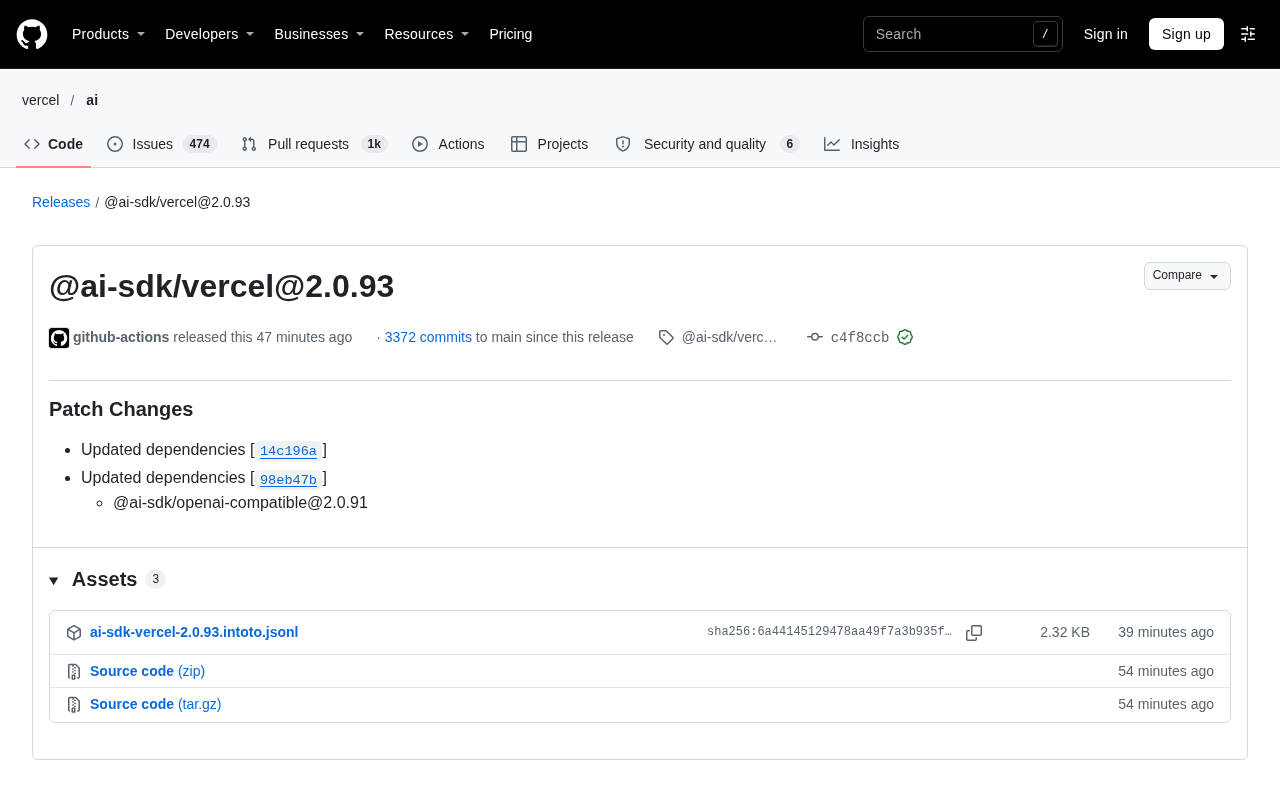
@ai-sdk/vercel 2.0.93 only syncs the openai-compatible 2.0.91 dependency—an automated patch release.
@ai-sdk/vercel released patch version 2.0.93 on GitHub. The only substantive change is bumping the dependency @ai-sdk/openai-compatible to 2.0.91, corresponding to two commit hashes, with no new APIs or breaking changes. The article draws two points from this: first, the frequent iteration of the openai-compatible layer shows that OpenAI-compatible interfaces have become the de facto standard for cross-provider integration, and the SDK side is continuously polishing its stability; second, the repository has accumulated 3,372 commits and is automatically published by github-actions, reflecting a highly automated release pipeline that lets patches and security fixes propagate downstream quickly. For consumers this is a seamless upgrade, and it is recommended to focus regression testing on model interfaces called through the compatibility layer after upgrading; projects pinned to older versions can hold off and handle it during a security audit, while the real thing to watch is the behavior adjustments that come with a minor version jump of the compatibility package.
A Seemingly Routine Patch Update
@ai-sdk/vercel has released version 2.0.93 on GitHub, a patch-level update. According to the release notes, there is only one core change: the dependency reference to @ai-sdk/openai-compatible@2.0.91 has been updated, corresponding to commit hashes 14c196a and 98eb47b. No new APIs, no breaking changes—a typical "follow-along" synchronized release.
For readers unfamiliar with the AI SDK ecosystem, some context: the Vercel AI SDK is a toolkit for integrating large model capabilities into JavaScript/TypeScript applications, split into multiple packages by provider. @ai-sdk/vercel targets Vercel's own platform, while @ai-sdk/openai-compatible is used to connect to any service that follows the OpenAI interface specification. This split lets developers import only what they need, avoiding the bundle-size cost of unused providers.
Semantic Versioning (SemVer) is a common convention across modern package manager ecosystems. The three-part version number MAJOR.MINOR.PATCH corresponds to breaking changes, backward-compatible feature additions, and backward-compatible bug fixes, respectively. Under this convention, patch-level updates should theoretically not introduce API changes and are therefore often treated by dependents as "safe to auto-upgrade." But in deep dependency chains, a package's patch release may occur simply because another package it depends on has changed—what this article calls a "follow-along" synchronized release. Such releases contain no code logic changes themselves, yet they "infect" downstream users with the new version of an upstream dependency. This is also why judging upgrade risk by version number alone is unreliable.
What the Dependency Update Reveals
openai-compatible Is Becoming a Common Foundation
The most noteworthy detail of this update is not the vercel package itself, but that the openai-compatible it synchronizes with has advanced to 2.0.91. This package's role is to abstract the OpenAI-style request/response protocol, so that any third-party model service that is "OpenAI-compatible" can be called uniformly through the SDK. As the compatibility layer iterates frequently, it is reasonable to infer that more and more model providers are choosing OpenAI-compatible interfaces as the de facto standard, while the SDK-side compatibility layer continues to be polished for stability.
"OpenAI-compatible interface" typically means the server implements endpoints such as /v1/chat/completions and /v1/embeddings, and follows OpenAI's request body fields (such as messages, model, temperature, stream) and response structures (choices, usage, etc.). This style was first established by OpenAI's REST API and was subsequently adopted as an external protocol by numerous inference services, local deployment frameworks, and cloud vendors, forming a de facto standard. For the SDK, abstracting this protocol into a standalone provider package means that adding a new service provider often only requires extending the compatibility layer and overriding a few differences (auth headers, model name mapping, special parameters), rather than implementing request serialization and streaming parsing from scratch—significantly lowering the cost of integration.
Patch Cadence Reflects Maintenance Activity
The same release record shows that the repository has accumulated 3,372 commits since the last release and is automatically published by github-actions. This indicates the project uses a highly automated release pipeline—patch versions can be generated automatically alongside dependency updates. For consumers, this means dependency security issues or compatibility fixes can propagate to downstream packages relatively quickly, but it also reminds teams to watch for implicit changes in the dependency chain when pinning versions.
The "3,372 commits" and "automatically published by github-actions" mentioned in the article point to an automated release pipeline built on GitHub Actions. A common approach uses tools like Changesets: developers declare the change type in a PR and generate a changeset file; after merging to the main branch, CI automatically calculates new version numbers for each package, updates the dependency references in package.json, generates a changelog, publishes to npm, and tags the release in git. In a multi-package repository (monorepo), this mechanism also handles internal dependency linkage between packages, ensuring that when a depended-upon package is upgraded, the packages that depend on it are released with new versions in sync—this is precisely the technical source of frequent patch versions.
Practical Impact on Developers
If you use @ai-sdk/vercel in your project, this upgrade is essentially a "seamless update": installing 2.0.93 will bump the indirect dependency openai-compatible to 2.0.91. In practice, it is recommended to run integration tests after upgrading, focusing on model interfaces called through the compatibility layer, because patches to the compatibility package sometimes involve detailed adjustments to request parameter defaults or error handling.
For projects pinned to older versions, there is no need to rush to follow up—patch-level dependency updates usually contain no functional changes, and can be handled together during a security audit. What truly deserves attention is when openai-compatible makes a minor version jump, which may come with interface behavior adjustments.
Pinning versions usually relies on a lockfile (package-lock.json for npm, pnpm-lock.yaml for pnpm, yarn.lock for Yarn), which fixes the exact versions and integrity checksums of the entire dependency tree. As long as the lockfile does not change, indirect dependencies will not be unexpectedly upgraded. But two caveats apply: first, when declaring range versions like ^2.0.93, reinstalling or updating the lockfile will pull in new patch versions; second, if multiple direct dependencies jointly reference the same indirect package, the package manager may hoist to a single version that satisfies all range constraints, causing the actually effective version to differ from what was expected. When troubleshooting, use npm ls <package-name> or pnpm why <package-name> to inspect dependency sources and resolution results.
Summary
Looking at this release note alone, the information is limited: one dependency sync, two commits, one automated publish. But placed within the AI SDK's multi-package architecture, it confirms two things—OpenAI-compatible interfaces have become common infrastructure for cross-provider integration, and mature open-source projects are using automated pipelines to minimize dependency maintenance costs.
(Information in this article comes from the GitHub release page; the release record does not expand on the specific dependency changes.)
Related articles
 Tech Frontiers
Sherlock: An Open-Source Tool for Tracking Usernames Across Social Networks
Sherlock is an open-source Python tool that tracks social accounts across networks by username. This article covers its core features, why developers love it, typical use cases, and privacy compliance considerations.
 Tech Frontiers
GitHub Daily·Nov 07: Agent-Ready and Context Compression
GitHub Trending Nov 07: meta's agent-ready design system astryx, billion-context's 5x context compression, sherlock nearing 100k stars, plus local-first localthings and bare-metal GPU orchestration nvke.
 Tech Frontiers
Buoyant Open-Sources Kinference: An Inference Control Plane for vLLM on K8s
Buoyant open-sources Kinference, an inference control plane for vLLM on Kubernetes, with declarative routing, KV-cache-aware load balancing, and per-tenant metrics—claiming 95% lower median TTFT in official benchmarks.