AI SDK Voyage 1.0.40 Patch Release: Dependency Upgrade Analysis

@ai-sdk/voyage releases patch 1.0.40, only syncing the provider-utils dependency to 4.0.63.
@ai-sdk/voyage@1.0.40 is a dependency-driven patch release. The only change is updating the shared foundation library @ai-sdk/provider-utils to 4.0.63, automatically published by GitHub Actions with a verification signature, commit hash 165a954. The article notes that provider-utils carries underlying capabilities such as request handling, error wrapping, and streaming responses. Although its version sync does not change the API surface of the Voyage provider, it may introduce subtle behavioral differences, so projects pinned to older versions should pay attention to changes after upgrading. Overall this is a low-risk change; it is recommended to run integration tests after upgrading to confirm call paths work properly, and decide whether to update the lockfile in sync based on your dependency locking strategy.
The Voyage provider package in the AI SDK ecosystem has received a patch version update. The release of @ai-sdk/voyage@1.0.40 may look like just a small bump in the version number, but the dependency chain adjustments behind it are worth developers' attention.
Patch Contents: A Dependency-Driven Update
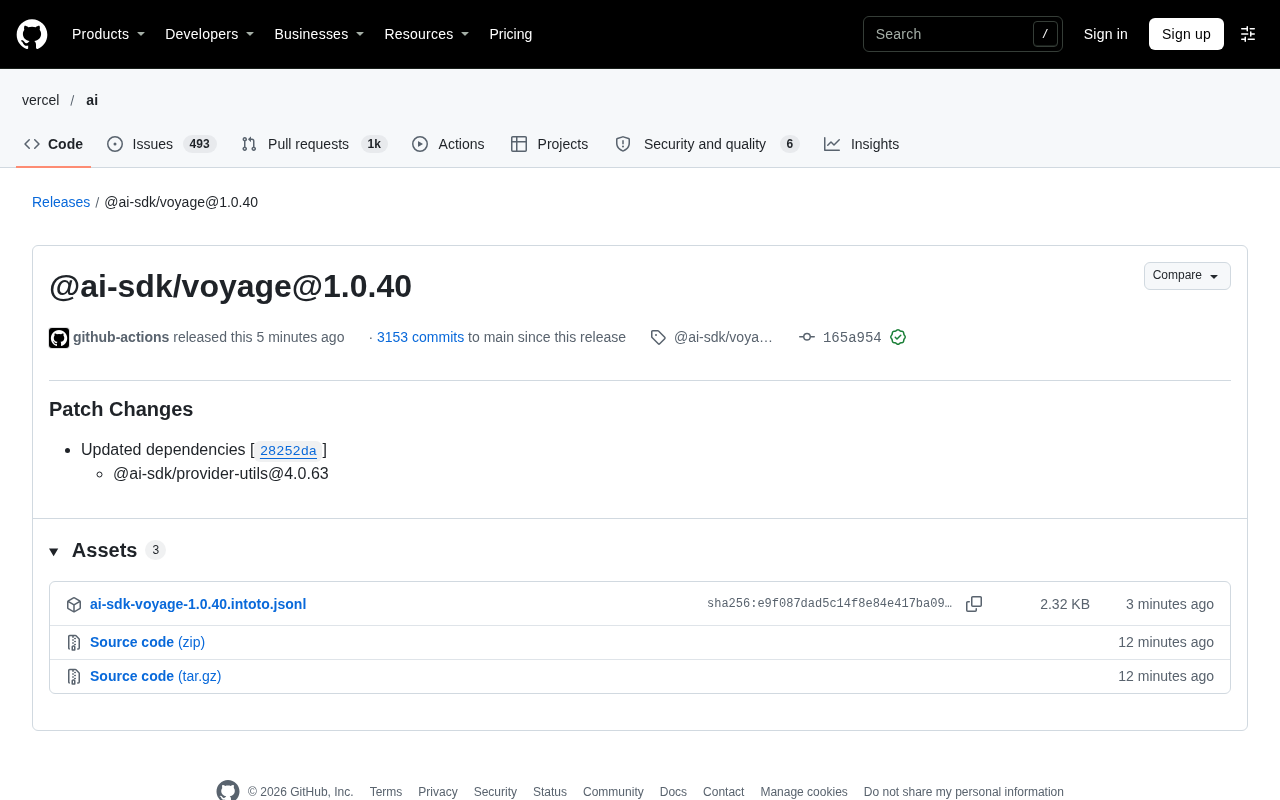
According to the GitHub release record, the core change in @ai-sdk/voyage@1.0.40 is classified as "Patch Changes," specifically updating the dependency @ai-sdk/provider-utils to version 4.0.63. This update was automatically published by GitHub Actions, with commit hash 165a954, and comes with GitHub's verification signature.
From the information on the release page, this update is not a feature-level change but a synchronized upgrade of the dependency version. For developers building applications with the AI SDK, such patches usually mean fixes or compatibility adjustments in the underlying utility functions.
AI SDK and the Provider Package Pattern: The Vercel AI SDK adopts a core + provider layered architecture. The core package defines unified interfaces (such as the language model's doGenerate and doStream), while each provider package (@ai-sdk/voyage, @ai-sdk/openai, etc.) is responsible for translating unified calls into the corresponding vendor's HTTP API. @ai-sdk/voyage wraps Voyage AI's text embedding and rerank services, commonly used in the RAG retrieval stage. Provider packages carry only adaptation logic; the real parameter validation, request retries, error normalization, stream parsing, and other general capabilities are pushed down to a shared layer. That's why version number changes in these packages often reflect underlying behavior adjustments more than feature updates do.
Semantic Versioning and Patch Changes: The third digit in 1.0.40 corresponds to the patch position in Semantic Versioning (SemVer), which by convention contains only backward-compatible bug fixes. The Changesets tool automatically reads change records in the repository to generate Patch Changes entries and write them to the CHANGELOG, then triggers the release. This is why the change description visible in the body is just a single line about a dependency upgrade—it's not that the maintainers omitted an explanation; rather, the tool generates a fixed format based on the change type.
Why the provider-utils Version Sync Is Worth Noting
@ai-sdk/provider-utils is a foundational utility library shared by multiple provider packages in the AI SDK. When this underlying package releases a new version, each provider package (such as voyage) needs to follow up by updating its dependency declaration to ensure consistency in dependency resolution.
Although this dependency sync does not directly change the API surface of the Voyage provider, it may affect underlying behaviors such as request handling, error wrapping, or streaming responses. If your project has pinned an older version, after upgrading to 1.0.40 you should watch for subtle differences introduced by the provider-utils version change.
@ai-sdk/provider-utils provides a collection of low-level utility functions shared by provider packages. Typical responsibilities include: defining and validating model parameter schemas with zod, uniformly converting error objects returned by various APIs into standard error types such as APICallError, handling AbortSignal cancellation, parsing SSE streaming responses, and generating request IDs and telemetry information. Its version number evolves independently and often releases subtle fixes by incrementing the patch position.
The risk point lies in the constraint that "only one version instance can exist in the same dependency tree": if a project installs multiple AI SDK provider packages at the same time and they each declare different ranges of provider-utils, the package manager will deduplicate or nest the installation. Nested installation can cause two providers to load different copies of the utilities, leading to hidden issues such as instanceof checks on error objects failing or inconsistent schema validation behavior. Therefore, provider packages following up with dependency declaration upgrades is essentially about maintaining convergence across the entire ecosystem on the same shared implementation.
Practical Impact on Users
For most projects, this patch upgrade is a low-risk change. The release record lists no breaking changes or behavior change notes; the dependency update is the only content.
However, dependency chain updates can sometimes indirectly affect build artifacts or runtime behavior. It is recommended to run your existing integration tests after upgrading to confirm that Voyage-related call paths work properly. If your project has a strict dependency version locking strategy, you can evaluate whether the provider-utils entry in the lockfile needs to be updated in sync.
Automation Signals in the Release Process
This release was completed by the github-actions bot, and the commit history shows that the main branch has had 3153 commits since that version. The maturity of the automated release process means the AI SDK maintenance team can push patch versions at a relatively high frequency, and developers can expect more timely bug fixes.
For teams following the AI SDK ecosystem, tracking such patch releases helps keep the dependency stack clean and secure. Although the information content of a single patch is limited, continuous version tracking is the basic work of maintaining long-term project stability.
The github-actions bot and verification signature mentioned in the article point to npm's provenance mechanism: at publish time, the CI environment uses OIDC to prove to npm the source repository and commit of the build artifact, generating a publicly verifiable attestation. Combined with GitHub Actions commit signing, users can check on the npm page whether the package's build source is indeed the official repository, thereby reducing supply chain poisoning risks.
Such automated pipelines are usually driven by Changesets: change intents are recorded when PRs are merged, and the release workflow calculates the new version number accordingly, updates the CHANGELOG and each package's dependency declarations, runs npm publish in batch, and handles multiple interdependent packages in a monorepo at once. This also explains why dependency-sync patches can be released at such a high frequency—manual cost has been reduced to near zero, at the cost of rapid version number growth. Writing dependency range declarations (such as ^4.0.0) rather than pinning exact versions helps reduce upgrade friction.
One-line Summary
@ai-sdk/voyage releases patch 1.0.40, only syncing the provider-utils dependency to 4.0.63.
Paragraph Summary
@ai-sdk/voyage@1.0.40 is a dependency-driven patch release. The only change is updating the shared foundation library @ai-sdk/provider-utils to 4.0.63, automatically published by GitHub Actions with a verification signature, commit hash 165a954. The article notes that provider-utils carries underlying capabilities such as request handling, error wrapping, and streaming responses. Although its version sync does not change the API surface of the Voyage provider, it may introduce subtle behavioral differences, so projects pinned to older versions should pay attention to changes after upgrading. Overall this is a low-risk change; it is recommended to run integration tests after upgrading to confirm call paths work properly, and decide whether to update the lockfile in sync based on your dependency locking strategy. The maturity of the automated release process also means the maintenance team can push fixes more promptly.
Related articles

AI Comic Drama with WorkBuddy from Scratch: A Step-by-Step Skill Pack Installation Guide
Learn how to create AI comic dramas with WorkBuddy from scratch. This guide covers installation, Skill pack import and invocation, plus a script generation demo with manual revision tips to get you through the first step from script to storyboard.

WorkBuddy Agent Runs the Entire GEO Database Mining Pipeline with a Single Prompt
WorkBuddy agent automates GEO database mining: from data search and curation to batch correction, differential analysis, co-expression networks, feature gene screening, and immune infiltration—a single prompt generates a complete bioinformatics report, greatly lowering the barrier to bioinformatics analysis.

PC Memory Wasted? Hacker News Debates Centralized Data Centers
Hacker News users argue that personal computer memory is wasted and should be centralized in data centers, sparking debate on centralized vs. distributed computing resource allocation. This article analyzes the logic behind the claim, the costs of centralization, and new tensions in memory resource allocation in the AI era.