AI SDK Voyage 1.0.44 Patch Update: provider-utils Dependency Upgraded

AI SDK's Voyage adapter releases patch 1.0.44, only upgrading provider-utils to 4.0.67 with no API changes.
The Voyage adapter package in Vercel's AI SDK ecosystem has released version 1.0.44, a typical patch update whose core action is solely upgrading the underlying dependency @ai-sdk/provider-utils to 4.0.67, with no new APIs, no breaking changes, and no developer-facing feature announcements. Since provider-utils is a shared utility layer for multiple provider adapters handling common logic such as request construction, streaming response parsing, and error mapping, the fixes that actually take effect after upgrading come from provider-utils rather than Voyage's own code. This version was automatically published by github-actions with a GitHub verified signature, consistent with the common patterns of coordinated dependency upgrades and automated releases in a monorepo. The article recommends that direct users upgrade smoothly following semver rules, while production environments should first validate in a small scope based on the actual changes in provider-utils.
A Low-Key Patch: What AI SDK Voyage 1.0.44 Delivers
The Voyage adapter package in Vercel's AI SDK ecosystem has released version 1.0.44. Judging from the GitHub release notes, this is a typical patch update (Patch Changes) with a single core action: upgrading the underlying dependency @ai-sdk/provider-utils to version 4.0.67.
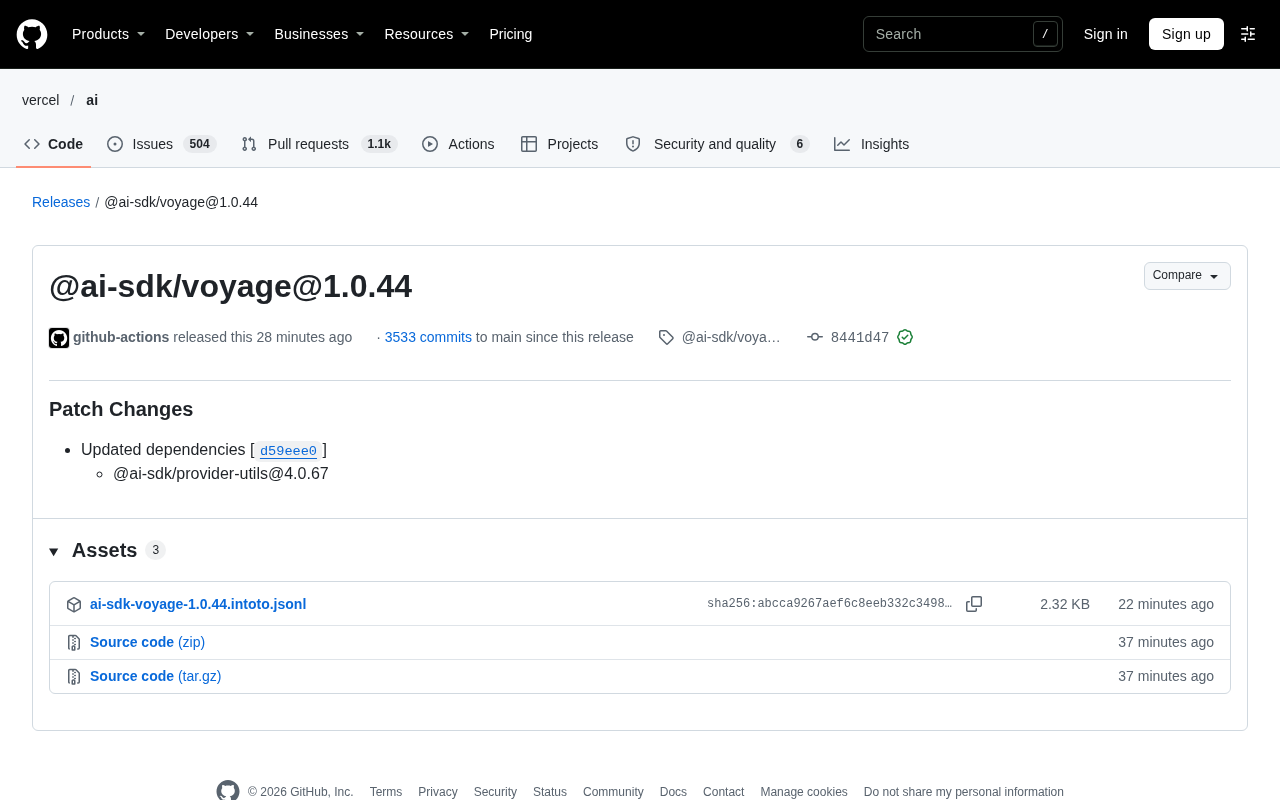
The release information shows that this version was automatically published by github-actions, with commit hash 8441d47, and carries a GitHub verified signature. The release page follows the standard GitHub Releases template, including interactive elements such as tag comparison and commit lists.
Such updates are extremely common in open-source projects. The version number stays at the patch position (third digit), meaning there are no new APIs, no breaking changes, and no feature announcements aimed at developers.
Behind the Patch: The Role of provider-utils in AI SDK
To understand the significance of this update, you first need to see where @ai-sdk/provider-utils fits in. It is the shared utility layer for multiple provider adapters in AI SDK, handling common logic such as request construction, streaming response parsing, and error mapping. Each provider package (like Voyage) typically only keeps a thin wrapper for interfacing with the specific service, with the remaining capabilities pushed down to provider-utils.
Therefore, minor version iterations of provider-utils often affect downstream packages as a "transitive dependency." Voyage 1.0.44 has no independent changelog of its own; the change description only references provider-utils 4.0.67, which matches the common pattern of coordinated dependency upgrades in a monorepo.
For users, this means the fixes or adjustments that actually take effect after upgrading come from provider-utils, not from code changes in the Voyage adapter itself.
Semantic Versioning (SemVer) is a convention in the open-source ecosystem that defines the meaning of version numbers, formatted as major.minor.patch. A major version change indicates incompatible API modifications, a minor version increase represents backward-compatible new features, and a patch number increment contains only backward-compatible bug fixes. In the original text, 1.0.44 staying at the third position is precisely the basis for judging it as having "no new APIs, no breaking changes." npm's dependency range symbols are also built on this convention: ^1.0.44 allows upgrading to the latest 1.x version, ~1.0.44 only allows upgrading to the latest 1.0.x patch, and an exact version fully locks it. Understanding this convention is necessary to judge whether a dependency update poses a risk to an existing project.
monorepo (single code repository) refers to an engineering model where multiple interrelated packages are placed in the same Git repository and managed together. AI SDK adopts exactly this structure, keeping provider adapters and the shared utility layer together. Its typical characteristic is a large number of internal dependencies between packages, so after modifying a low-level package, all downstream dependents often need coordinated upgrades. The "coordinated dependency upgrades" mentioned in the original text are a common product of monorepos: the Voyage adapter's own code has no changes at all; it simply synchronizes the change by raising its version requirement for provider-utils.
Who Needs to Pay Attention to This Update
For developers who directly call @ai-sdk/voyage, the upgrade threshold is very low: since it is a patch version, under semantic versioning (semver) rules, dependency declarations of ^1.0.44 or ~1.0.44 can pull it in smoothly. If the project pins an exact version, manual adjustment is required.
For upper-layer frameworks or applications that indirectly depend on this package, it is recommended to review the changes in provider-utils 4.0.67 before deciding whether to upgrade in sync. Since the release notes do not detail the specific fixes, the prudent approach is to verify in a small-scale environment first, then push to production.
It is worth noting that by the time this version was released, the repository had accumulated a large number of commits (the release page shows 3533 commits), indicating that the project is in a continuously active development rhythm with a high frequency of patch releases.
The Engineering Maturity of AI SDK, as Seen from the Release Process
This update also reveals a side note: the release was completed automatically by the github-actions bot, and the commit carries a GitHub verified signature. This kind of automated release pipeline is almost a necessity in multi-package repositories like AI SDK—manually publishing dozens of interdependent packages one by one is both inefficient and error-prone.
The direct benefit of automation is a stable version cadence, with patches reaching users quickly; the cost is that release notes often contain only dependency references, lacking human-readable context. For dependents, developing the habit of reviewing commit diffs rather than only reading release notes will be more reliable.
GitHub Actions is GitHub's built-in continuous integration and continuous delivery (CI/CD) service. It defines tasks through YAML configuration files that execute automatically when specific events (such as pushing code or tagging) are triggered. In multi-package repositories, it is often configured to automatically calculate version numbers, modify package.json, publish to npm, and create a GitHub Release. The github-actions bot publisher mentioned in the original text is exactly a manifestation of this process.
Commit signature verification is an integrity mechanism provided by Git: developers sign commits with GPG or SSH keys, and GitHub displays a "Verified" badge on the page, indicating that the commit was indeed created by the person holding the corresponding private key and that the content has not been tampered with. In an automated release pipeline, signatures can also prove that the release action originated from a trusted CI environment rather than human forgery. However, note that signatures only guarantee origin and integrity; they do not mean the code has been fully reviewed. Therefore, the original text recommends that dependents should still review commit diffs to judge the actual changes.
Summary
Voyage 1.0.44 is a routine patch primarily focused on dependency synchronization. It does not change the API surface or introduce new features; its value lies in keeping the Voyage adapter aligned with the latest provider-utils. For most projects, handling it through the normal dependency update process is sufficient; for version-sensitive production systems, it is recommended to assess the actual changes in provider-utils before upgrading.
Related articles

From 0 to 1: Vibe Coding an AI Knowledge Base — A Practical Retrospective and Tech Stack Breakdown
A retrospective on building the AI knowledge base OilBook from scratch with Vibe Coding: Next.js+Neon stack, Oil Dev Skill workflow, Stripe paywall security, interview-style writing, AI-flavor control, and Vercel deployment.

GLM-5.4 Hands-On: Native Vision Meets a New Vibe Coding Workflow
Hands-on with Zhipu GLM-5.4: native vision tested across a 3D product demo, pure-code video generation, and remote-control Vibe Coding, compared with GPT-6.2 and Gemini Neon.

AI and Humans Claim to Prove the Riemann Hypothesis: Machine-Verified, Yet Nobody Can Understand It
Anthropic mathematician and AI Claude claim to prove the Riemann Hypothesis with 17 million lines of Lean code, machine-verified but unreadable by humans. This article analyzes the event, the zero proportion record from 41.6% to 67.2%, and the gap between machine verification and human understanding.